Partition Frequency Moments: Modularity and Congruences
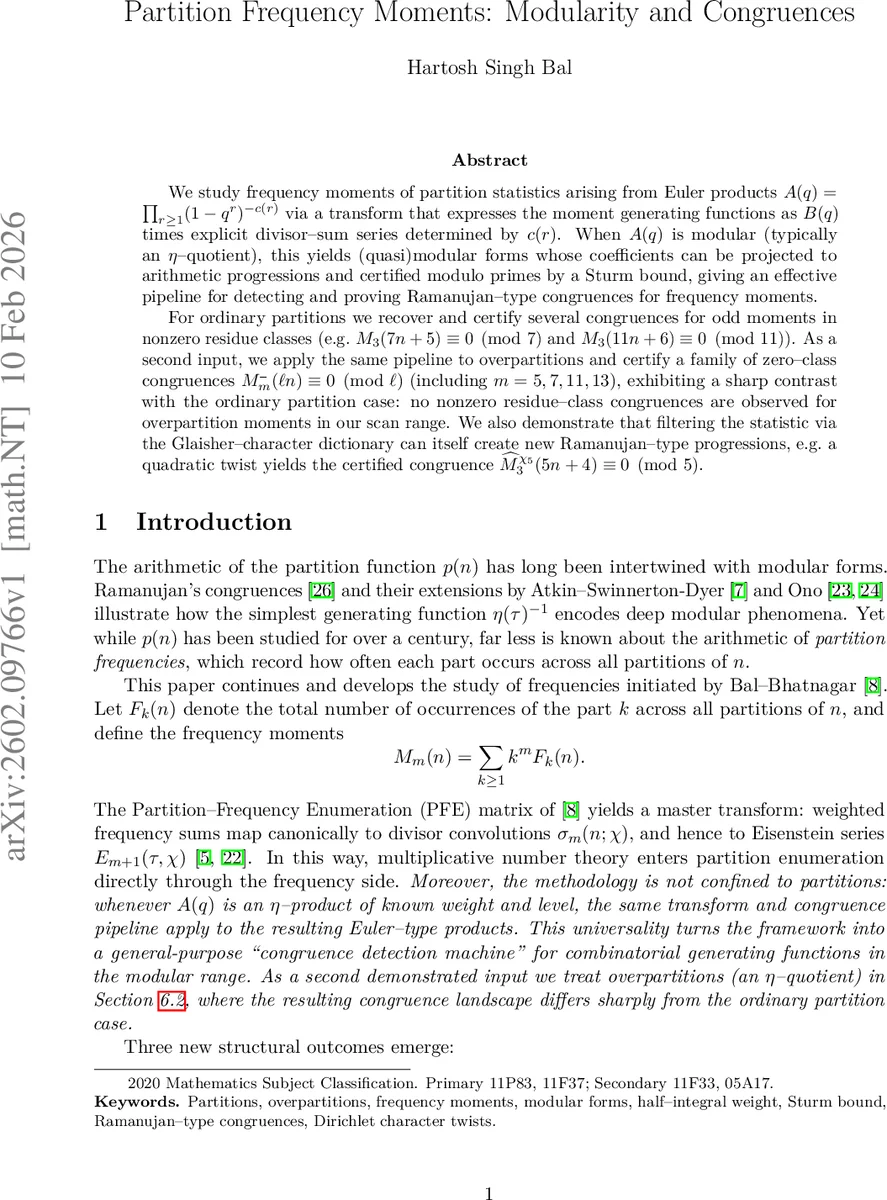
We study frequency moments of partition statistics arising from Euler products $A(q)=\prod_{r\ge1}(1-q^r)^{-c(r)}$ via a transform that expresses the moment generating functions as $B(q)$ times explicit divisor–sum series determined by $c(r)$. When $A(q)$ is modular (typically an $η$–quotient), this yields (quasi)modular forms whose coefficients can be projected to arithmetic progressions and certified modulo primes by a Sturm bound, giving an effective pipeline for detecting and proving Ramanujan–type congruences for frequency moments. For ordinary partitions we recover and certify several congruences for odd moments in nonzero residue classes (e.g.\ $M_3(7n+5)\equiv 0\pmod7$ and $M_3(11n+6)\equiv 0\pmod{11}$). As a second input, we apply the same pipeline to overpartitions and certify a family of zero–class congruences $M_m^{\overline{\ }}(\ell n)\equiv 0\pmod{\ell}$ (including $m=5,7,11,13$), exhibiting a sharp contrast with the ordinary partition case: no nonzero residue–class congruences are observed for overpartition moments in our scan range. We also demonstrate that filtering the statistic via the Glaisher–character dictionary can itself create new Ramanujan–type progressions, e.g.\ a quadratic twist yields the certified congruence $\widehat{M}^{χ_5}_3(5n+4)\equiv 0\pmod{5}$.
💡 Research Summary
The paper develops a unified framework for studying “frequency moments” of partition statistics, linking them to modular and quasimodular forms and providing an effective algorithmic pipeline for discovering and proving Ramanujan‑type congruences.
Starting from an Euler product (A(q)=\prod_{r\ge1}(1-q^r)^{-c(r)}) with integer or rational exponents (c(r)), the authors define a companion series (B(q)) (usually (A(q)-1)). They introduce the notion of (A)-frequencies (F^{A}_r(n)) – the total number of parts of size (r) across all “(A)-partitions” of (n) – and the associated moments (M^{A}m(n)=\sum{r\ge1} r^m F^{A}_r(n)).
The central “master transform” (Theorem 3.2) shows that the generating function of any weighted moment can be written as \
Comments & Academic Discussion
Loading comments...
Leave a Comment