Gas Line Absorption Mitigation in Hollow-Core Fibre using Spectral Pre-Equalisation
We study the impact of CO 2 absorption on hollow-core fibre transmission. Using spectral pre-equalisation, we digitally post-compensate gas-line absorption and show a 5.5 dB reduction in Q-factor penalty, outperforming a 383-tap equaliser by 1.3 dB.
💡 Research Summary
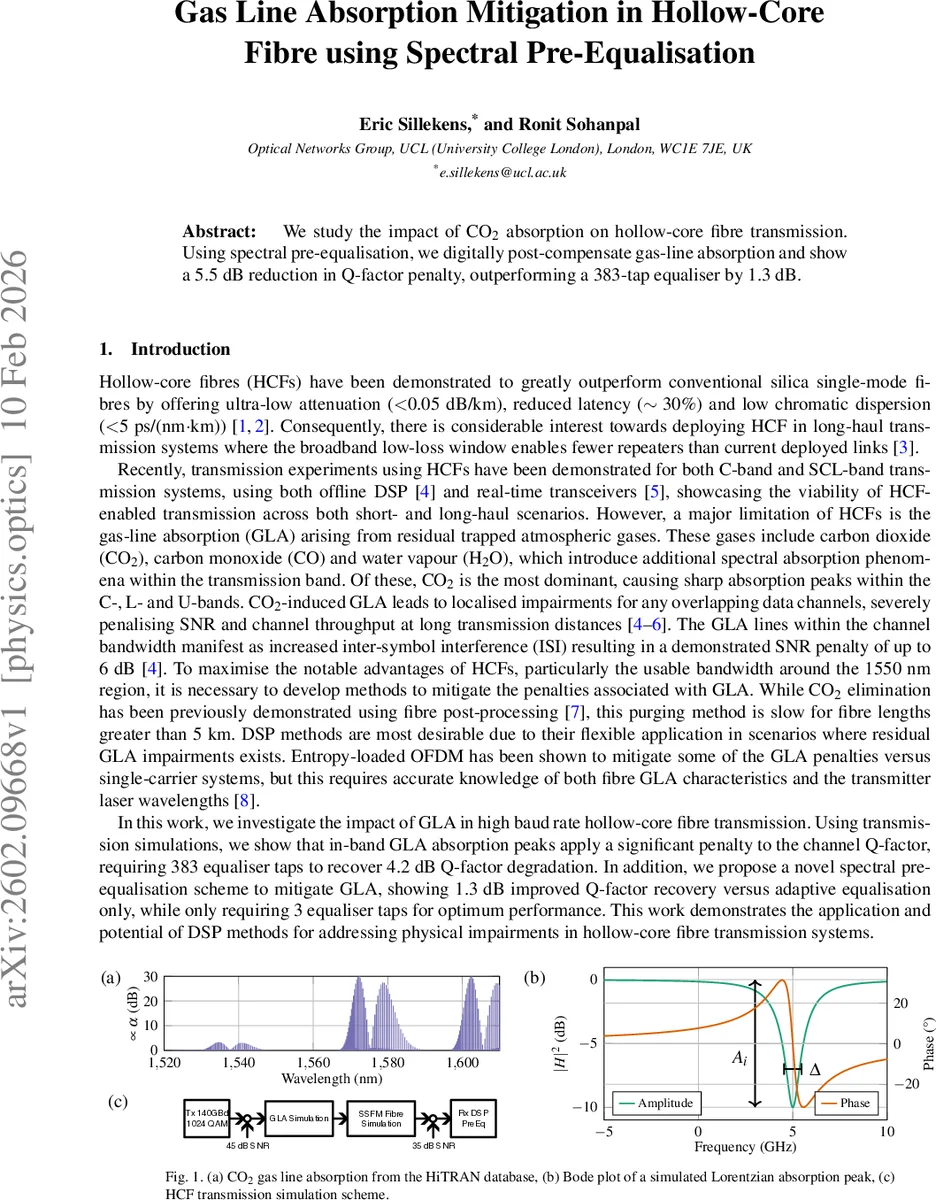
The paper investigates the detrimental effect of gas‑line absorption (GLA), primarily caused by residual CO₂, on hollow‑core fiber (HCF) transmission and proposes a novel digital signal processing (DSP) solution to mitigate this impairment. Using the HiTRAN database, the authors model CO₂ absorption as a series of Lorentzian notches with fixed full‑width‑half‑maximum (1 GHz) spaced every 40 GHz, enforcing causality through a minimum‑phase reconstruction via the Hilbert transform. A 300 km HCF link is simulated with a 140 GBd dual‑polarisation 1024‑QAM signal, incorporating three absorption notches within the signal bandwidth. The split‑step Fourier method models linear and nonlinear fiber effects, while transmitter and receiver OSNRs are set to 45 dB and 35 dB, respectively. Pilot‑aided recursive least‑squares (RLS) equalisation is employed as a baseline adaptive equaliser.
Results show that, without any mitigation, a 10 dB deep absorption notch reduces the Q‑factor by more than 6 dB. Conventional RLS equalisation can recover part of this loss, but requires 383 taps to achieve a 4.2 dB Q‑factor improvement, leading to high computational load and latency. To address this, the authors introduce a frequency‑domain spectral pre‑equaliser. The received signal is divided into 4096‑sample blocks; a two‑sided power spectral density (PSD) is estimated using Welch’s method with 50 % overlap. The pre‑equaliser’s amplitude response is set to the inverse square‑root of the PSD, while its phase response is derived from the Hilbert transform of the log‑amplitude, ensuring that the combined response neutralises both magnitude and phase distortions introduced by GLA. A regularisation factor based on an estimated SNR (fixed at 20 dB) yields an MMSE‑type weighting that limits noise amplification within the notches.
When this pre‑equaliser is cascaded with a short (2 samples/symbol) RLS equaliser using only three taps, the system achieves a 5.5 dB Q‑factor gain for a 10 dB notch depth, outperforming the 383‑tap RLS‑only solution by 1.3 dB while reducing computational complexity by roughly two orders of magnitude. The residual penalty relative to a notch‑free scenario remains modest (0.46 dB for 3 dB notches, 1.67 dB for 10 dB, and 5.33 dB for 30 dB), reflecting the limits imposed by noise and imperfect PSD estimation. Because the pre‑equaliser operates in the frequency domain, it can be integrated into existing chromatic‑dispersion compensation blocks, simplifying hardware implementation. The authors also note that block‑wise processing would enable real‑time deployment.
In conclusion, the study demonstrates that spectral pre‑equalisation is an effective, low‑complexity DSP technique for mitigating CO₂‑induced GLA in HCF links, enabling high‑order modulation formats to retain their performance over long distances. The work paves the way for practical deployment of HCF in future ultra‑low‑latency, high‑capacity networks, while highlighting the need for experimental validation, extension to other gas species, and hardware‑efficient designs.
Comments & Academic Discussion
Loading comments...
Leave a Comment