LDG method for solving spatial and temporal fractional nonlinear convection-diffusion equations
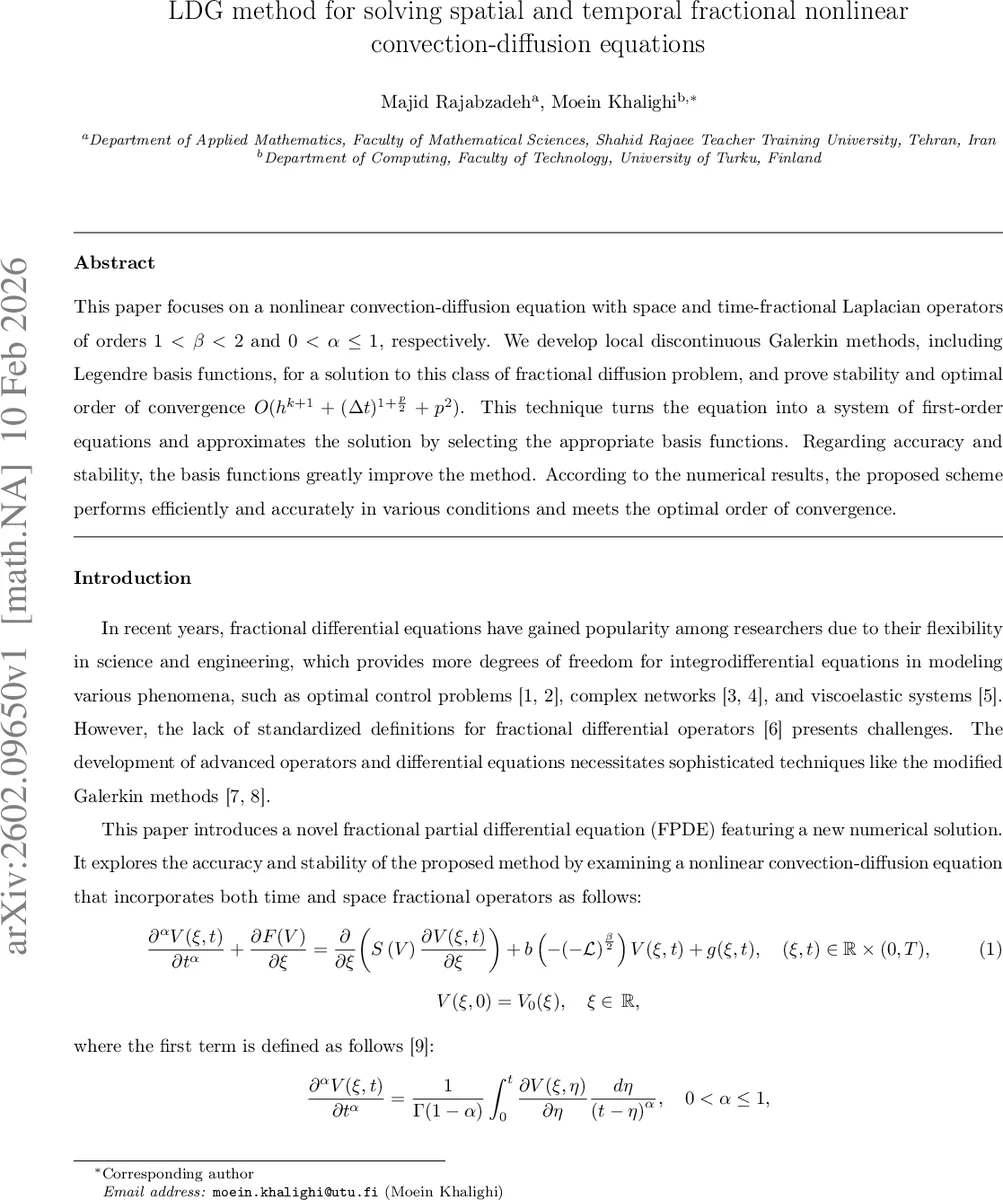
This paper focuses on a nonlinear convection-diffusion equation with space and time-fractional Laplacian operators of orders $1<β<2$ and $0<α\leq1$, respectively. We develop local discontinuous Galerkin methods, including Legendre basis functions, for a solution to this class of fractional diffusion problem, and prove stability and optimal order of convergence $O(h^{k+1}+(Δt)^{1+\frac{p}{2}}+p^2)$. This technique turns the equation into a system of first-order equations and approximates the solution by selecting the appropriate basis functions. Regarding accuracy and stability, the basis functions greatly improve the method. According to the numerical results, the proposed scheme performs efficiently and accurately in various conditions and meets the optimal order of convergence.
💡 Research Summary
The manuscript addresses the numerical solution of a nonlinear convection‑diffusion equation that incorporates both a time‑fractional derivative of order 0 < α ≤ 1 (Caputo type) and a space‑fractional Laplacian of order 1 < β < 2. The authors propose a Local Discontinuous Galerkin (LDG) scheme in which the original high‑order fractional PDE is rewritten as a first‑order system by introducing auxiliary variables (V, L, E, R). The spatial discretization uses Legendre polynomials as basis functions, while the temporal fractional derivative is approximated by a weighted sum of Caputo derivatives evaluated at a set of quadrature points α_j, with step size p = 1/M.
The paper first reviews the necessary fractional calculus definitions (Riemann‑Liouville integrals, Caputo derivative, singular integral representation of the fractional Laplacian) and the Legendre differential equation. It then derives the weak formulation of the first‑order system, defines numerical fluxes at element interfaces, and assembles the semi‑discrete LDG equations (equations (14)–(18)). The fluxes are chosen to be central for the primary variable V and upwind‑type for the auxiliary variables, ensuring consistency with the nonlocal operators.
A rigorous stability analysis follows. By constructing an energy functional B(·) that incorporates the weighted time‑fractional contributions and the spatial flux terms, the authors prove a discrete L²‑stability result (Theorem 6): the L²‑norm of the numerical solution at any final time does not exceed the norm of the initial data, independent of the mesh sizes or the fractional orders. Lemma 5 provides the key identity that cancels the interface contributions when the test functions are chosen as the solution itself.
The convergence analysis assumes a simplified setting (zero convection term, unit diffusion coefficient, identity flux function) to isolate the error mechanisms. Projection operators S⁺ and S⁻ are introduced to relate the exact solution to its polynomial approximation. The error e = (e_V, e_L, e_E, e_R) satisfies a residual equation that can be bounded by the approximation properties of the Legendre basis (order k + 1 in space) and the quadrature error in time (order Δt^{1+p/2}+p²). Consequently, the method achieves optimal convergence rates O(h^{k+1}) in space and O(Δt^{1+p/2}+p²) in time, matching the best known results for integer‑order LDG schemes.
Numerical experiments are presented for k = 1 and k = 2, with various combinations of α and β. The authors report L²‑error tables and convergence plots that confirm the theoretical rates. The experiments also demonstrate that the scheme remains stable for relatively large time steps, reflecting the unconditional stability proved analytically. However, the paper lacks a detailed discussion of boundary treatment for the unbounded spatial domain and provides limited guidance on the selection of the quadrature parameter p, which can dominate the temporal error term.
Overall, the contribution of the work can be summarized as follows:
- Introduction of an LDG framework capable of handling simultaneous time‑ and space‑fractional operators in a nonlinear convection‑diffusion context.
- Derivation of a stable semi‑discrete scheme with rigorously proved L²‑stability that does not depend on restrictive CFL conditions.
- Proof of optimal order convergence in both space and time, extending existing LDG theory to fractional PDEs.
- Numerical validation that confirms the theoretical findings across a range of fractional orders.
The manuscript is well‑structured and the mathematical derivations are generally sound. Minor issues include typographical errors, occasional ambiguous notation (e.g., repeated definitions of λ_j and a_{αj l}), and insufficient detail on the implementation of absorbing boundary conditions for the fractional Laplacian. Addressing these points would improve reproducibility and broaden the applicability of the method to practical engineering problems.
In conclusion, the paper makes a solid theoretical and computational contribution to the numerical analysis of fractional PDEs, and with minor revisions it would be a valuable addition to the literature on high‑order discontinuous Galerkin methods for nonlocal problems.
Comments & Academic Discussion
Loading comments...
Leave a Comment