Impact of Market Reforms on Deterministic Frequency Deviations in the European Power Grid
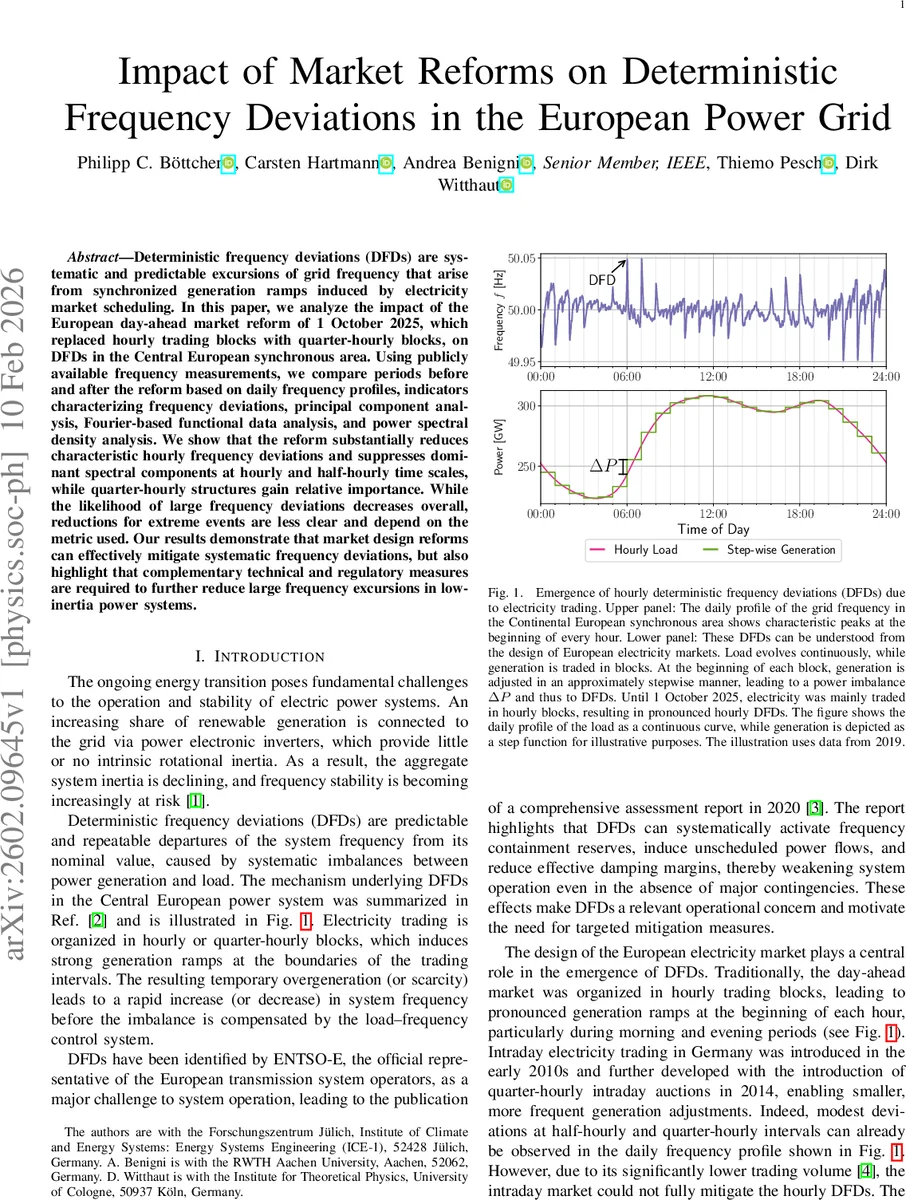
Deterministic frequency deviations (DFDs) are systematic and predictable excursions of grid frequency that arise from synchronized generation ramps induced by electricity market scheduling. In this paper, we analyze the impact of the European day-ahead market reform of 1 October 2025, which replaced hourly trading blocks with quarter-hourly blocks, on DFDs in the Central European synchronous area. Using publicly available frequency measurements, we compare periods before and after the reform based on daily frequency profiles, indicators characterizing frequency deviations, principal component analysis, Fourier-based functional data analysis, and power spectral density analysis. We show that the reform substantially reduces characteristic hourly frequency deviations and suppresses dominant spectral components at hourly and half-hourly time scales, while quarter-hourly structures gain relative importance. While the likelihood of large frequency deviations decreases overall, reductions for extreme events are less clear and depend on the metric used. Our results demonstrate that market design reforms can effectively mitigate systematic frequency deviations, but also highlight that complementary technical and regulatory measures are required to further reduce large frequency excursions in low-inertia power systems.
💡 Research Summary
The paper investigates how the European day‑ahead market reform of 1 October 2025, which replaced hourly trading blocks with quarter‑hourly (15 min) blocks, affected deterministic frequency deviations (DFDs) in the Central European synchronous area. Using publicly available 1‑second resolution frequency measurements from the German transmission system operator, the authors compare three‑month periods before (Oct‑Dec 2024) and after (Oct‑Dec 2025) the reform, applying a suite of analytical tools. Power spectral density (PSD) analysis via Welch’s method reveals that before the reform the spectrum exhibits strong peaks at 1 h and 30 min periods, reflecting synchronized generation ramps at market boundaries. After the reform these peaks are markedly suppressed, while the 15 min peak gains relative prominence. Daily frequency profiles, together with 5 % and 95 % quantiles, show that the characteristic “hour‑turn” spikes are reduced, indicating smoother intra‑day dynamics. Four deviation indicators—Nadir, mean‑square deviation (MSD), integrated deviation, and rate of change of frequency (RoCoF)—are computed for each hour; all show lower average values post‑reform, with especially pronounced reductions in RoCoF and Nadir, suggesting improved stability. Principal component analysis (PCA) on hourly segments demonstrates that the leading component, which previously captured the bulk of hourly‑scale variance, loses explanatory power after the market change, confirming a weakening of market‑induced synchronization. Complementary Fourier‑based functional data analysis decomposes each hour into harmonic components; the energy of the fundamental (k = 1, 1 h) decreases, whereas the fourth harmonic (k = 4, 15 min) becomes relatively larger, directly quantifying the shift in spectral content. Overall, the transition to finer‑resolution trading blocks substantially mitigates systematic hourly DFDs and reshapes the frequency spectrum, but the reduction of extreme excursions remains ambiguous and depends on the chosen metric. The authors conclude that while market design reforms are an effective lever for DFD mitigation, additional technical measures (e.g., fast‑acting reserves, inverter‑based controls) and regulatory actions are required to further curb large frequency excursions in low‑inertia power systems.
Comments & Academic Discussion
Loading comments...
Leave a Comment