A Survey on STAR-RIS Enabled Joint Communications and Sensing: Fundamentals, Recent Advances and Research Challenges
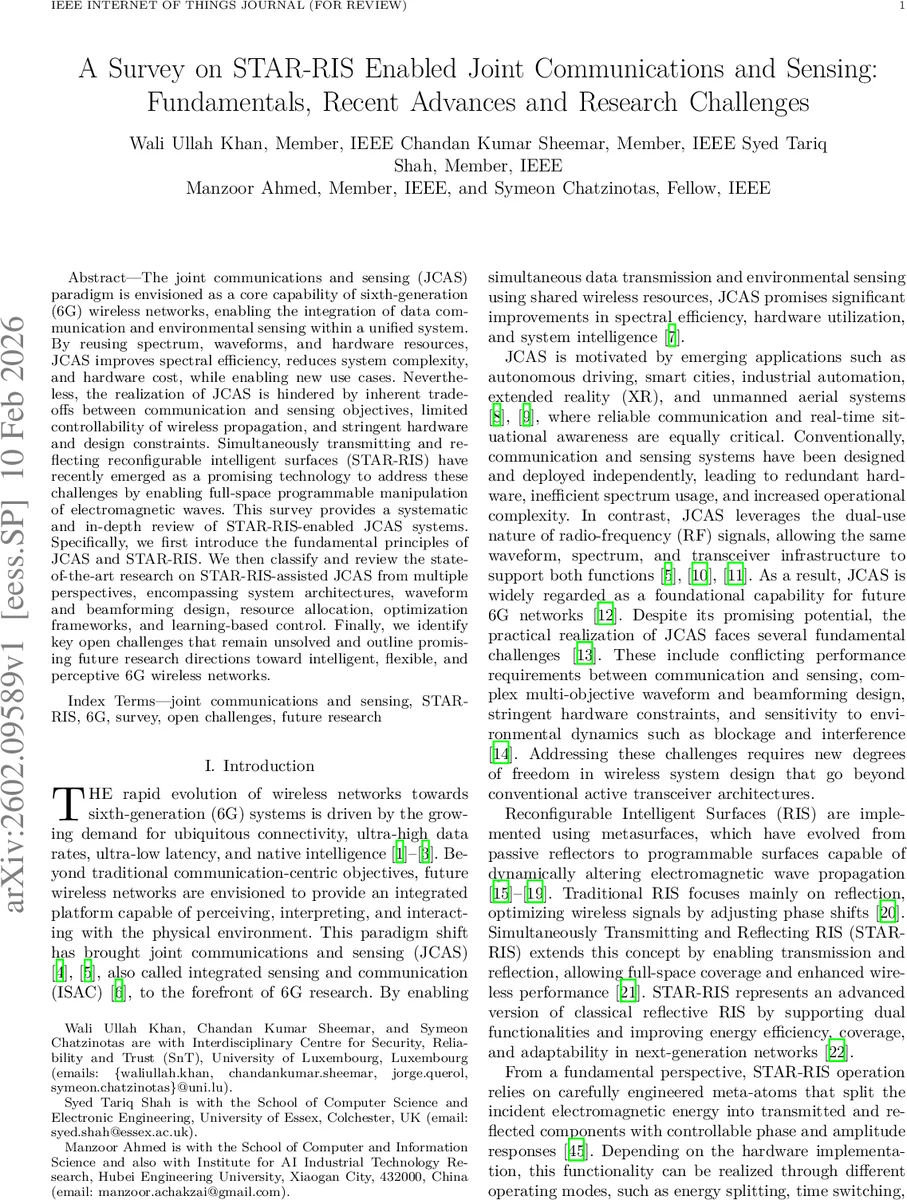
The joint communications and sensing (JCAS) paradigm is envisioned as a core capability of sixth-generation (6G) wireless networks, enabling the integration of data communication and environmental sensing within a unified system. By reusing spectrum, waveforms, and hardware resources, JCAS improves spectral efficiency, reduces system complexity, and hardware cost, while enabling new use cases. Nevertheless, the realization of JCAS is hindered by inherent trade-offs between communication and sensing objectives, limited controllability of wireless propagation, and stringent hardware and design constraints. Simultaneously transmitting and reflecting reconfigurable intelligent surfaces (STAR-RIS) have recently emerged as a promising technology to address these challenges by enabling full-space programmable manipulation of electromagnetic waves. This survey provides a systematic and in-depth review of STAR-RIS-enabled JCAS systems. Specifically, we first introduce the fundamental principles of JCAS and STAR-RIS. We then classify and review the state-of-the-art research on STAR-RIS-assisted JCAS from multiple perspectives, encompassing system architectures, waveform and beamforming design, resource allocation, optimization frameworks, and learning-based control. Finally, we identify key open challenges that remain unsolved and outline promising future research directions toward intelligent, flexible, and perceptive 6G wireless networks.
💡 Research Summary
This survey paper presents a comprehensive review of the emerging integration of Joint Communications and Sensing (JCAS) with Simultaneously Transmitting and Reflecting Reconfigurable Intelligent Surfaces (STAR‑RIS), a technology poised to become a cornerstone of sixth‑generation (6G) wireless networks. The authors begin by outlining the motivation for JCAS: modern applications such as autonomous driving, smart cities, industrial automation, extended reality, and unmanned aerial systems demand both ultra‑reliable high‑rate data links and real‑time environmental awareness. Traditional designs treat communication and sensing as separate subsystems, leading to duplicated hardware, inefficient spectrum use, and increased system complexity. JCAS addresses these issues by sharing spectrum, waveforms, and transceiver hardware, but it introduces a fundamental multi‑objective trade‑off between communication throughput and sensing accuracy (e.g., Cramér‑Rao bound versus achievable rate).
STAR‑RIS is introduced as a powerful means to alleviate the JCAS trade‑off. Unlike conventional RIS, which only reflects incident waves, STAR‑RIS can split the incoming electromagnetic energy into transmitted and reflected components with independently controllable phase and amplitude. Three practical operating modes are discussed: energy‑splitting, time‑switching, and mode‑switching. These modes provide additional degrees of freedom (DoF) for jointly shaping communication and sensing beams, enabling full‑space (both forward and backward) wave manipulation. The paper details how STAR‑RIS hardware—typically a layered metasurface with active control circuits—realizes these functions, while still preserving the low‑power, lightweight, and easy‑deployment advantages of RIS.
The survey classifies the state‑of‑the‑art research on STAR‑RIS‑enabled JCAS into several dimensions:
-
System Architectures – Multi‑layer designs comprising base stations, STAR‑RIS panels, user equipment, and sensing targets; cooperative deployments of multiple RIS panels; integration with non‑terrestrial platforms (UAVs, satellites) for ubiquitous coverage.
-
Waveform and Beamforming Design – Extensions of OFDM, FMCW, and OTFS waveforms to support simultaneous data and radar functions; joint optimization of phase‑shift and amplitude coefficients for both transmission and reflection; multi‑beam formation for multi‑user and multi‑target scenarios.
-
Resource Allocation and Optimization Frameworks – Joint power‑splitting between transmission and reflection, time/frequency/space scheduling, and multi‑objective formulations solved via conventional techniques (block coordinate descent, successive convex approximation, QCQP) as well as stochastic methods (reinforcement learning, deep learning). The authors also discuss the synergy with NOMA and RSMA for spectral efficiency.
-
Learning‑Based Control – Application of model‑free reinforcement learning algorithms (DDPG, TD3, SAC) for real‑time phase‑control and power‑splitting decisions; meta‑learning and transfer learning to cope with dynamic channel conditions; challenges related to data collection, safety, and convergence.
-
Application Scenarios – High‑mobility vehicular networks (V2X, V2I), UAV‑assisted communications, THz‑band operations, simultaneous wireless information and power transfer (SWIPT), and security/privacy considerations at the physical layer.
The authors identify seven major open challenges: (i) accurate channel modeling for the combined transmission‑reflection links; (ii) scalable hardware design for high‑frequency (including THz) metasurfaces with minimal power consumption; (iii) distributed control protocols to manage thousands of meta‑atoms with low overhead; (iv) low‑latency, low‑complexity real‑time optimization algorithms; (v) robust physical‑layer security and privacy mechanisms; (vi) seamless integration with advanced multiple‑access schemes (NOMA/RSMA); and (vii) standardization efforts and test‑bed development for experimental validation.
In conclusion, the paper argues that STAR‑RIS provides a unique set of programmable degrees of freedom that can fundamentally mitigate the inherent trade‑offs of JCAS, enabling intelligent, flexible, and perceptive 6G networks. However, realizing this vision requires interdisciplinary research spanning electromagnetic metasurface engineering, stochastic optimization, machine learning, and security, as well as coordinated standardization activities. The survey serves as a detailed roadmap for researchers and practitioners aiming to design, analyze, and deploy STAR‑RIS‑enabled JCAS systems.
Comments & Academic Discussion
Loading comments...
Leave a Comment