A Combinatorial Proof of Cayley's Formula via Degree Sequences
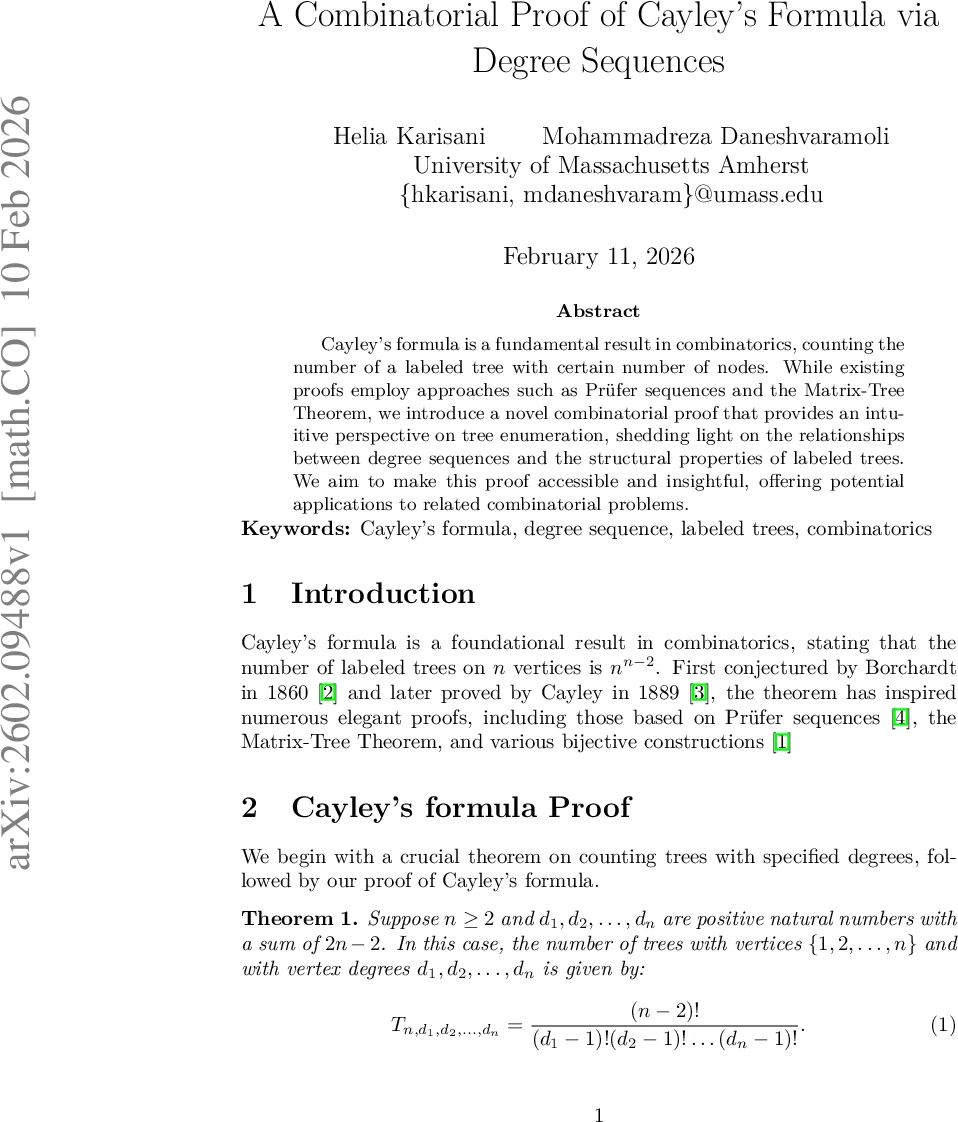
Cayley’s formula is a fundamental result in combinatorics that counts the number of labeled trees on n vertices. While existing proofs use approaches such as Prufer sequences and the Matrix-Tree Theorem, we give a combinatorial proof that highlights the role of degree sequences and structural properties of labeled trees. Our goal is to provide an accessible perspective and suggest connections to related enumeration problems.
💡 Research Summary
The paper presents a purely combinatorial proof of Cayley’s formula, which states that the number of labeled trees on (n) vertices equals (n^{,n-2}). The authors begin by recalling a classic enumeration result (Theorem 1): for a prescribed degree sequence ((d_1,\dots,d_n)) with (\sum d_i = 2n-2), the number of labeled trees realizing that sequence is ((n-2)!/\prod_{i=1}^n (d_i-1)!). Although the proof of this theorem is delegated to an external source (Joy Al and André), it serves as the backbone of the subsequent argument.
The main proof (Theorem 2) proceeds by induction on (n). The base case (n=2) is trivial. Assuming the formula holds for all smaller sizes, the authors analyze a tree on (n) vertices by focusing on vertex 1. Let the degree of vertex 1 be (k) ((1\le k\le n-1)). Removing vertex 1 disconnects the remaining (n-1) vertices into (k) connected subtrees of sizes (a_1,\dots,a_k) with (\sum a_i=n-1). Because the ordering of the multiset ({a_i}) does not affect the structure, they divide by (k!) to avoid over‑counting.
For a fixed multiset ({a_i}), the number of ways to partition the (n-1) labeled vertices into blocks of those sizes is ((n-1)!/\prod a_i!). Within each block, a tree can be formed in (T_{a_i}) ways, where (T_m) denotes the number of labeled trees on (m) vertices. Moreover, each block must contribute exactly one vertex to connect to vertex 1, giving a factor (\prod a_i). Multiplying these contributions yields the expression (5) and, after simplification, equation (6).
Lemma 3 is the technical heart of the argument. It shows that the sum over all admissible ({a_i}) collapses to a simple closed form: \
Comments & Academic Discussion
Loading comments...
Leave a Comment