Dieu khien he da tac tu
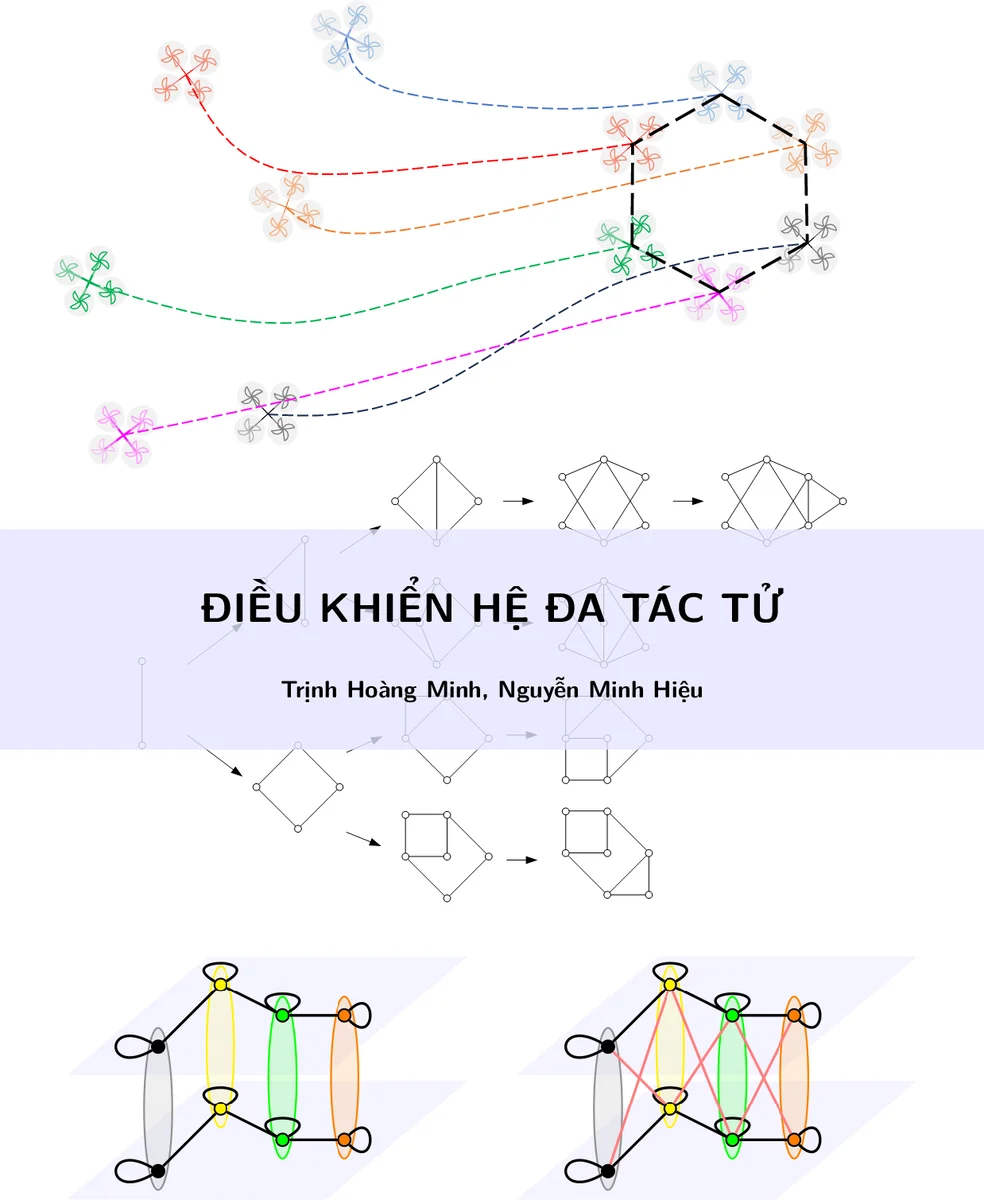
Since the early 2000s, control of multiagent systems has attracted significant research interest, with applications ranging from natural collective behaviors and social dynamics to engineered systems such as autonomous vehicles, sensor networks, and smart grids. Although research on multi-agent systems has diversified into numerous specialized directions, textbooks – including those in English – that provide a systematic treatment of the fundamental principles of multi-agent system control remain scarce. The material presented in this book has been developed and used in teaching since 2021, initially as a concise Vietnamese-language reference for the courses Networked Control Systems and Control of Multi-Agent Systems at Hanoi University of Science and Technology. The book focuses on a selection of fundamental topics of broad and continuing interest in the field. The complexity of several topics is asymptotic to that encountered in research-level studies, however, the analysis is presented in a step-by-step manner to facilitate access to commonly used methods and tools. The material is divided into three main parts. Part I introduces multiagent systems and basic graph-theoretic concepts. Part II addresses the design and analysis of linear consensus algorithms. Part III covers selected applications and research directions, including formation control, network localization, distributed optimization, opinion dynamics, and matrix-weighted networks. Each chapter concludes with notes on notable researchers in this field, further reading, and exercises. This book cannot be completed without the encouragement, support and suggestions from families, colleagues and friends. The authors appreciate feedback from readers to further improve the content of the book.
💡 Research Summary
“Control of Multi‑Agent Systems” (original Vietnamese title “Điều khiển hệ đa tác tử”) is a comprehensive textbook that originated from teaching materials developed at Hanoi University of Science and Technology since 2021. Authored by Trinh Hoang Minh and Nguyen Minh Hieu, the latest edition (February 2026) is available both as a PDF and with accompanying MATLAB simulation code via a dedicated website. The book addresses a notable gap in the literature: while many research papers and specialized monographs exist, systematic textbooks covering the fundamental principles of multi‑agent system (MAS) control—especially in languages other than English—are scarce.
The text is organized into three major parts. Part I introduces MAS concepts and essential graph‑theoretic tools. It covers agents, interaction graphs, adjacency and Laplacian matrices, connectivity, and spectral properties, providing intuitive visual examples and step‑by‑step proofs. This foundation prepares readers for the more advanced material that follows.
Part II focuses on linear consensus algorithms. Both continuous‑time and discrete‑time Laplacian‑based dynamics are presented, together with convergence conditions (e.g., graph connectivity, positivity of the second smallest eigenvalue). Stability is proved using Lyapunov functions, spectral analysis, and Barbalat’s lemma. The authors also discuss extensions such as asynchronous updates, communication delays, and stochastic disturbances, always maintaining a pedagogical balance between rigorous research‑level mathematics and accessible exposition.
Part III explores selected applications and current research directions. The chapters cover:
- Formation control – distance‑ and angle‑based strategies, robustness analysis, and leader‑follower schemes.
- Network localization – algorithms for estimating node positions in sensor networks, handling measurement noise and random initializations.
- Distributed optimization – consensus‑based subgradient methods, ADMM, and constrained optimization via distributed Lagrange multipliers.
- Opinion dynamics – classic models (DeGroot, Friedkin‑Johnsen, Hegselmann‑Krause), analysis of convergence, clustering, and polarization.
- Matrix‑weighted networks – generalization of scalar‑weighted graphs, properties of matrix Laplacians, and applications to cooperative robotics.
Each chapter concludes with a set of exercises ranging from theoretical proofs to hands‑on MATLAB simulations, a list of notable researchers in the field, and an extensive bibliography for further reading. This structure encourages self‑directed learning and provides clear pathways for students to transition from textbook material to contemporary research.
The appendices serve as a mathematical toolbox. Appendix A reviews linear algebra topics such as eigenvalue decomposition, Jordan canonical form, Perron‑Frobenius theory, and Gerschgorin circles. Appendix B presents Lyapunov theory, including Barbalat’s lemma and related stability results. Appendix C offers practical guidance on MATLAB/Simulink modeling of MAS, with code snippets for 2‑D and 3‑D visualizations, time‑varying graphs, and simulation of the algorithms discussed in the main text.
Strengths of the book include its systematic progression from fundamentals to advanced topics, the inclusion of both theoretical derivations and practical simulation tools, and the thoughtful placement of exercises and references that support deeper exploration. The step‑by‑step presentation makes concepts that are typically encountered only in research papers accessible to graduate students and early‑career researchers. However, the exclusive use of Vietnamese limits accessibility for the broader international community, and the bibliography could be updated to reflect the most recent advances (post‑2023). Despite these limitations, the textbook stands out as a valuable resource for anyone seeking a solid grounding in MAS control, especially in the context of teaching or self‑study.
Comments & Academic Discussion
Loading comments...
Leave a Comment