A Theory for Probabilistic Polynomial-Time Reasoning
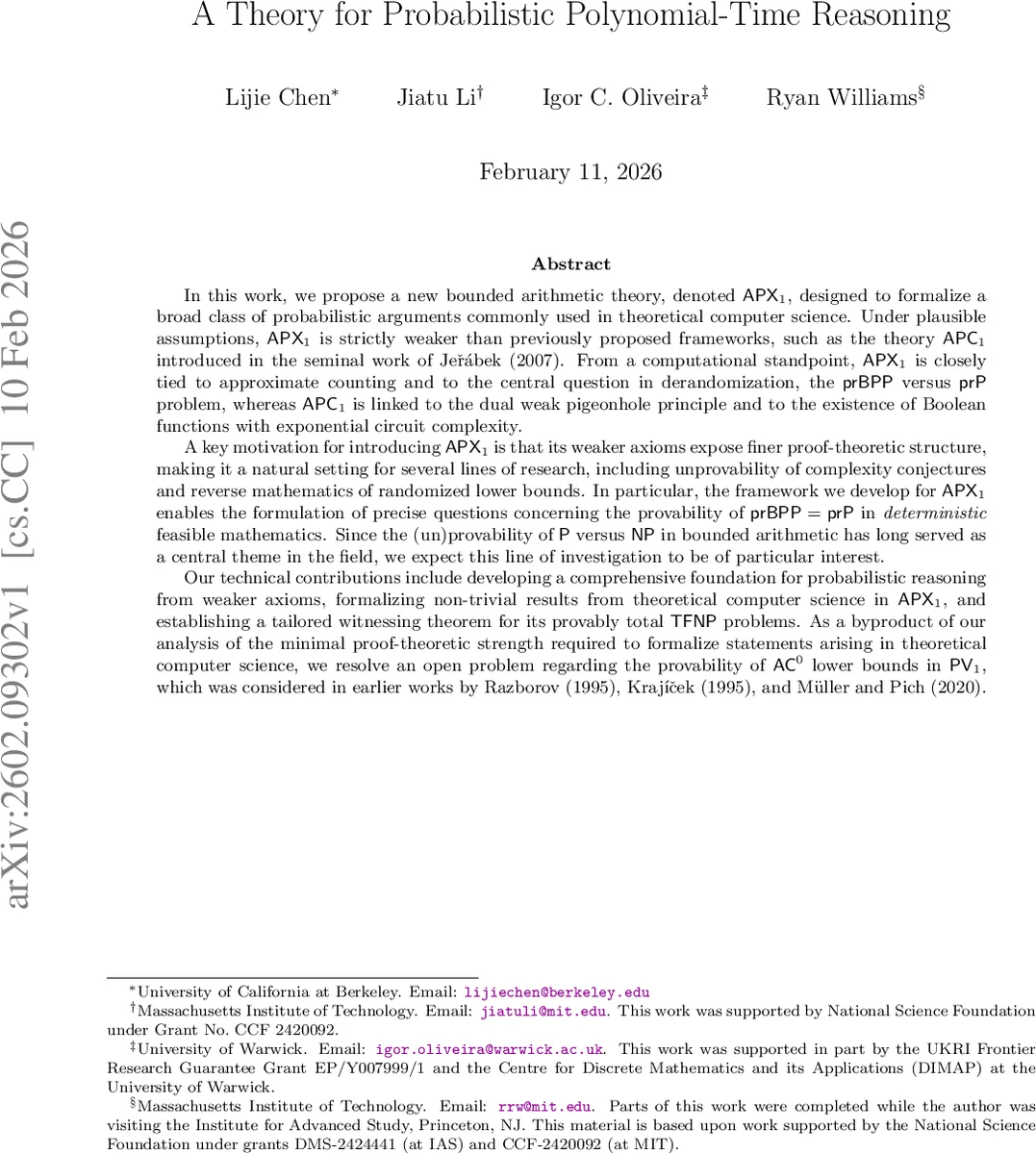
In this work, we propose a new bounded arithmetic theory, denoted $APX_1$, designed to formalize a broad class of probabilistic arguments commonly used in theoretical computer science. Under plausible assumptions, $APX_1$ is strictly weaker than previously proposed frameworks, such as the theory $APC_1$ introduced in the seminal work of Jerabek (2007). From a computational standpoint, $APX_1$ is closely tied to approximate counting and to the central question in derandomization, the prBPP versus prP problem, whereas $APC_1$ is linked to the dual weak pigeonhole principle and to the existence of Boolean functions with exponential circuit complexity. A key motivation for introducing $APX_1$ is that its weaker axioms expose finer proof-theoretic structure, making it a natural setting for several lines of research, including unprovability of complexity conjectures and reverse mathematics of randomized lower bounds. In particular, the framework we develop for $APX_1$ enables the formulation of precise questions concerning the provability of prBPP=prP in deterministic feasible mathematics. Since the (un)provability of P versus NP in bounded arithmetic has long served as a central theme in the field, we expect this line of investigation to be of particular interest. Our technical contributions include developing a comprehensive foundation for probabilistic reasoning from weaker axioms, formalizing non-trivial results from theoretical computer science in $APX_1$, and establishing a tailored witnessing theorem for its provably total TFNP problems. As a byproduct of our analysis of the minimal proof-theoretic strength required to formalize statements arising in theoretical computer science, we resolve an open problem regarding the provability of $AC^0$ lower bounds in $PV_1$, which was considered in earlier works by Razborov (1995), Krajicek (1995), and Muller and Pich (2020).
💡 Research Summary
The paper introduces a new bounded‑arithmetic theory, APX₁, designed to capture the reasoning needed for probabilistic polynomial‑time algorithms while remaining strictly weaker than the previously studied APC₁. The authors motivate APX₁ by pointing out that APC₁’s reliance on the dual weak pigeonhole principle (dWPHP(PV)) brings in unnecessary strength: it encodes the existence of exponentially hard Boolean functions and serves as a powerful counting principle, both of which go beyond what is required for most probabilistic arguments.
APX₁ extends the language of Cook’s PV₁ but adds only a handful of axioms concerning approximate counting, approximate expectation, and basic probability inequalities (union bound, Markov, Chebyshev, Chernoff). These axioms are sufficient to develop a full “probability theory” inside the system: linearity of expectation, averaging arguments, complementarity, independence, error reduction, and concentration bounds are all proved without invoking dWPHP(PV). A central technical device is the “pointwise‑to‑global” technique, which lifts local approximate counting statements to global probability estimates.
The paper proceeds to formalize several non‑trivial results from theoretical computer science within APX₁. It gives a bounded‑arithmetic version of Yao’s distinguisher‑to‑predictor transformation, an Atserias‑Tzameret proof of the Schwartz‑Zippel lemma, and a construction of linear hash functions. Most notably, the authors prove an average‑case AC⁰ lower bound for the Parity function inside APX₁ and, as a by‑product, a matching worst‑case lower bound in PV₁, thereby resolving an open problem raised by Razborov, Krajíček, and Müller‑Pich. The paper also formalizes the Blum‑Luby‑Rubinfeld linearity test, establishing its completeness, correctness, and soundness in the APX₁ framework.
A major contribution is a tailored witnessing theorem. The authors define a TFZPP problem called Refuter(Yao) and show that every provably total NP relation in APX₁ deterministically reduces to Refuter(Yao). Consequently, if the feasible derandomization statement prBPP = prP holds, APX₁ admits deterministic polynomial‑time witnessing for all its provably total TFNP problems, yielding a KPT‑style witnessing theorem for APX₁. This provides a precise formalization of the question “Is prBPP = prP feasibly provable?” and links its answer directly to the proof‑theoretic strength of APX₁.
The final section develops a reverse‑mathematics of randomness using APX₁ as a base theory. By establishing equivalences between compression principles, communication complexity upper bounds, and average‑case lower bounds, the authors demonstrate that many randomized lower‑bound arguments can be carried out without the heavy combinatorial machinery of dWPHP(PV). This opens a new line of research where the logical strength of probabilistic proofs is systematically classified.
Overall, APX₁ offers a minimal yet expressive framework for reasoning about probabilistic polynomial‑time computation, approximate counting, and lower‑bound techniques. It bridges the gap between deterministic feasible mathematics (PV₁) and the stronger APC₁, enabling both the formalization of important algorithmic results and the exploration of unprovability and reverse‑mathematics questions concerning randomness and derandomization. Future work suggested includes separating APX₁ from APC₁ under plausible complexity assumptions, investigating the feasible provability of prBPP = prP, and extending the reverse‑mathematics program to broader classes of randomized algorithms.
Comments & Academic Discussion
Loading comments...
Leave a Comment