An omega result for the least negative Hecke eigenvalue
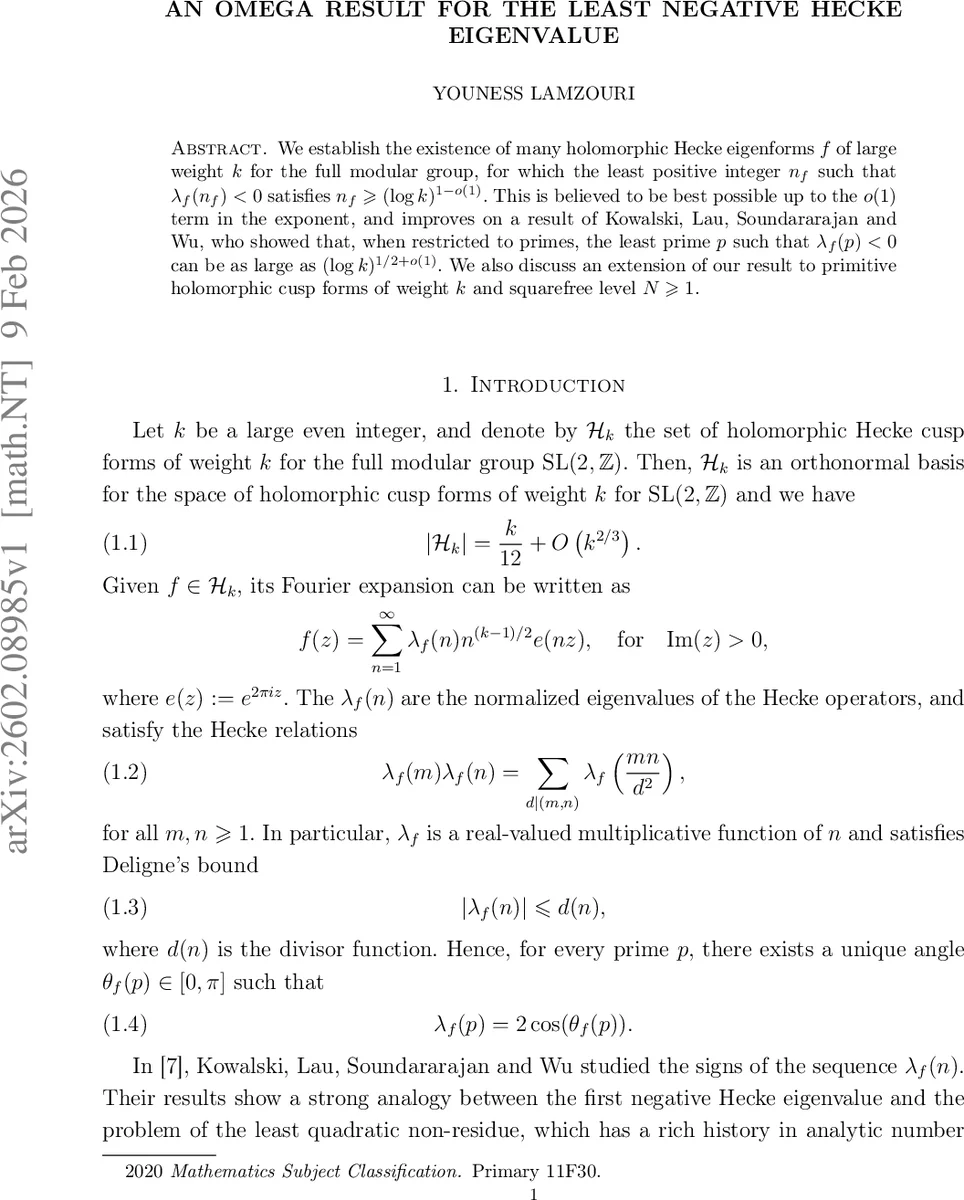
We establish the existence of many holomorphic Hecke eigenforms $f$ of large weight $k$ for the full modular group, for which the least positive integer $n_f$ such that $λ_f(n_f)<0$ satisfies $n_f \ge (\log k)^{1-o(1)}.$ This is believed to be best possible up to the $o(1)$ term in the exponent, and improves on a result of Kowalski, Lau, Soundararajan and Wu, who showed that, when restricted to primes, the least prime $p$ such that $λ_f(p)<0$ can be as large as $(\log k)^{1/2+o(1)}$. We also discuss an extension of our result to primitive holomorphic cusp forms of weight $k$ and squarefree level $N\geq 1$.
💡 Research Summary
The paper by Youness Lamzouri addresses a natural question about the sign changes of Fourier coefficients of holomorphic cusp forms: given a holomorphic Hecke eigenform f of large even weight k for the full modular group SL(2,ℤ), how large can the smallest positive integer n_f with λ_f(n_f)<0 be? Earlier work gave only modest upper bounds (Matomäki showed n_f≪k^{3/4}) and, under the Generalized Riemann Hypothesis, one can improve this to n_f≪(log k)^2. On the lower‑bound side, the only “omega‑type” result was due to Kowalski, Lau, Soundararajan and Wu, who proved that for a positive proportion of forms the least prime p with λ_f(p)<0 can be as large as (log k)^{1/2+o(1)}. Because λ_f is not completely multiplicative, this does not directly give information about n_f.
Lamzouri fills this gap by proving that for a set of cusp forms of size ≫|H_k|·exp(−5 log k log^3 k/(log log k)^3) the quantity n_f is at least of order log k/(log log k)^2, which is essentially (log k)^{1‑o(1)}. The same statement holds for primitive cusp forms of weight k and square‑free level N, with log k replaced by log(kN).
The proof combines two main ingredients:
-
A sharply localized trigonometric polynomial. Lemma 2.1 constructs, for a large integer L and a parameter δ≤½, a trigonometric polynomial
f(θ)=∑_{ℓ=0}^{L}c_ℓ e^{-iℓθ}
satisfying f(0)=1, |f(θ)|≤2 e^{-πLδ} for δ≤θ≤1−δ, and with good L^2‑norm estimates (∫|f|^2≈1/(L+1) and a weighted integral ≫1/L^3). This is essentially the Chebyshev‑based construction used by Gonek and Montgomery. -
Petersson trace formula and Hecke relations. Lemma 2.2 gives the average of λ_f(m) over the family with harmonic weight ω_f:
∑_{f∈H_k^*(N)} ω_f λ_f(m)=1/m+O(m^{1/3}(kN)^{-5/6}).
The harmonic weight satisfies ω_f≪(log kN)^2 kN.
From the polynomial f, the author defines g(θ)=|f(θ/2π)|^2, which is a non‑negative even function bounded by 1, with average a_0≈∫0^π g(θ) dµ{ST}≈(log log k)^{-6}. Expanding g in the orthonormal basis of Chebyshev polynomials X_ℓ(θ)=sin((ℓ+1)θ)/sinθ yields
g(θ)=∑_{ℓ=0}^{L} a_ℓ X_ℓ(θ),
with |a_ℓ|≤1 and a_ℓ=0 for ℓ>L.
The key combinatorial object is
G(f)=∑{p≤z} g(θ_f(p))−ε ∑{q≤z}∏_{p≤z, p|q} g(θ_f(p)),
where ε=4 e^{-2πLδ}≈(log k)^{-π/2} and z will be chosen later. If any prime q≤z satisfies θ_f(q)∈
Comments & Academic Discussion
Loading comments...
Leave a Comment