"I Don't Trust Any Professional Research Tool": A Re-Imagination of Knowledge Production Workflows by, with, and for Blind and Low-Vision Researchers
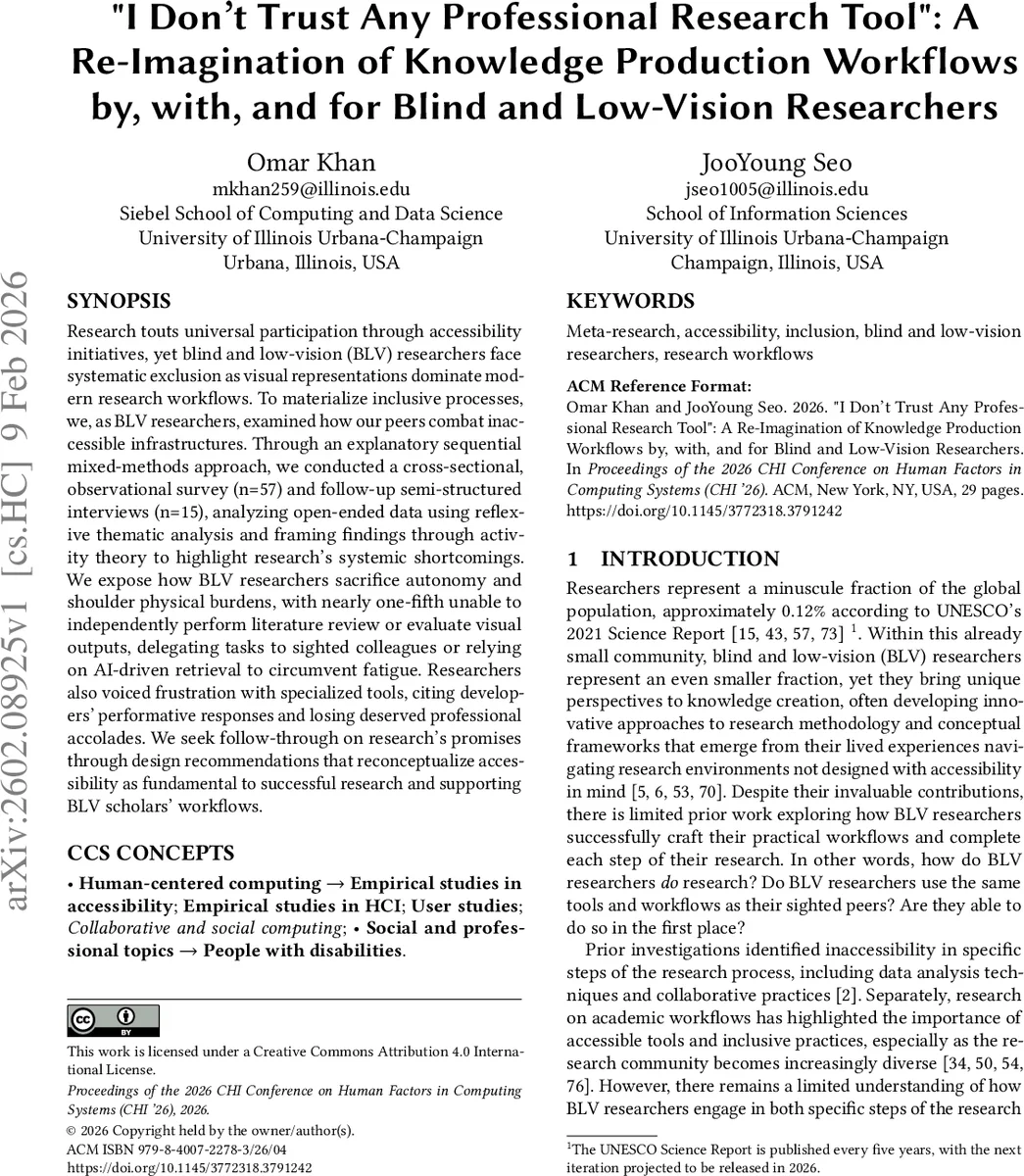
Research touts universal participation through accessibility initiatives, yet blind and low-vision (BLV) researchers face systematic exclusion as visual representations dominate modern research workflows. To materialize inclusive processes, we, as BLV researchers, examined how our peers combat inaccessible infrastructures. Through an explanatory sequential mixed-methods approach, we conducted a cross-sectional, observational survey (n=57) and follow-up semi-structured interviews (n=15), analyzing open-ended data using reflexive thematic analysis and framing findings through activity theory to highlight research’s systemic shortcomings. We expose how BLV researchers sacrifice autonomy and shoulder physical burdens, with nearly one-fifth unable to independently perform literature review or evaluate visual outputs, delegating tasks to sighted colleagues or relying on AI-driven retrieval to circumvent fatigue. Researchers also voiced frustration with specialized tools, citing developers’ performative responses and losing deserved professional accolades. We seek follow-through on research’s promises through design recommendations that reconceptualize accessibility as fundamental to successful research and supporting BLV scholars’ workflows.
💡 Research Summary
The paper investigates the systemic exclusion of blind and low‑vision (BLV) researchers in contemporary research workflows, which are heavily dominated by visual representations and tools. Using a community‑driven, explanatory sequential mixed‑methods design, the authors first surveyed 57 BLV scholars about the tools they use, the accessibility challenges they encounter, and the impact on their work. Follow‑up semi‑structured interviews with 15 participants provided deeper insight into coping strategies and lived experiences. Open‑ended responses were analyzed through reflexive thematic analysis and interpreted with activity theory, which frames research as an activity system comprising six interrelated components: subject, tool, rules, community, division of labor, and object.
Key findings reveal that BLV researchers face pervasive barriers across all stages of the research pipeline. In literature review, nearly one‑fifth cannot independently interpret graphs, charts, or visual abstracts, relying instead on sighted collaborators or AI‑driven image‑to‑text services. During data collection and analysis, mainstream statistical (e.g., SPSS) and qualitative (e.g., NVivo) software lack screen‑reader compatibility, forcing users to develop undocumented workarounds or to outsource analysis tasks. Manuscript preparation is hampered by journal mandates for high‑resolution figures, color‑coded visualizations, and LaTeX‑generated PDFs that are often inaccessible without semantic markup such as MathML. These tool‑related mismatches generate contradictions between the “rules” (publication standards) and the “object” (knowledge production), compelling BLV scholars to assume additional invisible labor—explaining visual content, creating alternative descriptions, and negotiating authorship roles.
The study quantifies the impact: participants report an average 20‑30 % increase in time required to complete tasks, reduced perceived professional competence, and heightened mental fatigue and physical strain (e.g., eye strain, awkward postures). Interviewees criticize developers for performative accessibility fixes that do not address real‑world usability, and they note that institutional policies rarely enforce accessibility audits, leading to a “ableist infrastructure” that systematically marginalizes disabled scholars.
From a systemic perspective, the authors argue that these barriers are not isolated technical bugs but structural contradictions within the activity system. Inaccessible collaborative platforms disrupt the division of labor, while non‑accessible conference formats and field‑work sites amplify exclusion through multiplicative effects. The paper therefore reframes accessibility from an individual accommodation issue to a fundamental design principle essential for robust, inclusive research.
Three actionable recommendations are proposed: (1) Tool developers should embed “visual‑independent” interfaces as a baseline, ensuring full screen‑reader compatibility and providing accessible APIs; (2) Academic publishers must mandate alternative text, machine‑readable data, and semantic markup for all visual elements, integrating accessibility checks into peer review; (3) Institutions should establish dedicated accessibility support units, allocate budget for physical and digital infrastructure upgrades, and embed accessibility criteria into hiring, promotion, and grant evaluation processes.
By documenting BLV researchers’ lived experiences and situating them within activity theory, the paper contributes empirical evidence of systemic barriers, a theoretical analysis of why these barriers persist, and concrete design and policy recommendations. It ultimately calls for a paradigm shift that treats accessibility as a core component of research excellence rather than a peripheral accommodation.
Comments & Academic Discussion
Loading comments...
Leave a Comment