FreqLens: Interpretable Frequency Attribution for Time Series Forecasting
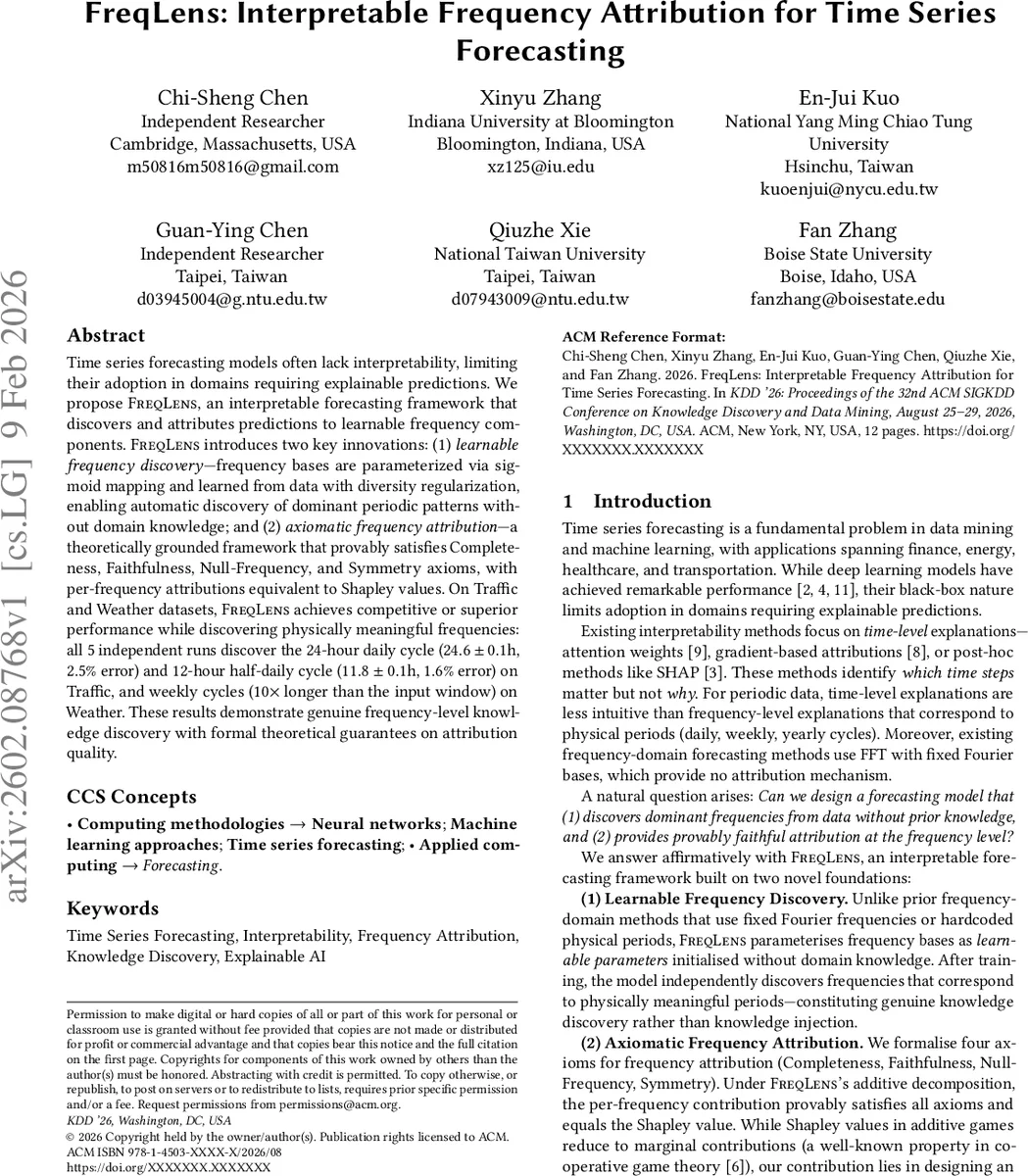
Time series forecasting models often lack interpretability, limiting their adoption in domains requiring explainable predictions. We propose \textsc{FreqLens}, an interpretable forecasting framework that discovers and attributes predictions to learnable frequency components. \textsc{FreqLens} introduces two key innovations: (1) \emph{learnable frequency discovery} – frequency bases are parameterized via sigmoid mapping and learned from data with diversity regularization, enabling automatic discovery of dominant periodic patterns without domain knowledge; and (2) \emph{axiomatic frequency attribution} – a theoretically grounded framework that provably satisfies Completeness, Faithfulness, Null-Frequency, and Symmetry axioms, with per-frequency attributions equivalent to Shapley values. On Traffic and Weather datasets, \textsc{FreqLens} achieves competitive or superior performance while discovering physically meaningful frequencies: all 5 independent runs discover the 24-hour daily cycle ($24.6 \pm 0.1$h, 2.5% error) and 12-hour half-daily cycle ($11.8 \pm 0.1$h, 1.6% error) on Traffic, and weekly cycles ($10\times$ longer than the input window) on Weather. These results demonstrate genuine frequency-level knowledge discovery with formal theoretical guarantees on attribution quality.
💡 Research Summary
FreqLens addresses the long‑standing interpretability gap in time‑series forecasting by jointly learning a set of frequency bases and providing rigorous, frequency‑level attributions for each forecast. The method consists of two novel components. First, instead of relying on fixed Fourier or wavelet bases, it parameterizes N candidate frequencies through a sigmoid mapping f_i = f_min + (f_max‑f_min)·σ(θ_i), where θ_i are learnable scalars. This mapping guarantees that each frequency stays within a predefined interval
Comments & Academic Discussion
Loading comments...
Leave a Comment