Benchmarking Autonomous Vehicles: A Driver Foundation Model Framework
Autonomous vehicles (AVs) are poised to revolutionize global transportation systems. However, its widespread acceptance and market penetration remain significantly below expectations. This gap is primarily driven by persistent challenges in safety, comfort, commuting efficiency and energy economy when compared to the performance of experienced human drivers. We hypothesize that these challenges can be addressed through the development of a driver foundation model (DFM). Accordingly, we propose a framework for establishing DFMs to comprehensively benchmark AVs. Specifically, we describe a large-scale dataset collection strategy for training a DFM, discuss the core functionalities such a model should possess, and explore potential technical solutions to realize these functionalities. We further present the utility of the DFM across the operational spectrum, from defining human-centric safety envelopes to establishing benchmarks for energy economy. Overall, We aim to formalize the DFM concept and introduce a new paradigm for the systematic specification, verification and validation of AVs.
💡 Research Summary
The paper proposes a Driver Foundation Model (DFM) as a comprehensive benchmark for autonomous vehicles (AVs), addressing the persistent gaps in safety, comfort, commuting efficiency, and energy economy that hinder widespread acceptance. Recognizing the limitations of existing driver models—chiefly their rule‑based nature, narrow multi‑agent scope, and poor generalization across diverse operational design domains (ODDs)—the authors introduce a data‑driven, multimodal framework that captures human driving behavior at scale and uses it to define human‑centric performance envelopes for AVs.
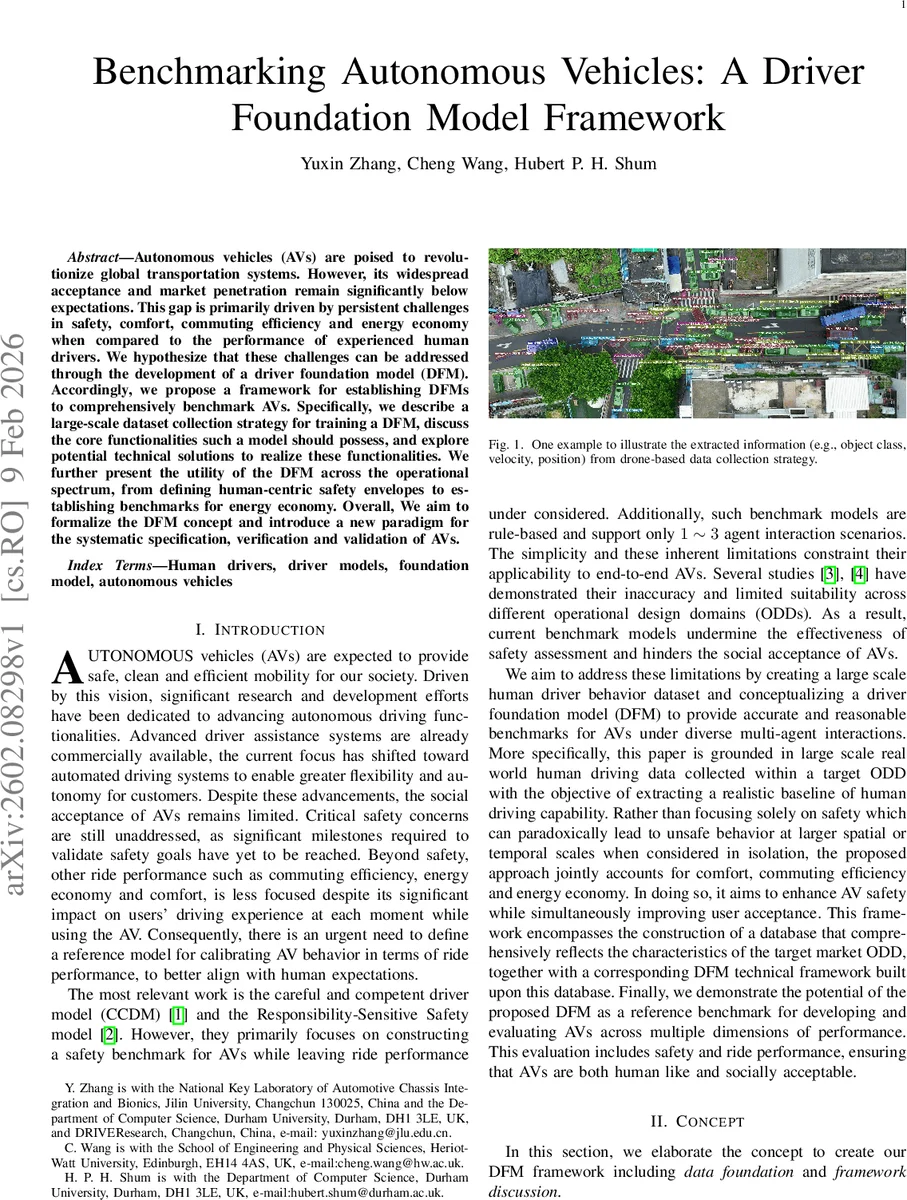
Data collection is performed via aerial drones that hover over road segments, recording high‑resolution video. A processing pipeline (video correction, object detection, tracking, smoothing) extracts continuous trajectories (position, velocity, yaw) for all road users. By January 2026 the authors have amassed over 7.5 million trajectories, covering an extensive set of urban scenarios: residential streets, arterial roads, intersections, on‑ramps, expressways, off‑ramps, roundabouts, accident/construction zones, icy/snowy conditions, and parking lots. The top‑down perspective eliminates occlusions and sensor bias inherent to ego‑vehicle datasets, enabling precise observation of multi‑agent interactions and long‑horizon decision making. The dataset is partially open‑sourced, and the authors suggest generative models to synthesize rare events for further diversity.
The DFM is defined around five core questions—How, What, Where, When, Why—each mapping to a specific output: (1) “How” provides reference trajectories that reproduce human driving in a given scenario; (2) “What” yields statistical distributions of key metrics (e.g., time‑to‑collision, velocity, jerk), forming a “competence envelope”; (3) “Where” pinpoints spatial hotspots that trigger distinct behaviors; (4) “When” identifies temporal triggers (e.g., weather thresholds) for maneuver transitions; (5) “Why” offers causal explanations by highlighting the most influential environmental cues.
To realize these functionalities, the authors design a multimodal encoder–multitask decoder architecture. The encoder comprises four sub‑encoders: a language encoder (pre‑trained LLM such as GPT) to parse user queries; a trajectory encoder for kinematic data of multiple agents; an attribute encoder for vehicle‑specific properties (size, class); and an environmental encoder for weather, lighting, and road conditions. Cross‑attention bridges or a shared latent space fuse these modalities, allowing language queries to attend selectively to spatial or environmental features.
The decoder splits the fused representation into parallel heads: a trajectory decoder that generates language‑conditioned, metric‑space trajectories (the “human‑optimal” reference); a parametric distribution head that predicts probability distributions for velocity, acceleration, jerk, etc., thereby quantifying the range of acceptable human behavior; and a spatio‑temporal attribution module that back‑projects attention weights onto the scene, answering “Where” and “Why” by visualizing causal factors. This multi‑task design enables both generative benchmarking and explainable diagnostics.
The paper then illustrates four concrete benchmark applications:
-
Safety – By synthesizing surrounding agents with varying driving styles (aggressive, cautious), the DFM enables scenario‑based stress testing of AVs, exposing robustness gaps that rule‑based CCDMs cannot capture. The competence envelope derived from human data provides formal safety specifications, while the attribution module pinpoints exact failure locations for targeted improvements.
-
Comfort – Using the parametric head, the DFM extracts human‑level longitudinal jerk and lateral acceleration distributions for maneuvers such as high‑speed merges or urban left turns. AV motion profiles can be calibrated to stay within these statistical bounds, turning the subjective notion of comfort into a quantifiable, language‑gated specification that can be verified during road testing.
-
Commuting Efficiency – The “How” and “What” outputs reveal human‑optimal velocity profiles and path‑planning strategies that maintain high progress rates without sacrificing safety. By querying “efficient goal‑reaching in dense traffic,” developers obtain benchmark travel‑time distributions for specific intersections or highway segments, ensuring AVs do not become traffic bottlenecks.
-
Energy Economy – The model identifies momentum‑conserving patterns used by expert drivers to minimize unnecessary acceleration/deceleration cycles. For heavy‑duty trucks, the DFM supplies distributions of acceleration/deceleration rates that achieve optimal fuel/energy consumption, enabling power‑train tuning for maximal range and reduced operational cost.
In conclusion, the authors argue that the DFM fills a critical void: a human‑centric, data‑rich reference model for AV evaluation that simultaneously addresses safety, comfort, efficiency, and energy use. The drone‑based data collection strategy complements existing ego‑vehicle datasets, providing a scalable foundation for future mobility research. The paper calls for a concrete technical roadmap and collaborative efforts with industry, academia, and regulators to turn the DFM into a standardized benchmark tool, thereby accelerating the social and technical acceptance of autonomous vehicles.
Comments & Academic Discussion
Loading comments...
Leave a Comment