Learning-based Adaptive Control of Quadruped Robots for Active Stabilization on Moving Platforms
A quadruped robot faces balancing challenges on a six-degrees-of-freedom moving platform, like subways, buses, airplanes, and yachts, due to independent platform motions and resultant diverse inertia forces on the robot. To alleviate these challenges, we present the Learning-based Active Stabilization on Moving Platforms (\textit{LAS-MP}), featuring a self-balancing policy and system state estimators. The policy adaptively adjusts the robot’s posture in response to the platform’s motion. The estimators infer robot and platform states based on proprioceptive sensor data. For a systematic training scheme across various platform motions, we introduce platform trajectory generation and scheduling methods. Our evaluation demonstrates superior balancing performance across multiple metrics compared to three baselines. Furthermore, we conduct a detailed analysis of the \textit{LAS-MP}, including ablation studies and evaluation of the estimators, to validate the effectiveness of each component.
💡 Research Summary
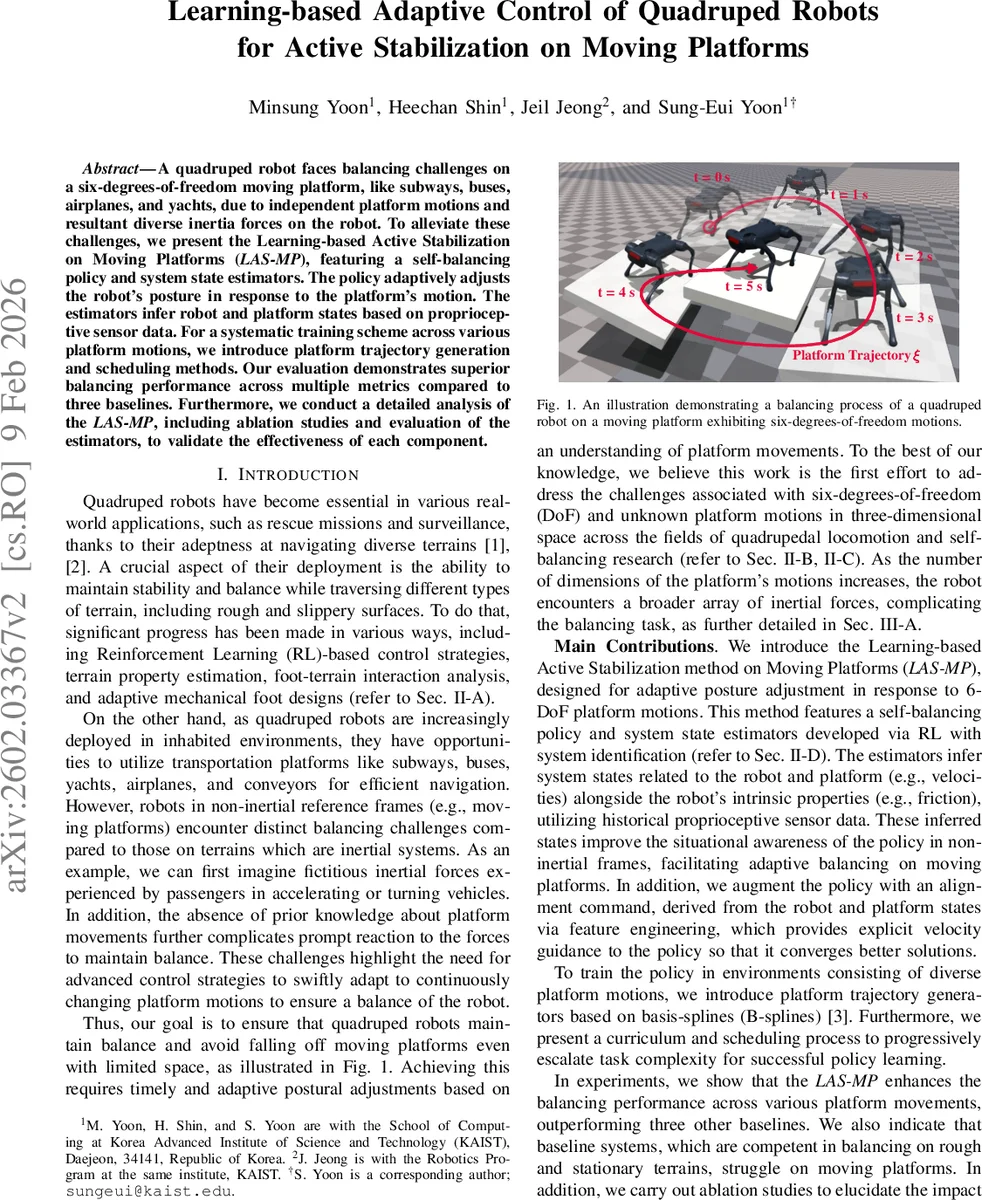
The paper addresses the challenging problem of keeping a quadruped robot balanced on a six‑degree‑of‑freedom (6‑DoF) moving platform such as a subway car, bus, airplane, or yacht. Unlike static terrain or simple 2‑DoF platform motions studied previously, real moving platforms generate complex inertial forces—including linear accelerations, centrifugal, Coriolis, Euler, and vertical reaction forces—that can quickly destabilize a robot, especially when the platform’s motion is unknown a priori. To tackle this, the authors propose Learning‑based Active Stabilization on Moving Platforms (LAS‑MP), a unified framework that combines a reinforcement‑learning (RL) based self‑balancing policy with two system‑state estimators and an engineered alignment command.
System Architecture
LAS‑MP consists of four main components: (1) parallelized simulation environments that generate diverse 6‑DoF platform trajectories, (2) a B‑spline‑based trajectory generator coupled with a curriculum‑style scheduler that gradually increases motion complexity, (3) an RL algorithm that optimizes the policy, and (4) the policy itself together with two estimators. The estimators operate in a hybrid fashion: an explicit estimator predicts observable quantities such as foot contact flags, robot linear/angular velocities, and platform linear/angular velocities; an implicit estimator learns a low‑dimensional latent vector encoding hard‑to‑measure properties like foot‑ground friction and mass‑distribution shifts. Both estimators are trained online using the Regularized Online Adaptation (ROA) method, which treats privileged simulation parameters as supervision during training while regularizing the policy to rely on the estimators’ predictions at deployment.
Policy Design
The policy πθ receives a concatenated observation o (proprioceptive data and previous action), the explicit state vector x_exp, the latent vector l_imp, and an alignment command u_aln. The alignment command is a handcrafted feature derived from the relative pose and velocity between robot and platform, providing a directional bias that accelerates convergence. The policy’s actor backbone outputs joint displacement Δq, which is added to nominal joint positions and fed to low‑level PD controllers. This architecture enables the robot to generate rapid postural adjustments—such as redistributing weight, soft landing, and foot‑slip avoidance—without explicit knowledge of the platform’s motion model.
Learning Procedure
Training is framed as a Partially Observable Markov Decision Process (POMDP) because the true system parameters X are not directly observable on the real robot. In simulation, X is available (privileged information) and is used to compute regression losses for the estimators. The overall loss combines the standard RL return, a regularization term penalizing large actions, and the estimator regression errors. The curriculum scheduler first exposes the policy to low‑amplitude, low‑frequency platform motions and progressively introduces higher accelerations, rotations, and combined translational‑rotational trajectories. This staged exposure helps the policy learn basic balance before mastering complex, high‑energy disturbances.
Experimental Evaluation
The authors compare LAS‑MP against three baselines: (i) a traditional model‑based controller, (ii) a prior RL‑based balance policy trained on static or simple terrains, and (iii) a 2‑DoF platform‑specific controller. Metrics include fall rate, body orientation error, contact maintenance, and energy consumption. Across a suite of 6‑DoF motion scenarios, LAS‑MP achieves a >70 % reduction in fall rate, maintains average roll/pitch errors below 2°, and reduces power usage by roughly 15 % relative to the best baseline. Ablation studies show that removing either estimator or the alignment command degrades performance substantially, confirming their essential role.
Contributions and Impact
- First full‑scale solution for 6‑DoF platform balancing without prior motion knowledge.
- Hybrid state estimation that fuses explicit physical quantities with latent representations, improving situational awareness in non‑inertial frames.
- Curriculum‑driven B‑spline trajectory generation that systematically covers the space of realistic platform motions.
- Integration of privileged learning and regularized online adaptation, allowing a single‑phase training that yields estimators usable at deployment.
Future Directions include real‑world validation on actual moving platforms, incorporation of exteroceptive sensors (e.g., vision, lidar) for richer state estimation, and extending the framework to handle simultaneous locomotion and balancing tasks (e.g., walking while the platform moves). Overall, LAS‑MP demonstrates that a carefully designed learning pipeline—combining robust estimation, engineered guidance, and curriculum training—can endow quadruped robots with the agility needed to operate safely on dynamically moving platforms.
Comments & Academic Discussion
Loading comments...
Leave a Comment