Neural MJD: Neural Non-Stationary Merton Jump Diffusion for Time Series Prediction
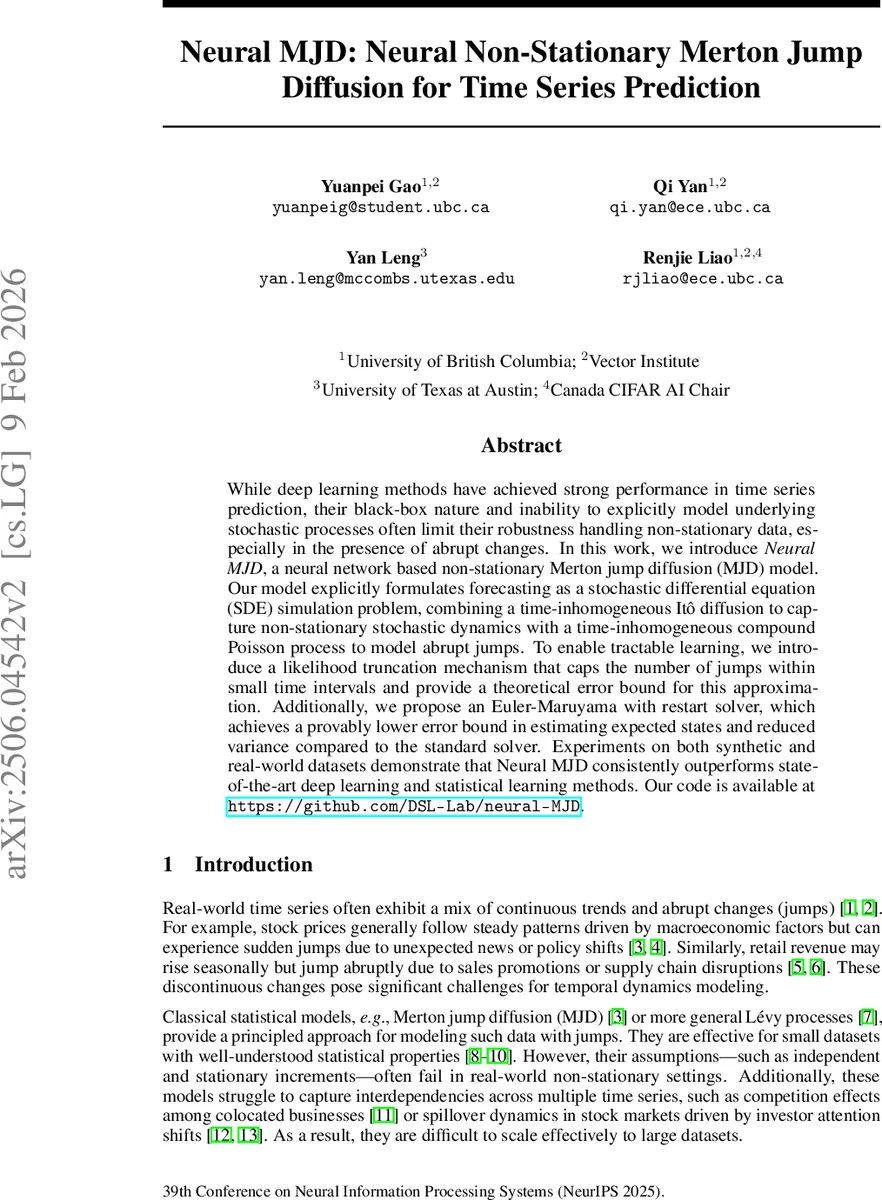
While deep learning methods have achieved strong performance in time series prediction, their black-box nature and inability to explicitly model underlying stochastic processes often limit their generalization to non-stationary data, especially in the presence of abrupt changes. In this work, we introduce Neural MJD, a neural network based non-stationary Merton jump diffusion (MJD) model. Our model explicitly formulates forecasting as a stochastic differential equation (SDE) simulation problem, combining a time-inhomogeneous Itô diffusion to capture non-stationary stochastic dynamics with a time-inhomogeneous compound Poisson process to model abrupt jumps. To enable tractable learning, we introduce a likelihood truncation mechanism that caps the number of jumps within small time intervals and provide a theoretical error bound for this approximation. Additionally, we propose an Euler-Maruyama with restart solver, which achieves a provably lower error bound in estimating expected states and reduced variance compared to the standard solver. Experiments on both synthetic and real-world datasets demonstrate that Neural MJD consistently outperforms state-of-the-art deep learning and statistical learning methods.
💡 Research Summary
Neural MJD introduces a novel approach to time‑series forecasting that explicitly models both continuous stochastic dynamics and abrupt jumps through a non‑stationary Merton jump‑diffusion (MJD) stochastic differential equation (SDE). Traditional MJD assumes constant drift, volatility, jump intensity, and jump‑size distribution parameters, which limits its applicability to real‑world data where these characteristics evolve over time. Neural MJD addresses this limitation by parameterizing the time‑varying drift μₜ, volatility σₜ, jump intensity λₜ, and log‑normal jump‑size parameters νₜ and γₜ with a single neural network fθ. The network receives the past observations {S₋Tp,…,S₀} together with optional contextual features C and outputs the full set of SDE coefficients for every future time step. This amortized inference enables a single model to be trained across many series while still providing series‑specific, time‑dependent dynamics.
The core SDE of Neural MJD is:
dSₜ = Sₜ
Comments & Academic Discussion
Loading comments...
Leave a Comment