Functional Critics Are Essential for Actor-Critic: From Off-Policy Stability to Efficient Exploration
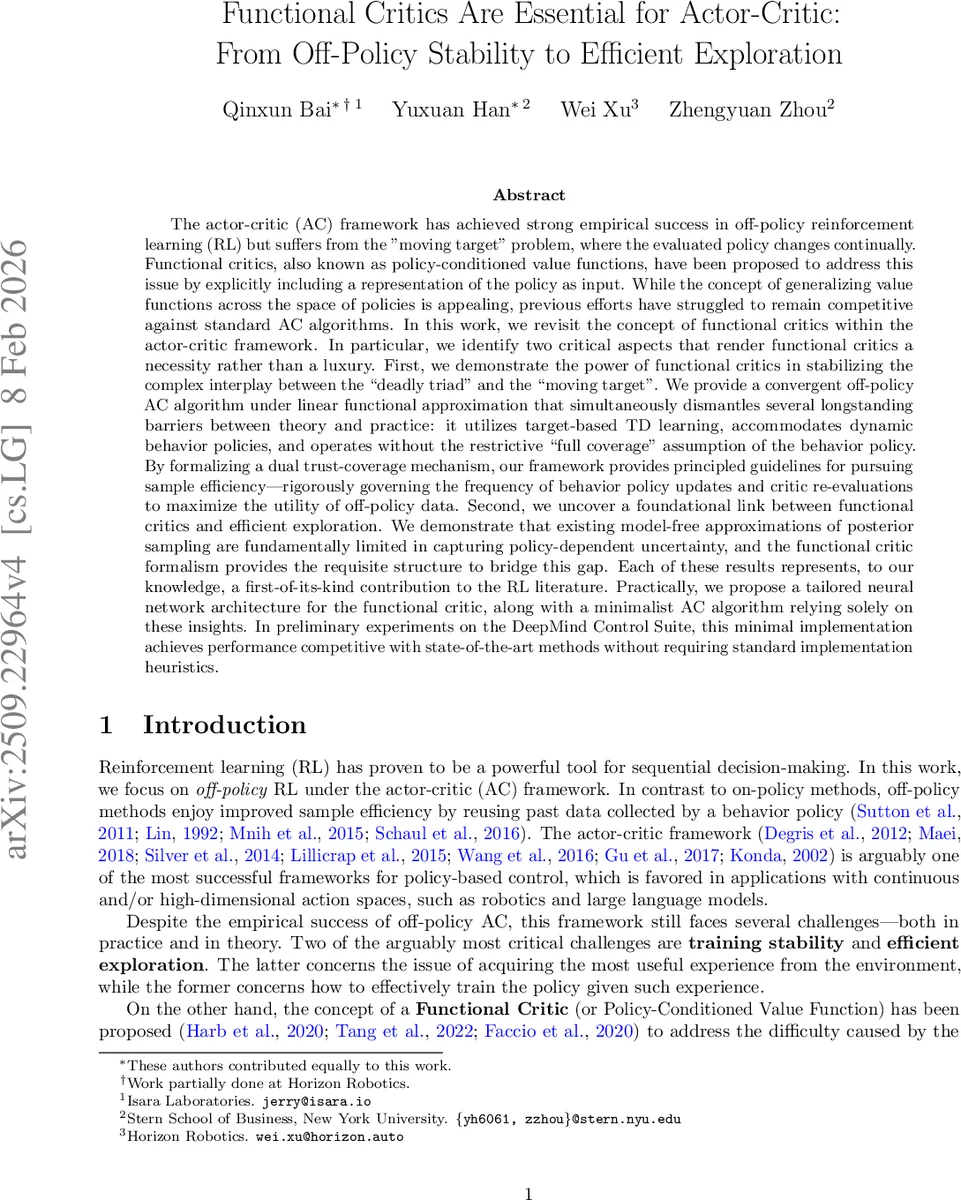
The actor-critic (AC) framework has achieved strong empirical success in off-policy reinforcement learning but suffers from the “moving target” problem, where the evaluated policy changes continually. Functional critics, or policy-conditioned value functions, address this by explicitly including a representation of the policy as input. While conceptually appealing, previous efforts have struggled to remain competitive against standard AC. In this work, we revisit functional critics within the actor-critic framework and identify two critical aspects that render them a necessity rather than a luxury. First, we demonstrate their power in stabilizing the complex interplay between the “deadly triad” and the “moving target”. We provide a convergent off-policy AC algorithm under linear functional approximation that dismantles several longstanding barriers between theory and practice: it utilizes target-based TD learning, accommodates dynamic behavior policies, and operates without the restrictive “full coverage” assumptions. By formalizing a dual trust-coverage mechanism, our framework provides principled guidelines for pursuing sample efficiency-rigorously governing behavior policy updates and critic re-evaluations to maximize off-policy data utility. Second, we uncover a foundational link between functional critics and efficient exploration. We demonstrate that existing model-free approximations of posterior sampling are limited in capturing policy-dependent uncertainty, a gap the functional critic formalism bridges. These results represent, to our knowledge, first-of-their-kind contributions to the RL literature. Practically, we propose a tailored neural network architecture and a minimalist AC algorithm. In preliminary experiments on the DeepMind Control Suite, this implementation achieves performance competitive with state-of-the-art methods without standard implementation heuristics.
💡 Research Summary
The paper revisits functional critics—value functions that explicitly take a policy representation as an input—and demonstrates that they are not a mere convenience but a necessity for modern off‑policy actor‑critic (AC) reinforcement learning. The authors first identify two intertwined challenges that have limited the stability and sample efficiency of off‑policy AC: the “deadly triad” (function approximation, off‑policy learning, and bootstrapping) and the “moving target” problem (the critic must constantly track a changing policy). By augmenting the critic with the policy itself, i.e., learning a global mapping Q(s, a, π), the need to relearn a new value function after each policy update disappears, and the critic can be trained with a target‑based temporal‑difference (TD) scheme that remains stable under function approximation.
The theoretical contribution is a convergence proof for a target‑based off‑policy AC algorithm under linear functional approximation that relaxes three long‑standing practical constraints: (1) it works with dynamically changing behavior policies rather than a fixed μ; (2) it does not require the restrictive full‑coverage assumption (μ(a|s) > 0 for all state‑action pairs); and (3) it avoids the heavy machinery of Gradient‑TD or Emphatic‑TD. Central to the analysis is a novel “dual trust‑coverage” mechanism. The first metric, evaluation trust C(k), quantifies how well the current behavior policy covers the features of the target policy, guaranteeing that the off‑policy data are informative enough for the functional critic. The second metric, gradient trust Δ_{k,t}, monitors the deviation between the anchored critic (trained on past data) and the current policy gradient; when this deviation exceeds a threshold, the critic is re‑evaluated. Together these metrics automatically determine (i) how long a behavior policy can be reused for data collection before it must be updated, and (ii) how many gradient steps the actor can safely take before the critic needs to be refreshed. This yields a principled, sample‑efficient schedule that bridges the gap between theory and practice.
Beyond stability, the paper establishes a foundational link between functional critics and efficient exploration. Model‑free approximations of Posterior Sampling Reinforcement Learning (PSRL) typically rely on ensembles or randomized priors, which cannot capture policy‑dependent uncertainty. Because a functional critic models the entire mapping from the policy manifold to the value space, it can be treated as a Bayesian posterior over Q‑functions conditioned on π. By sampling the critic’s parameters from this posterior and using the sampled Q(s,a,π) to derive a policy, the algorithm performs true posterior‑sampling exploration within the AC framework, without needing an explicit model of the environment. This addresses a major limitation of existing model‑free exploration schemes and provides a theoretically sound, scalable alternative.
Empirically, the authors implement a minimalist neural architecture for the functional critic: a policy encoder that embeds the current policy parameters into a low‑dimensional vector, and a value decoder that combines this embedding with state‑action features to output Q(s,a,π). They deliberately omit common deep‑RL heuristics such as twin‑Q networks, action‑space noise, and entropy regularization. Despite this stripped‑down design, the method matches or exceeds the performance of state‑of‑the‑art off‑policy algorithms (SAC, TD3, DDPG) on a suite of continuous control tasks from the DeepMind Control Suite. The experiments demonstrate that the dual trust‑coverage schedule indeed allows the behavior policy to track the target policy closely while still providing sufficient exploration, confirming the theoretical claims.
In summary, the paper makes four major contributions: (1) it provides the first convergence guarantee for a target‑based off‑policy AC algorithm that incorporates functional critics, dynamic behavior policies, and partial coverage; (2) it introduces a dual trust‑coverage framework that rigorously governs behavior‑policy updates and critic re‑evaluations, thereby maximizing off‑policy data utility; (3) it reveals that functional critics are the missing ingredient for model‑free posterior‑sampling exploration, enabling principled uncertainty‑aware exploration in high‑dimensional continuous domains; and (4) it validates these ideas with a clean, heuristic‑free implementation that achieves competitive results on benchmark tasks. These contributions narrow the longstanding gap between reinforcement‑learning theory and practice and propose a new paradigm for building stable, sample‑efficient, and exploration‑effective actor‑critic agents.
Comments & Academic Discussion
Loading comments...
Leave a Comment