On Time-Changed Birth-Death Processes with Catastrophes
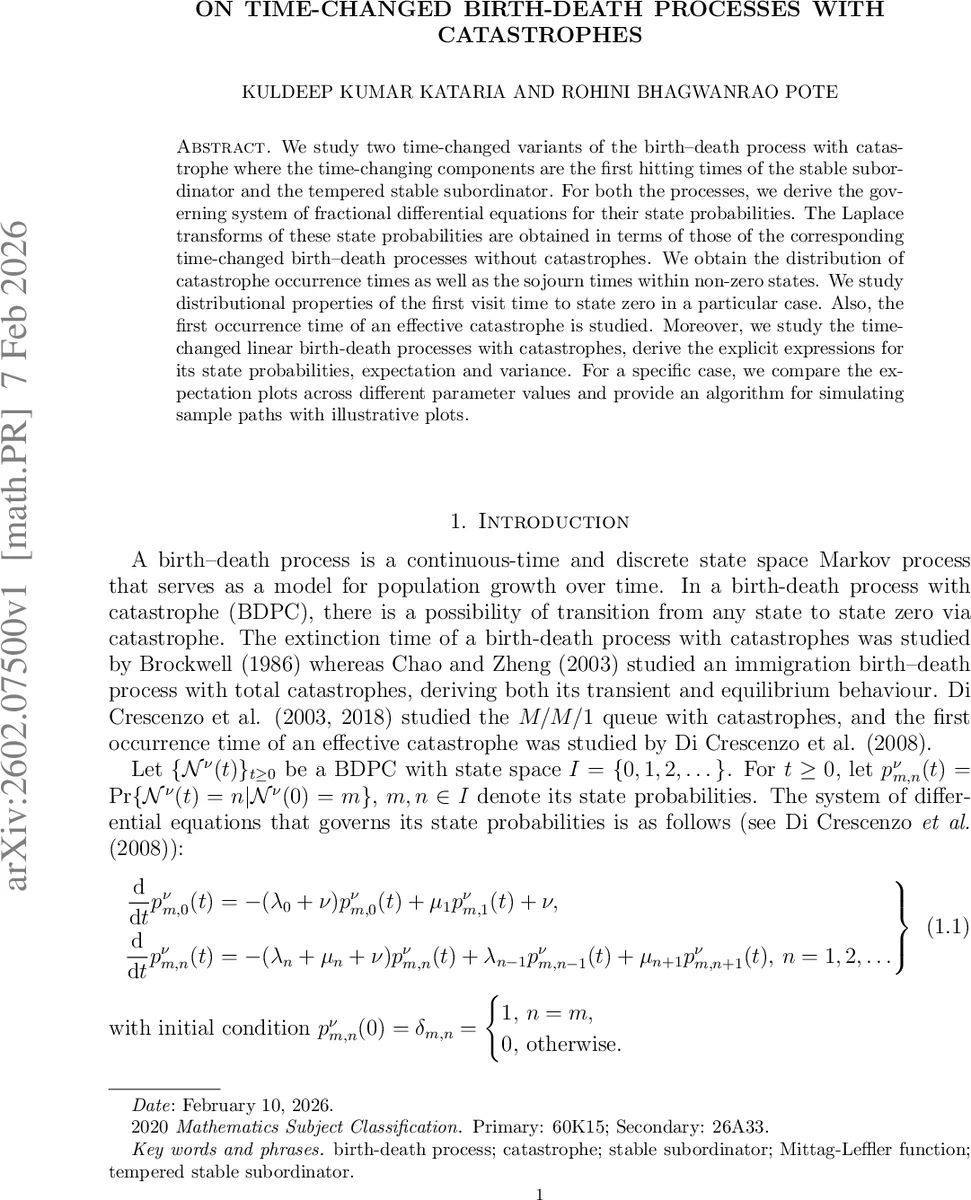
We study two time-changed variants of the birth-death process with catastrophe where the time-changing components are the first hitting times of the stable subordinator and the tempered stable subordinator. For both the processes, we derive the governing system of fractional differential equations for their state probabilities. The Laplace transforms of these state probabilities are obtained in terms of those of the corresponding time-changed birth-death processes without catastrophes. We obtain the distribution of catastrophe occurrence times as well as the sojourn times within non-zero states. We study distributional properties of the first visit time to state zero in a particular case. Also, the first occurrence time of an effective catastrophe is studied. Moreover, we study the time-changed linear birth-death processes with catastrophes, derive the explicit expressions for its state probabilities, expectation and variance. For a specific case, we compare the expectation plots across different parameter values and provide an algorithm for simulating sample paths with illustrative plots.
💡 Research Summary
This paper introduces and thoroughly investigates two time‑changed variants of the classical birth‑death process with catastrophes (BDPC). The time‑changing mechanisms are the first hitting times of (i) a stable subordinator and (ii) a tempered stable subordinator, known respectively as the inverse stable subordinator Yα(t) and the inverse tempered stable subordinator Yθ,α(t). By composing the original BDPC Nν(t) with these non‑decreasing processes, the authors define the time‑changed BDPCs Nα,ν(t)=Nν(Yα(t)) and Nθ,α,ν(t)=Nν(Yθ,α(t)). Because the time‑change is independent of the underlying Markov chain, the resulting processes are semi‑Markov and inherit the same state‑space transition structure while exhibiting random, non‑linear time flow.
The core theoretical contribution is the derivation of governing fractional differential equations for the state probabilities pα,ν,m,n(t)=Pr{Nα,ν(t)=n|Nα,ν(0)=m}. Using the Caputo fractional derivative of order α∈(0,1] the authors obtain a system (3.4) that generalises the classical Kolmogorov forward equations (1.1). When α=1 the system collapses to the ordinary BDPC equations; when ν=0 it reduces to the time‑changed birth‑death process without catastrophes. For the tempered case, the Caputo‑tempered derivative dθ,α/dtθ,α appears, yielding an analogous system.
Laplace transform techniques reveal a simple relationship between the transformed state probabilities of the time‑changed and the original processes:
\
Comments & Academic Discussion
Loading comments...
Leave a Comment