Information Theoretic Modeling of Interspecies Molecular Communication
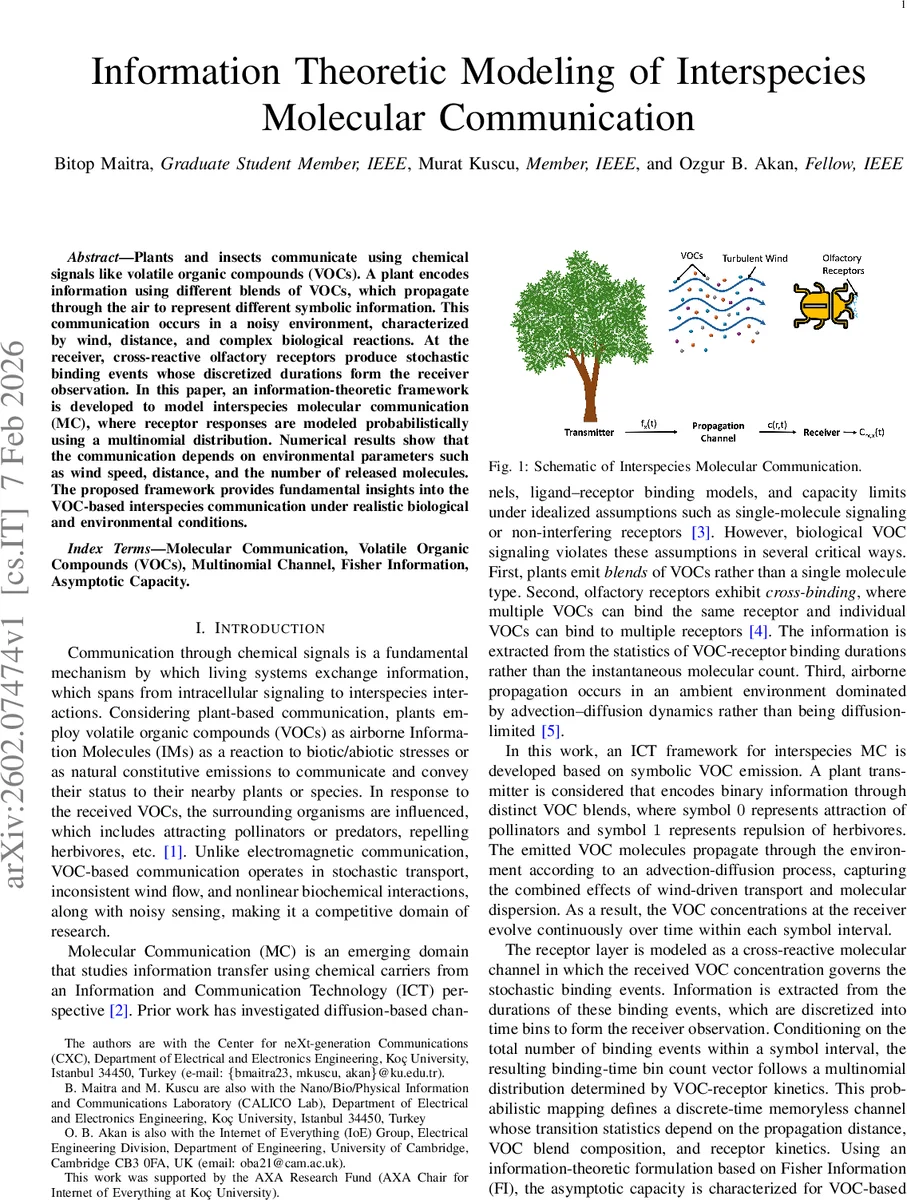
Plants and insects communicate using chemical signals like volatile organic compounds (VOCs). A plant encodes information using different blends of VOCs, which propagate through the air to represent different symbolic information. This communication occurs in a noisy environment, characterized by wind, distance, and complex biological reactions. At the receiver, cross-reactive olfactory receptors produce stochastic binding events whose discretized durations form the receiver observation. In this paper, an information-theoretic framework is developed to model interspecies molecular communication (MC), where receptor responses are modeled probabilistically using a multinomial distribution. Numerical results show that the communication depends on environmental parameters such as wind speed, distance, and the number of released molecules. The proposed framework provides fundamental insights into the VOC-based interspecies communication under realistic biological and environmental conditions.
💡 Research Summary
This paper presents an information‑theoretic framework for modeling interspecies molecular communication (MC) between plants and insects mediated by volatile organic compounds (VOCs). The authors consider a binary signaling scheme in which a plant transmitter releases a burst of VOC molecules to encode two symbols: “0” (attract pollinators) and “1” (repel herbivores). Each symbol is represented by a distinct blend of six VOC species (β‑Ionone, MeSA, Geraniol, Limonene, β‑Caryophyllene, β‑Ocimene). The blend is described by a probability vector ρₓ (x∈{0,1}) with Σρₓ,i=1; a continuous blend parameter s∈
Comments & Academic Discussion
Loading comments...
Leave a Comment