Bonsai: Intentional and Personalized Social Media Feeds
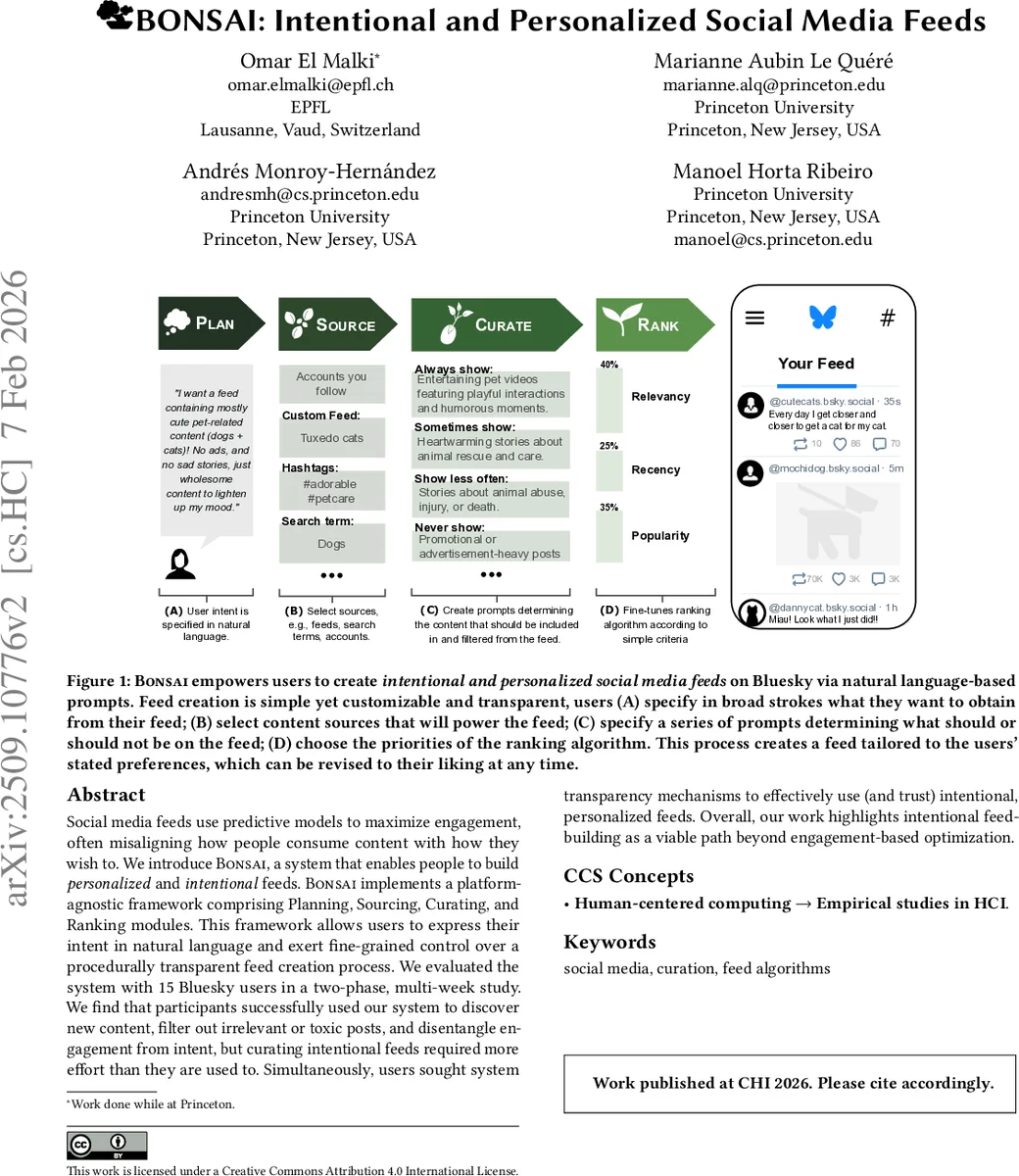
Social media feeds use predictive models to maximize engagement, often misaligning how people consume content with how they wish to. We introduce Bonsai, a system that enables people to build personalized and intentional feeds. Bonsai implements a platform-agnostic framework comprising Planning, Sourcing, Curating, and Ranking modules. This framework allows users to express their intent in natural language and exert fine-grained control over a procedurally transparent feed creation process. We evaluated the system with 15 Bluesky users in a two-phase, multi-week study. We find that participants successfully used our system to discover new content, filter out irrelevant or toxic posts, and disentangle engagement from intent, but curating intentional feeds required more effort than they are used to. Simultaneously, users sought system transparency mechanisms to effectively use (and trust) intentional, personalized feeds. Overall, our work highlights intentional feedbuilding as a viable path beyond engagement-based optimization.
💡 Research Summary
The paper presents Bonsai, a novel system that lets users build intentional and personalized social media feeds by expressing their goals in natural language. Traditional social media feeds rely on predictive models that maximize engagement, often leading to a mismatch between what users actually want and what they end up consuming. Bonsai addresses this gap by introducing a platform‑agnostic four‑stage framework: Planning, Sourcing, Curating, and Ranking. In the Planning stage, a large language model (LLM) parses a user’s free‑form description into candidate sources, inclusion and exclusion keywords, and filtering rules. The Sourcing stage gathers posts from various channels on Bluesky—feeds, lists, hashtags, search queries, and pre‑scraped databases—while recording metadata such as timestamps and popularity. In the Curating stage, a second LLM scores each candidate post against the user‑specified prompts (e.g., “show cute pet videos, hide ads and sad stories”), effectively translating high‑level intent into low‑level relevance scores. Finally, the Ranking stage orders the posts according to user‑defined trade‑offs among relevance, recency, and popularity, producing a feed that directly reflects the articulated intent rather than inferred engagement likelihood.
Bonsai was implemented for the decentralized platform Bluesky and evaluated with fifteen participants over a multi‑week, two‑phase field study. Participants used the system to discover new content, filter out irrelevant or toxic posts, and separate engagement from intent. The study revealed several key findings. First, the natural‑language interface lowered the barrier to creating fine‑grained, intent‑driven feeds compared with existing rule‑based tools that require technical expertise. Second, while users appreciated the transparency of seeing which sources were used, which filters were applied, and how posts were ranked, they also reported higher cognitive and time costs when configuring the feed. Third, participants expressed a strong desire for more immediate feedback mechanisms—such as the ability to flag undesired items and have the system adapt in real time. Fourth, many users preferred a hybrid approach that combines intentional feeds with traditional engagement‑optimized feeds, suggesting that a single pure‑intent feed may not satisfy all usage contexts.
The authors discuss design implications: (1) transparency must be actionable, allowing users not only to view but also to edit the underlying configurations; (2) tightening the feedback loop—by automatically incorporating user corrections into the LLM’s prompting—can reduce the effort required to maintain alignment; and (3) leveraging natural language remains central, as it enables expressive, high‑level goal specification without demanding low‑level rule writing. Limitations include the additional effort needed to craft prompts and the reliance on the quality of the underlying LLM, which may occasionally misinterpret ambiguous intent.
In conclusion, Bonsai demonstrates the feasibility of LLM‑mediated, intent‑driven feed construction, offering a promising direction beyond engagement‑centric personalization. It highlights how users can regain agency over their social media experience by directly authoring the algorithmic behavior that shapes their timelines. Future work should explore automated feedback integration, longitudinal adaptation of the LLM, and broader applicability across diverse platforms.
Comments & Academic Discussion
Loading comments...
Leave a Comment