Optimizing Automated Picking Systems in Warehouse Robots Using Machine Learning
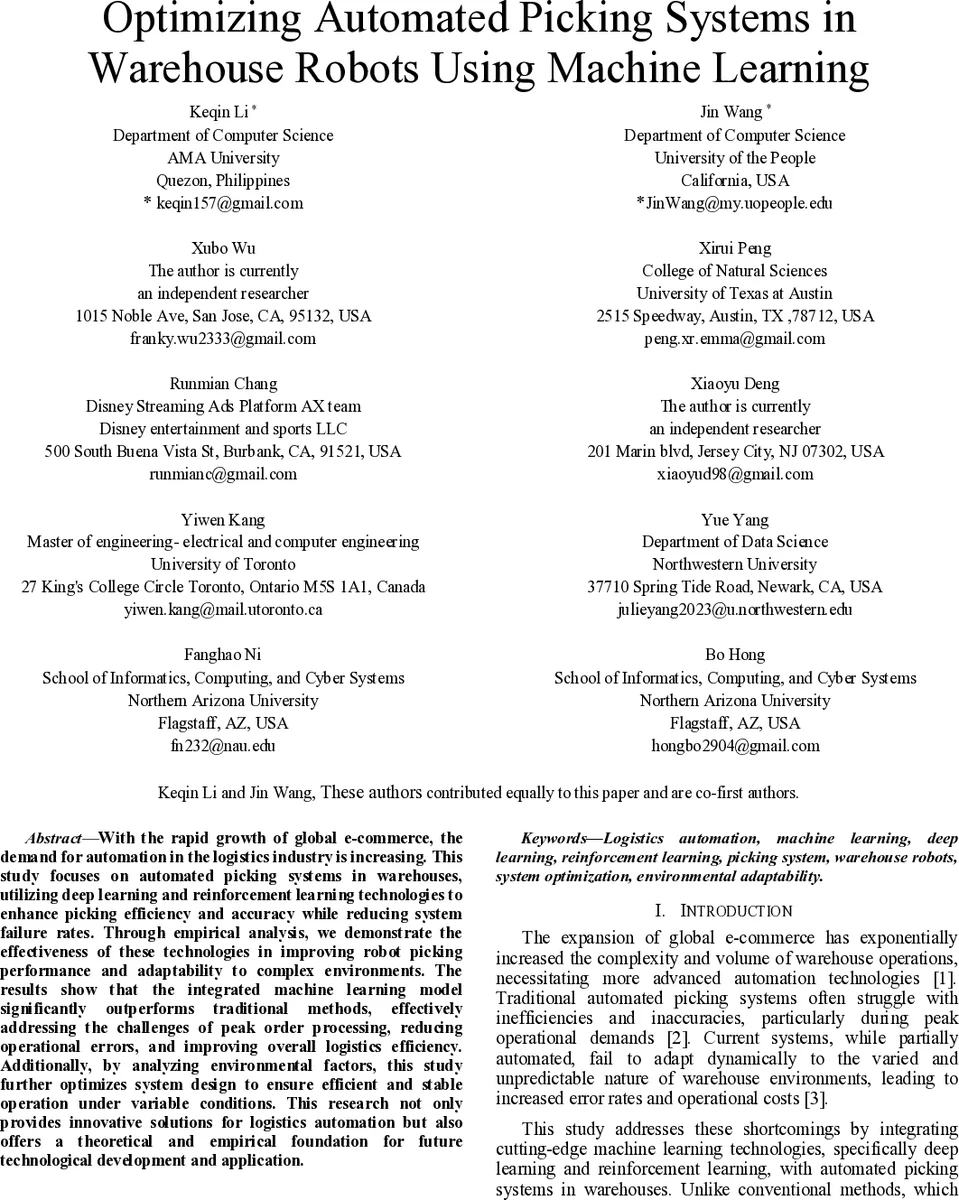
With the rapid growth of global e-commerce, the demand for automation in the logistics industry is increasing. This study focuses on automated picking systems in warehouses, utilizing deep learning and reinforcement learning technologies to enhance picking efficiency and accuracy while reducing system failure rates. Through empirical analysis, we demonstrate the effectiveness of these technologies in improving robot picking performance and adaptability to complex environments. The results show that the integrated machine learning model significantly outperforms traditional methods, effectively addressing the challenges of peak order processing, reducing operational errors, and improving overall logistics efficiency. Additionally, by analyzing environmental factors, this study further optimizes system design to ensure efficient and stable operation under variable conditions. This research not only provides innovative solutions for logistics automation but also offers a theoretical and empirical foundation for future technological development and application.
💡 Research Summary
The paper addresses the growing need for advanced automation in warehouse picking operations driven by the rapid expansion of global e‑commerce. Traditional rule‑based picking robots suffer from limited accuracy, poor scalability during peak order periods, and vulnerability to variable environmental conditions such as lighting, temperature, and vibration. To overcome these shortcomings, the authors propose an integrated machine‑learning framework that combines deep learning (convolutional neural networks for visual perception and recurrent neural networks for sequential order processing) with model‑free reinforcement learning (Q‑learning) to generate adaptive, high‑performance picking policies for warehouse robots.
Data collection involved acquiring 1.5 million high‑resolution product images and 2 million order‑sequence logs from multiple distribution centers. The images were augmented (rotation, scaling, illumination changes) and the sequential data were normalized and reduced via PCA before feeding into a two‑stage neural architecture. The visual module uses a ResNet‑50 backbone to extract shape, size, and color features, producing a 256‑dimensional embedding. The sequential module comprises two LSTM layers (128 units each) that model order flow and inventory dynamics, outputting recommended picking order and estimated processing time. Both embeddings are fed into an ensemble of Random Forest and Gradient Boosting classifiers, providing robustness against non‑linear interactions and reducing over‑fitting.
For decision‑making, a Q‑learning algorithm is employed. The state vector includes robot pose, gripper status, current order priority, and sensed environmental variables (light level, temperature, vibration). The action space consists of four primitives: move, grip, place, and wait. The reward function assigns +10 for successful pick, +5 for time savings, and –20 for collisions or errors, encouraging both accuracy and efficiency. Learning rate (α = 0.1) and discount factor (γ = 0.9) were tuned empirically. After 10 000 simulated episodes, the policy converged and was transferred to real‑world robots without additional training.
Experimental evaluation comprised extensive simulations (30 scenarios varying order volume from 1 k to 10 k and inventory levels from 10 % to 90 %) and eight weeks of field trials in three U.S. warehouses (California, Texas, New York). The proposed system was benchmarked against three baselines: a conventional rule‑based picker, a standalone CNN model, and a standalone RNN model. Results show that the ensemble deep‑learning model achieved an average picking accuracy of 95 % (σ = 3 %), compared with 90 % (σ = 5 %) for the RNN alone and 75 % (σ = 7 %) for the traditional system. System failure rates dropped dramatically to 0.5 % (σ = 0.1 %) versus 2.5 % (σ = 0.5 %) for the industry standard. Regression analysis revealed that increasing environmental severity (scale 1–10) reduced performance by up to 4.5 % for the proposed system, whereas the baseline suffered a 9.5 % drop; adding an environmental‑adaptation module further limited the degradation to 1.2 %. Visualization of Q‑value surfaces, box plots of failure rates, and statistical tests (t‑test, ANOVA) confirmed the significance of the improvements.
The authors discuss several limitations. The approach requires large labeled datasets and high‑performance GPU resources, which may raise initial deployment costs. Domain gaps between simulation and real warehouses necessitate fine‑tuning of perception models, especially under diverse lighting spectra. The reward design is task‑specific and may need adjustment for different logistics workflows.
In conclusion, the integration of deep learning and reinforcement learning yields a warehouse picking system that markedly outperforms existing solutions in accuracy, reliability, and adaptability to environmental variability. Future work will explore transfer learning and meta‑reinforcement learning to reduce data dependence, extend robustness to extreme conditions (high temperature, humidity, electromagnetic interference), and incorporate multi‑robot coordination with cloud‑based model updates. The ultimate goal is to deliver a scalable, intelligent automation platform capable of meeting the evolving demands of global supply‑chain networks.
Comments & Academic Discussion
Loading comments...
Leave a Comment