Symmetry and localisation in causally constrained quantum operator dynamics
This paper explores the connection between causality and many-body dynamics by studying the algebraic structure of tri-partite unitaries (‘walls’) which permanently arrest local operator spreading in their time-periodic evolution. We show that the resulting causally independent subsystems arise from the invariance of an embedded sub-algebra in the system (ie. a generalised symmetry) that leads to the splitting of operator space into commuting sub-algebras. The commutant structure of the invariant algebra is then used to construct local conserved quantities. Using representation theory of finite matrix algebras, the general form of wall gates is derived as unitary automorphisms. Taking causal independence as a minimal model for non-ergodic dynamics, we study its effect on probes of many-body quantum chaos. We prove an entanglement area-law due to local constraints and we study its stability against projective measurements. In a random ensemble exhibiting causal independence, we compare spectral correlations with the universal (chaotic) ensemble using the spectral form factor. Our results offer a rigorous understanding of locally constrained quantum dynamics from a quantum information perspective.
💡 Research Summary
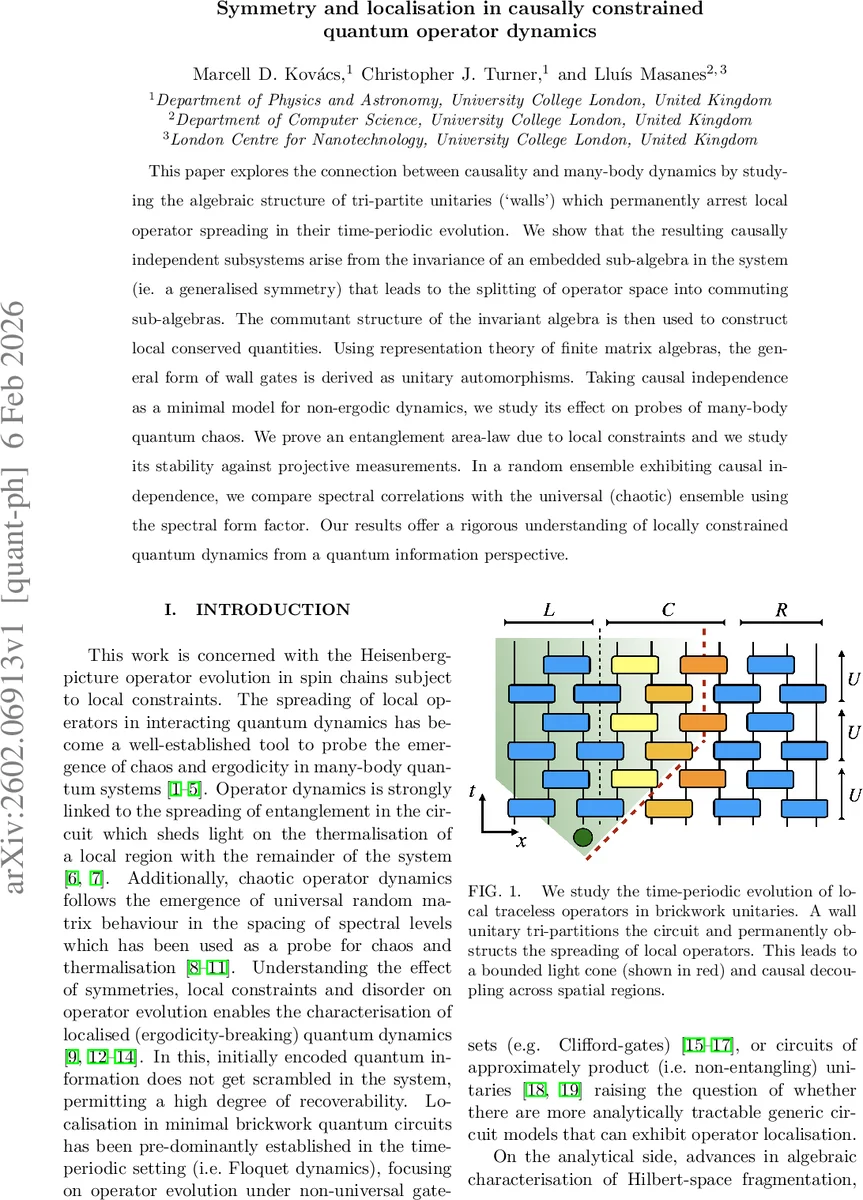
The paper investigates the algebraic underpinnings of quantum circuits that enforce a strict causal constraint, preventing the spread of local operators beyond a bounded light‑cone for arbitrarily long times. The authors focus on a three‑partite unitary—dubbed a “wall” unitary—acting on left (L), central (C), and right (R) subsystems. A wall unitary is defined by the property that any operator initially supported on L (or R) remains, under Heisenberg evolution, confined to the L‑C (or C‑R) region for all discrete time steps.
The first major result (Theorem II.1) shows that the left‑wall condition is equivalent to the right‑wall condition; both can be expressed as commutation relations between the evolved left algebra and the right algebra, and vice versa. By expanding the adjoint action Ad_U in its eigenbasis, the authors demonstrate that these commutation relations hold for every eigenvalue, establishing the equivalence rigorously.
Next, the authors introduce the invariant operator algebras M_L and M_R, generated respectively by the time‑evolved left‑local and right‑local operators. Lemma II.3 proves that M_L and M_R commute with each other, implying that the full operator space factorises into two mutually commuting sectors. The central structural theorem (Theorem II.4) states that there exist two sub‑algebras A_C and B_C within the central system such that
M_L = M_L ⊗ A_C ⊗ 𝟙_R, M_R = 𝟙_L ⊗ B_C ⊗ M_R,
with A_C and B_C commuting (i.e., B_C = Comm_C(A_C)). This decomposition reveals that the causal constraint is equivalent to the existence of a non‑trivial invariant sub‑algebra in the central region that splits the operator space into commuting blocks.
Section III applies finite‑dimensional matrix algebra representation theory to characterise all possible wall unitaries. When A_C is Abelian, the invariant quantities are scalar central elements, leading to conventional conserved charges. In the non‑Abelian case, more exotic local symmetries arise, and the wall unitary can be expressed as a unitary automorphism that permutes the matrix blocks of A_C and B_C. Concretely, any wall gate can be written as a finite sum of tensor‑product unitaries U = Σ_α V_α ⊗ W_α ⊗ X_α, where each factor acts on L, C, and R respectively, and the coefficients respect the algebraic constraints imposed by the commutant structure.
Section IV explores dynamical consequences. Because operator support never exceeds a finite region, the entanglement entropy of a subsystem obeys an area law rather than a volume law. The authors prove this rigorously using the bounded‑light‑cone geometry and show that the area law persists under local projective measurements, as long as the wall condition is not broken. They then construct a random ensemble of wall unitaries and compute the spectral form factor (SFF). Compared with the universal SFF of chaotic (Haar‑random) circuits, the wall ensemble exhibits Poisson‑like level statistics, reflecting the lack of level repulsion and confirming non‑ergodic behaviour.
The conclusion summarises the findings and outlines extensions: (i) generalisation to infinite‑dimensional systems such as lattice quantum field theories, (ii) implications for the complexity of verifying causal decoupling on quantum computers, and (iii) potential connections to Lieb‑Robinson bounds and space‑like separation in relativistic QFT. Overall, the work provides a rigorous, information‑theoretic framework linking causal constraints, generalized symmetries, and localisation, thereby deepening our understanding of non‑ergodic quantum dynamics.
Comments & Academic Discussion
Loading comments...
Leave a Comment