Automorphic Cohomology and the Limits of Algebraic Cycles
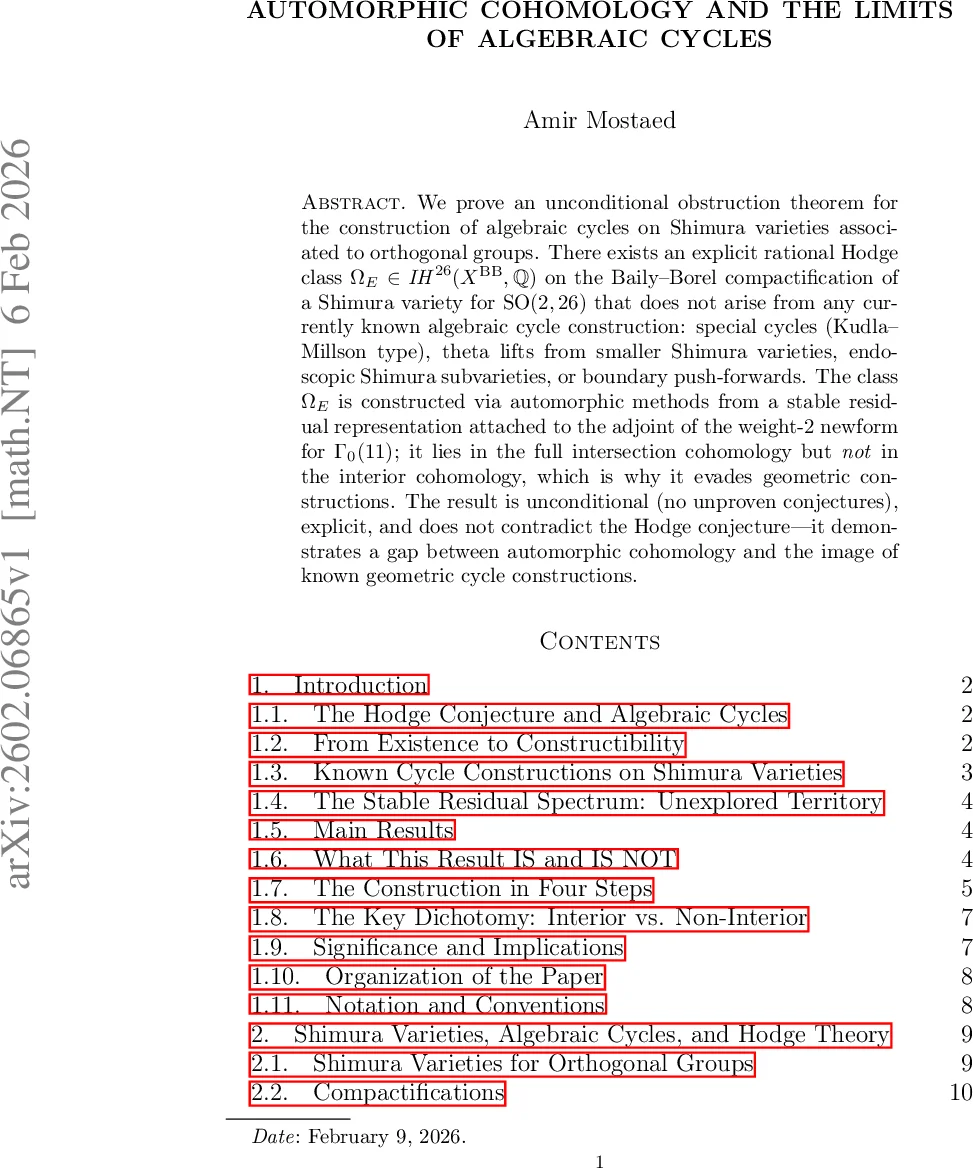
This paper establishes an explicit obstruction to constructing algebraic cycles from automorphic cohomology classes on Shimura varieties. We produce a rational Hodge class $Ω_E$ in the intersection cohomology of the Baily-Borel compactification of a Shimura variety for $\text{SO}(2,26)$, arising from a stable residual automorphic representation via theta lift from the weight-$2$ newform of conductor $11$. While $Ω_E$ is automorphic and of pure Hodge type, we prove it is non-interior and hence cannot be obtained from special cycles, theta lifts, endoscopic transfers, or boundary pushforwards, all of which yield interior classes. The result is unconditional, relying only on Arthur’s classification, Vogan-Zuckerman theory, the fundamental lemma, and the Zucker conjecture (proven by Looijenga-Saper-Stern), and it highlights a fundamental asymmetry between automorphic cohomology and geometric access to algebraic cycles, refining the Hodge conjecture from a question of existence to one of constructive tractability.
💡 Research Summary
The paper investigates the relationship between automorphic cohomology and algebraic cycles on Shimura varieties, focusing on a concrete counterexample that demonstrates a fundamental obstruction to constructing algebraic cycles from certain automorphic classes. The authors work with the orthogonal group SO(2, 26) and its associated Shimura variety X, which has complex dimension 13 and thus middle‑degree cohomology in degree 26.
The construction begins with the unique weight‑2 newform f of level 11. Because the space S₂(Γ₀(11)) is one‑dimensional, the Fourier coefficients of f are rational integers and the Hecke field is ℚ. The modular form gives rise to a two‑dimensional ℓ‑adic Galois representation ρ_f, and its adjoint representation Ad(ρ_f) is a three‑dimensional irreducible representation with Hodge–Tate weights {1,0,−1}. The adjoint L‑function L(s, Ad ρ_f) has a simple pole at s = 1, which is the analytic source of a residual Eisenstein series.
Using the theta correspondence for the dual pair (SL₂, SO(V)) with V a 28‑dimensional quadratic space of signature (2, 26), the authors lift f to an automorphic representation Π of SO(V). Rallis’s inner‑product formula guarantees that the lift is non‑zero. Arthur’s classification identifies the global Arthur parameter of Π as
ψ = Ad(f) ⊠ 1^{25}.
This parameter is residual (it comes from a pole of an Eisenstein series) and stable (it does not factor through any proper Levi subgroup). Consequently, Π lies in the discrete spectrum but is not cuspidal.
The archimedean component Π_∞ is analyzed via Vogan–Zuckerman theory. The (𝔤, K)-cohomology of Π_∞ is concentrated in a single degree, namely degree 26, and is one‑dimensional. The infinitesimal character forces the Hodge type to be (13, 13), so the associated cohomology class is a pure rational Hodge class. Denoting by Ω_E the generator of the automorphic contribution to the intersection cohomology IH^{26}(X_BB, ℚ) (where X_BB is the Baily–Borel compactification), the authors obtain an explicit class with the following properties:
- Automorphic origin – it comes from the stable residual representation Π.
- Pure Hodge type – (13, 13) and defined over ℚ.
- Non‑interior – it does not lie in the interior (or “compactly supported”) cohomology IH^{26}_!(X_BB, ℚ).
The key dichotomy exploited in the paper is that every algebraic cycle on X_BB yields a class in interior cohomology (a consequence of Franke’s theorem and the analysis of boundary residues), whereas residual automorphic classes are known, by Franke’s work, to contribute only to the full cohomology and never to the interior part. Hence Ω_E cannot be obtained from any of the known geometric constructions: Kudla–Millson special cycles, Hecke correspondences, endoscopic Shimura subvarieties, theta lifts of algebraic cycles, or Gysin maps from boundary strata.
The main results are stated as:
- Theorem 1.6 (Main Theorem): There exists an explicit rational Hodge class Ω_E ∈ IH^{26}(X_BB, ℚ) of type (13, 13) that is not interior.
- Theorem 1.7 (Obstruction Theorem): Because all known algebraic‑cycle constructions produce interior classes, Ω_E cannot be realized by any such construction.
The authors emphasize that this does not contradict the Hodge conjecture; the class Ω_E might still be algebraic, but its algebraic realization would require a fundamentally new geometric construction beyond the current toolkit. In this sense the paper refines the Hodge conjecture from a purely existential statement to a question of constructibility.
Methodologically, the proof is unconditional: it relies only on established results—Arthur’s classification for orthogonal groups, Vogan–Zuckerman cohomological induction, the fundamental lemma (Ngô), and the Zucker conjecture (proved by Looijenga, Saper, and Stern). No unproven conjectures are invoked.
The broader significance is threefold:
- For the Hodge conjecture: It highlights a gap between the existence of Hodge classes (guaranteed by Hodge theory) and our ability to produce explicit algebraic cycles representing them.
- For the Langlands program: It shows an asymmetry: automorphic representations can detect cohomological phenomena that are invisible to current geometric cycle constructions.
- For the Kudla program and special cycles: It demonstrates that special cycles do not exhaust the middle‑degree cohomology of orthogonal Shimura varieties, suggesting the need for new cycle constructions (perhaps involving non‑interior or boundary phenomena).
The paper concludes with several directions for future work, including the search for “non‑interior” algebraic cycles, extending the analysis to other groups (unitary, symplectic), and developing new geometric tools that could bridge the gap identified. In sum, the work provides a concrete, unconditional example of an automorphic Hodge class that lies beyond the reach of all known algebraic‑cycle methods, thereby opening a fresh line of inquiry at the intersection of automorphic forms, Hodge theory, and algebraic geometry.
Comments & Academic Discussion
Loading comments...
Leave a Comment