Simultaneous polynomial approximation in Beurling-Sobolev spaces via Blaschke products
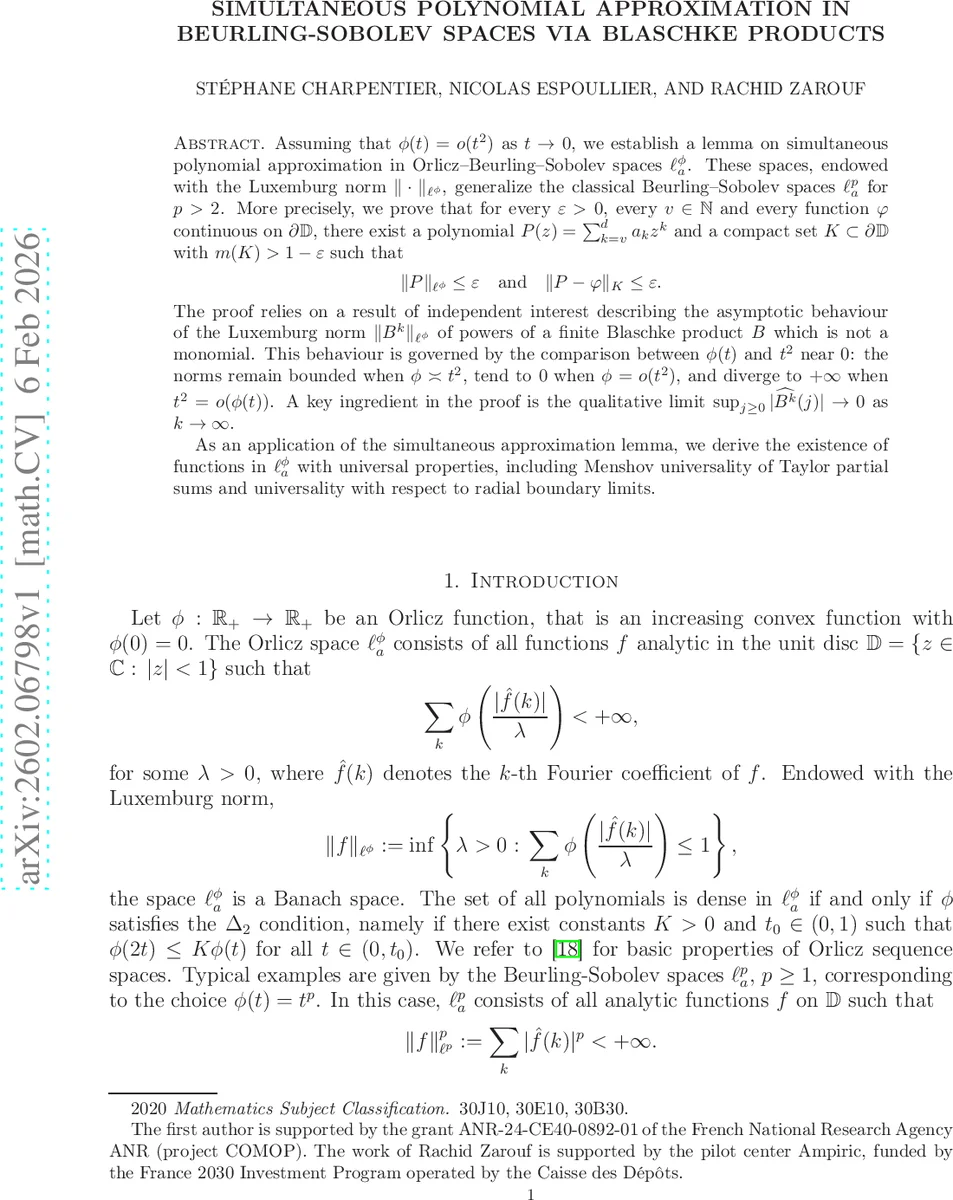
Assuming that $ϕ(t)=o(t^2)$ as $t\to0$, we establish a lemma on simultaneous polynomial approximation in Orlicz-Beurling-Sobolev spaces $\ell_a^ϕ$. These spaces, endowed with the Luxemburg norm $\Vert \cdot \Vert_{\ell^ϕ}$, generalize the classical Beurling-Sobolev spaces $\ell_a^p$ for $p>2$. More precisely, we prove that for every $\varepsilon>0$, every $v\in\mathbb{N}$ and every function $φ$ continuous on $\partial\mathbb{D}$, there exist a polynomial $P(z)=\sum_{k=v}^d a_k z^k$ and a compact set $K\subset\partial\mathbb{D}$ with $m(K)>1-\varepsilon$ such that [|P|{\ell^ϕ}\le\varepsilon \quad \text{and}\quad |P-φ|K\le\varepsilon.] The proof relies on a result of independent interest describing the asymptotic behaviour of the Luxemburg norm $|B^k|{\ell^ϕ}$ of powers of a finite Blaschke product $B$ which is not a monomial. This behaviour is governed by the comparison between $ϕ(t)$ and $t^2$ near $0$: the norms remain bounded when $ϕ\asymp t^2$, tend to $0$ when $ϕ=o(t^2)$, and diverge to $+\infty$ when $t^2=o(ϕ(t))$. A key ingredient in the proof is the qualitative limit $\sup{j\ge0}|\widehat{B^k}(j)|\to0$ as $k\to\infty$. As an application of the simultaneous approximation lemma, we derive the existence of functions in $\ell_a^ϕ$ with universal properties, including Menshov universality of Taylor partial sums and universality with respect to radial boundary limits.
💡 Research Summary
The paper studies simultaneous polynomial approximation in Orlicz‑Beurling‑Sobolev spaces ℓ_a^ϕ, where ϕ is an Orlicz function satisfying the mild growth condition ϕ(t)=o(t²) as t→0. These spaces consist of analytic functions f on the unit disc whose Fourier coefficients (̂f(k)) satisfy ∑k ϕ(|̂f(k)|/λ)≤1 for some λ>0; the Luxemburg norm ‖f‖{ℓ^ϕ} is the infimum of such λ. When ϕ(t)=t^p the space reduces to the classical Beurling‑Sobolev space ℓ_a^p (p>2). The authors prove a simultaneous approximation lemma (Lemma 1.1): for any ε>0, any integer v≥0 and any continuous boundary function φ on the unit circle, there exists a polynomial P(z)=∑{k=v}^d a_k z^k and a compact set K⊂∂D with Lebesgue measure m(K)>1−ε such that ‖P‖{ℓ^ϕ}≤ε and ‖P−φ‖_K≤ε. The result extends earlier work of Kahane and Nestoridis, but the proof is completely deterministic and relies on inner functions rather than probabilistic constructions.
The central technical tool is Theorem 1.2, which describes the asymptotic behaviour of the Luxemburg norm of powers of a finite Blaschke product B that is not a monomial. Writing B(z)=∏{j=1}^m b{λ_j}(z) with b_{λ}(z)=(λ−z)/(1−\overline{λ}z), the authors show:
- If ϕ(t)≈t² near 0, then ‖B^k‖_{ℓ^ϕ} stays bounded (indeed ≍1 when ϕ(t)=t²).
- If ϕ(t)=o(t²), then ‖B^k‖_{ℓ^ϕ}→0 as k→∞.
- If t²=o(ϕ(t)), then ‖B^k‖{ℓ^ϕ}→∞ as k→∞. The proof hinges on the qualitative estimate sup_j|c{B^k}(j)|→0, where c_{B^k}(j) are the Fourier coefficients of B^k. This is obtained via a van der Corput lemma applied to the phase ψ_B(θ)=arg B(e^{iθ}), exploiting the fact that ψ_B’’ has only finitely many zeros when B is not a pure power of z. Consequently the ℓ^∞‑norm of B^k tends to zero, and the comparison between ϕ and t² translates this decay (or growth) into the Luxemburg norm.
With Theorem 1.2 in hand, Lemma 1.1 is proved as follows. First, by Mergelyan’s theorem, a polynomial R approximates φ on a large arc I⊂∂D within ε. Next, choose a polynomial Q of degree at least v that equals 1 at the origin and a finite Blaschke product B vanishing at 0 but not a monomial. Lemma 3.1 (a direct corollary of Theorem 1.2) guarantees an integer n₀ such that for all n≥n₀, ‖Q∘B^n‖{ℓ^ϕ}<ε. Define g(z)=R(z)·(Q∘B^{n₀})(z); g has a zero of order ≥v at 0 and satisfies ‖g‖{ℓ^ϕ}≤ε·‖R‖_{ℓ^∞}. Since g is not a polynomial, the authors apply a radial dilation S_r(f)(z)=f(rz) (which does not increase the Luxemburg norm) and then truncate the Taylor series with the partial‑sum operator S_N. For r close enough to 1 and N large enough, P=S_N(S_r(g)) is a polynomial meeting both norm and uniform approximation requirements. The set K is taken as B^{-n₀}(I); because B is inner, it preserves Lebesgue measure, so m(K)=m(I)>1−ε, and on K∩I the uniform error is bounded by 2ε.
Finally, the simultaneous approximation lemma is used to construct universal functions in ℓ_a^ϕ (Theorem 1.4). Under the same ϕ(t)=o(t²) hypothesis, the authors exhibit a function f∈ℓ_a^ϕ whose Taylor partial sums are Menshov‑universal (i.e., for any measurable boundary function ψ, a subsequence of partial sums converges to ψ almost everywhere) and whose radial translates converge to any prescribed measurable boundary function along suitable radii. When ϕ satisfies the Δ₂ condition, the set of such universal functions is dense and G_δ in ℓ_a^ϕ. This extends known universality results for ℓ_a^p (p>2) to the broader Orlicz setting, showing that the crucial ingredient is the sub‑quadratic growth of ϕ near zero rather than any specific power law.
The paper is organized as follows: Section 2 proves Theorem 1.2, first establishing the qualitative ℓ^∞‑decay of B^k via van der Corput estimates and then translating it into Luxemburg‑norm asymptotics. Section 3 derives Lemma 1.1 from Theorem 1.2 and completes the construction of the approximating polynomial. The final part discusses the universality applications and situates the results within the existing literature on universal series, highlighting the deterministic inner‑function approach as an alternative to earlier probabilistic methods.
Comments & Academic Discussion
Loading comments...
Leave a Comment