Bridging Quantum and Semi-Classical Thermodynamics in Cavity QED
In cavity quantum electrodynamics (QED), photons leaving the cavity can be irreversibly lost or reused as a power source. This dichotomy is reflected in two different thermodynamic bookkeepings of the light field, both corresponding to valid thermodynamic frameworks. In this work, we formulate a rigorous semi-classical limit of cavity QED and show that the resulting thermodynamic description may qualitatively differ from that of the fully quantised model. We find that violations of the thermodynamic uncertainty relations are recovered in the semi-classical limit only by one of the two thermodynamic frameworks: the one which treats part of the photon flux as a power source. We illustrate our findings in a three-level system coupled to a driven cavity.
💡 Research Summary
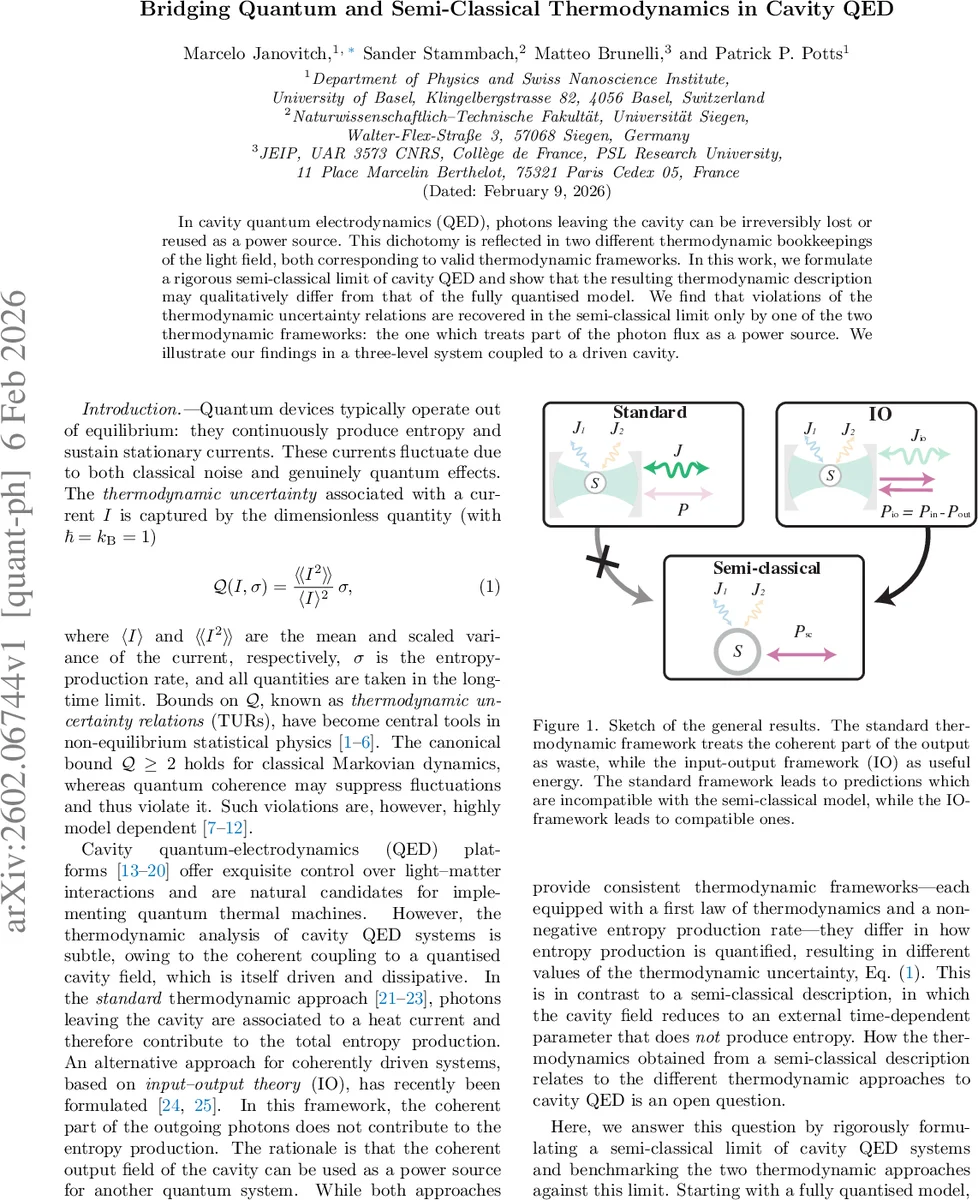
This paper investigates two fundamentally different ways of accounting for photons that leave a driven, dissipative cavity in cavity quantum electrodynamics (QED). In the “standard” thermodynamic framework, every outgoing photon is treated as a heat carrier that contributes to entropy production, whereas in the input‑output (IO) framework the coherent part of the output field is regarded as useful work that can be harvested by another quantum system. Both frameworks satisfy the first and second laws of thermodynamics, but they differ in how entropy production is defined, and consequently they predict different values for the thermodynamic‑uncertainty relation (TUR) (Q = \langle!\langle I^{2}\rangle!\rangle \langle I\rangle^{-2}\sigma).
The authors start from a fully quantised cavity‑QED model described by a master equation that includes (i) the bare system Hamiltonian (H’), (ii) a driven cavity Hamiltonian (H_{0}(t)=\Omega a^{\dagger}a+iE(a^{\dagger}e^{i\omega_{d}t}-ae^{-i\omega_{d}t})), and (iii) a linear system‑cavity interaction (V=g(aO^{\dagger}+a^{\dagger}O)). The cavity is coupled to a thermal bath with damping rate (\kappa) and occupation (\bar n); the system itself may be coupled to additional baths (e.g., hot and cold reservoirs).
To connect with the semi‑classical description, the cavity mode is split into a large coherent amplitude (\alpha(t)) and a small quantum fluctuation (\tilde a): (a=\alpha(t)+\tilde a). The semi‑classical limit is defined by (|\alpha|\to\infty), (g\kappa\to0) while keeping (g\kappa|\alpha|=\text{const}). In this regime the cavity field becomes an externally prescribed drive (\alpha(t)) and the reduced system dynamics obey a master equation with a time‑dependent Hamiltonian (H_{\text{sc}}(t)=H’+g
Comments & Academic Discussion
Loading comments...
Leave a Comment