Future-blindness and the product topology
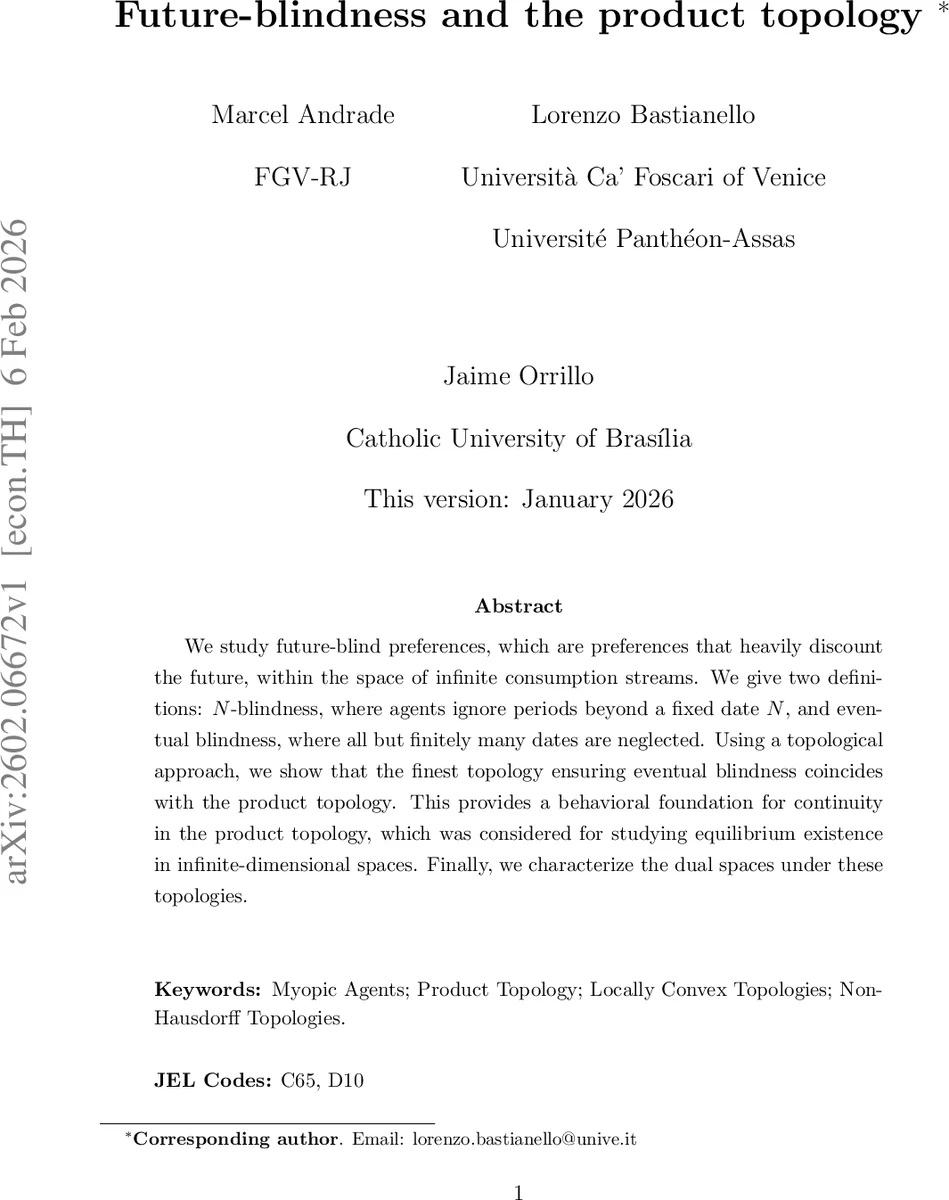
We study future-blind preferences, which are preferences that heavily discount the future, within the space of infinite consumption streams. We give two definitions: $N$-blindness, where agents ignore periods beyond a fixed date $N$, and eventual blindness, where all but finitely many dates are neglected. Using a topological approach, we show that the finest topology ensuring eventual blindness coincides with the product topology. This provides a behavioral foundation for continuity in the product topology, which was considered for studying equilibrium existence in infinite-dimensional spaces. Finally, we characterize the dual spaces under these topologies.
💡 Research Summary
This paper, “Future-blindness and the product topology,” provides a rigorous mathematical and economic analysis of extreme forms of impatience within the context of infinite-horizon consumption streams. The central object of study is the space of bounded real-valued sequences, l∞, representing potential consumption paths. The authors introduce and formalize the concept of “future-blind” preferences, which exhibit a severe discounting of the future, and establish a profound connection between this behavioral axiom and a specific mathematical topology.
The analysis is built upon two precise definitions of future-blindness. The first, termed “N-blindness,” describes an agent who completely ignores all periods beyond a fixed, exogenous date N. Formally, a preference relation is N-blind if, whenever x is strictly preferred to y (x ≻ y), then x remains strictly preferred to y even after any stream z is appended to y from period N onwards (x ≻ y + T_N(z)). This represents an absolute myopia starting at a predetermined point. The second, more flexible concept is “eventual blindness.” Here, an agent’s preference is eventually blind if, for any strict preference x ≻ y and any potential future compensation z, there exists some finite time horizon (which can depend on x, y, and z) beyond which appending z to y no longer reverses the strict preference. This captures the idea that sufficiently distant future events are eventually neglected, even if the compensation grows without bound.
The paper’s primary methodological contribution lies in its topological approach. Instead of taking continuity as a primitive technical assumption, the authors ask: what is the finest topology on l∞ that forces continuous preferences to exhibit a specific type of future-blind behavior? They define a topology as “N-blind” (or “eventually blind”) if every preference relation that is continuous with respect to that topology must satisfy the corresponding blindness property.
The key results are characterization theorems. Proposition 3.2 shows that a locally convex topology is N-blind if and only if every generating seminorm p satisfies p(T_n(x)) = 0 for all n ≥ N and all x. This implies that in such a topology, any sequence that is non-zero only after period N is indistinguishable from the zero sequence. The main result, Proposition 4.3, establishes that the finest locally convex topology ensuring eventual blindness is precisely the product topology (τp). The product topology is the topology of pointwise convergence, generated by the seminorms p_n(x) = |x_n|. This finding provides a clear behavioral foundation for the use of the product topology in infinite-dimensional economic models: continuity in the product topology is equivalent to the assumption that economic agents are eventually blind to the far future. This formalizes an intuition and justifies the topological choice made in earlier work, such as that of Peleg and Yaari (1970) on equilibrium existence.
Furthermore, the paper investigates the dual spaces (spaces of continuous linear functionals, generalizing prices) associated with these topologies. Theorem 5.1 shows that the dual of l∞ under the finest N-blind topology is isomorphic to c_N00, the space of sequences that are zero after the N-th coordinate. Theorem 5.2 confirms the well-known result that the dual under the product topology is isomorphic to c00, the space of sequences with only finitely many non-zero elements. This underscores the economic interpretation: in the product topology, only a finite number of “periods” or “commodities” can have non-zero “prices” in any continuous valuation.
In conclusion, this work successfully bridges a behavioral economic concept (extreme impatience/future-blindness) with a specific mathematical structure (the product topology). It demonstrates that the choice of topology in infinite-dimensional analysis is not merely a technical convenience but can be directly linked to assumptions about agent behavior, offering a deeper justification for the tools used in studying intertemporal choice and general equilibrium with an infinite horizon.
Comments & Academic Discussion
Loading comments...
Leave a Comment