AS-Mamba: Asymmetric Self-Guided Mamba Decoupled Iterative Network for Metal Artifact Reduction
Metal artifact significantly degrades Computed Tomography (CT) image quality, impeding accurate clinical diagnosis. However, existing deep learning approaches, such as CNN and Transformer, often fail to explicitly capture the directional geometric features of artifacts, leading to compromised structural restoration. To address these limitations, we propose the Asymmetric Self-Guided Mamba (AS-Mamba) for metal artifact reduction. Specifically, the linear propagation of metal-induced streak artifacts aligns well with the sequential modeling capability of State Space Models (SSMs). Consequently, the Mamba architecture is leveraged to explicitly capture and suppress these directional artifacts. Simultaneously, a frequency domain correction mechanism is incorporated to rectify the global amplitude spectrum, thereby mitigating intensity inhomogeneity caused by beam hardening. Furthermore, to bridge the distribution gap across diverse clinical scenarios, we introduce a self-guided contrastive regularization strategy. Extensive experiments on public andclinical dental CBCT datasets demonstrate that AS-Mamba achieves superior performance in suppressing directional streaks and preserving structural details, validating the effectiveness of integrating physical geometric priors into deep network design.
💡 Research Summary
The paper introduces AS‑Mamba, a novel deep‑learning framework for metal artifact reduction (MAR) in computed tomography (CT) that explicitly incorporates the physical characteristics of metal‑induced artifacts into its architecture. Metal implants generate two dominant error components: (1) high‑frequency, directionally anisotropic streaks that propagate along straight lines in the image domain, and (2) low‑frequency intensity inhomogeneity caused by beam hardening. Existing CNN‑based or Transformer‑based MAR methods either lack the ability to model long‑range linear trajectories or suffer from high computational cost and fragmented processing of streaks.
AS‑Mamba tackles these issues with four key innovations. First, it leverages the sequential modeling capability of State‑Space Models (SSMs) and, in particular, the Mamba architecture, whose data‑dependent scanning mechanism aligns naturally with the linear propagation of streaks. By treating the image as a 1‑D sequence along the Mamba scan path, the network can trace and suppress non‑local streaks with linear (O(N)) complexity, avoiding the locality constraints of convolutions and the quadratic cost of Transformers.
Second, the framework adopts an asymmetric dual‑branch design that decouples high‑ and low‑frequency processing. The High‑Frequency Reduction Network (HFRN) receives the concatenated high‑frequency wavelet sub‑bands (LH, HL, HH) and processes them through a U‑Net‑style encoder‑decoder built from MambaBlocks. This branch focuses on fine‑grained streak suppression. Simultaneously, the Dual Enhancement Network (DEN) operates on the low‑frequency LL sub‑band: it computes a 2‑D real FFT, learns to correct the corrupted amplitude spectrum, and applies an inverse FFT to restore global intensity uniformity, thereby mitigating beam‑hardening artifacts.
Third, to improve robustness across diverse clinical scenarios (different metal types, patient anatomies, acquisition settings), the authors introduce Self‑Guided Contrastive Regularization (SGCR). SGCR forms positive pairs from the same patient under varying metal conditions and negative pairs from different patients, encouraging the network to preserve anatomical structure while making the artifact representation invariant to distribution shifts. This contrastive loss is embedded within an iterative refinement loop (MANet), which progressively refines the reconstruction and reinforces the regularization at each step.
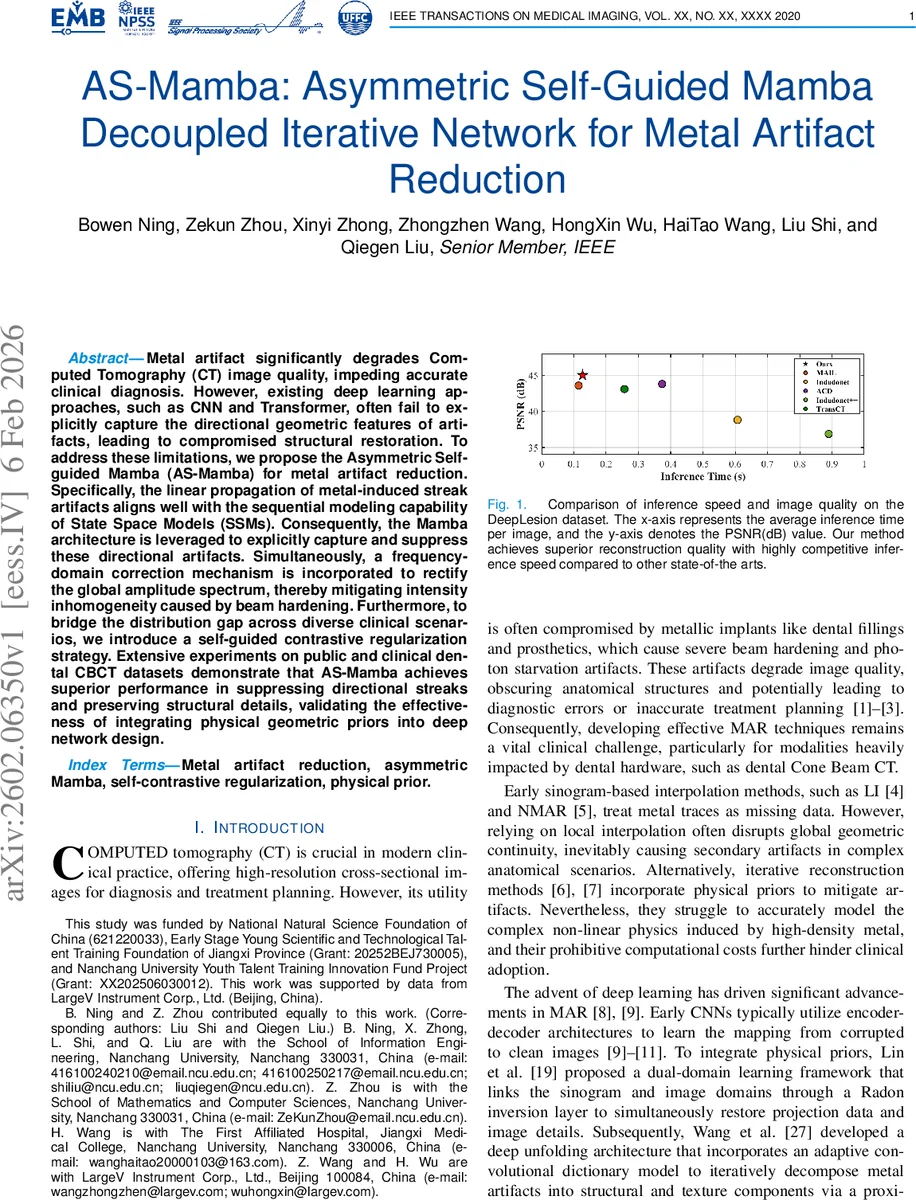
Extensive experiments on public datasets (DeepLesion) and a clinical dental cone‑beam CT (CBCT) collection demonstrate that AS‑Mamba outperforms state‑of‑the‑art MAR methods, including MDS‑MAR, CNN‑UNet, and Vision‑Transformer variants. Quantitatively, it achieves an average PSNR improvement of over 1.2 dB and an SSIM gain of ~0.03, while maintaining an inference time of roughly 30 ms per image, suitable for real‑time clinical workflows. Visual inspection confirms superior streak removal and better preservation of fine anatomical details, especially in cases where streaks are dense or beam‑hardening effects are severe.
In summary, AS‑Mamba contributes (i) a physics‑informed use of the Mamba SSM to directly model and suppress linear streak artifacts, (ii) a frequency‑domain amplitude correction module for low‑frequency shading, (iii) an asymmetric architecture that prevents interference between the two frequency components, and (iv) a self‑guided contrastive regularization that enhances generalization across heterogeneous data. The combination of these elements yields a MAR solution that is both accurate and computationally efficient, representing a significant step forward for CT imaging in the presence of metal implants.
Comments & Academic Discussion
Loading comments...
Leave a Comment