Design-Conditional Prior Elicitation for Dirichlet Process Mixtures: A Unified Framework for Cluster Counts and Weight Control
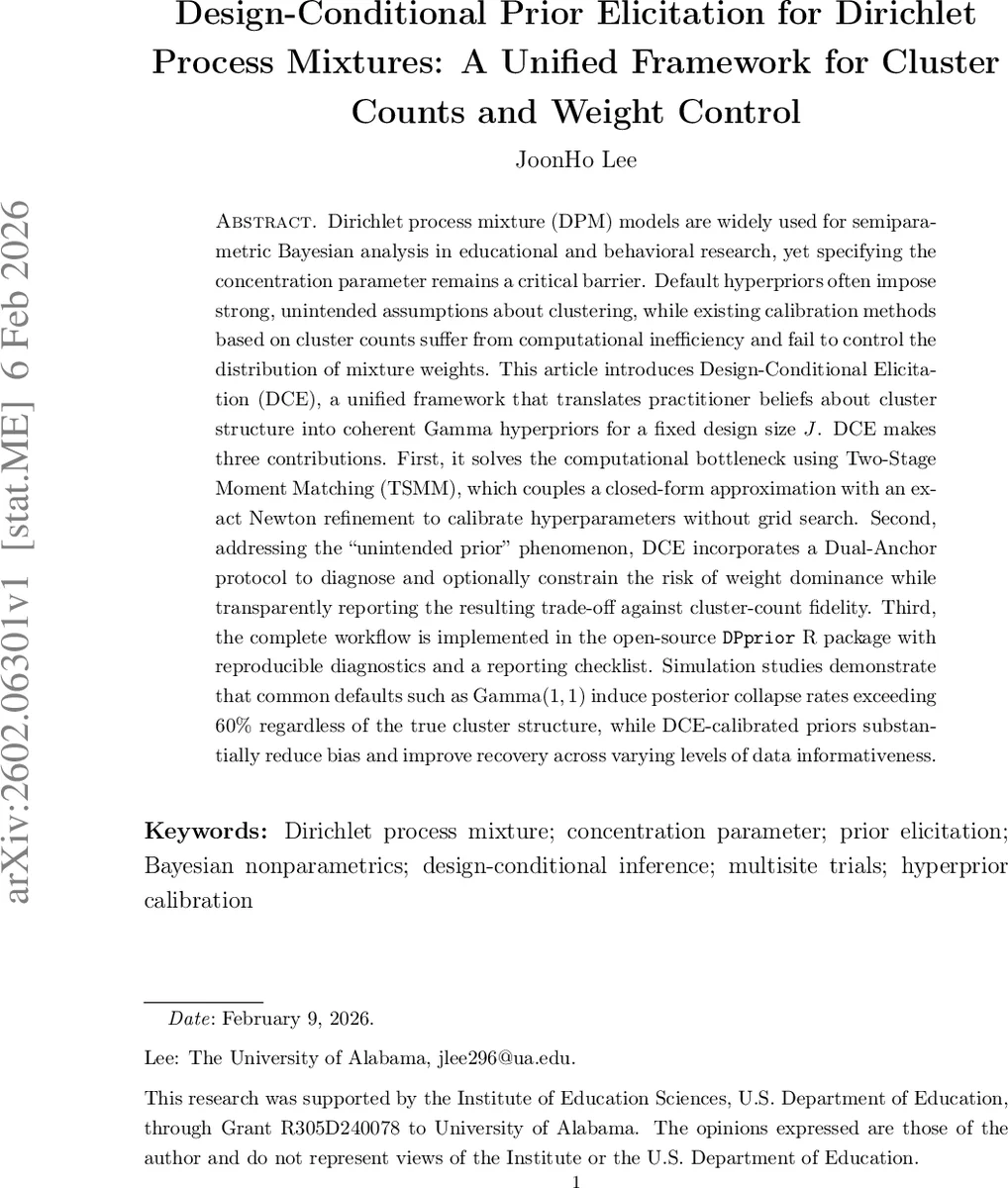
Dirichlet process mixture (DPM) models are widely used for semiparametric Bayesian analysis in educational and behavioral research, yet specifying the concentration parameter remains a critical barrier. Default hyperpriors often impose strong, unintended assumptions about clustering, while existing calibration methods based on cluster counts suffer from computational inefficiency and fail to control the distribution of mixture weights. This article introduces Design-Conditional Elicitation (DCE), a unified framework that translates practitioner beliefs about cluster structure into coherent Gamma hyperpriors for a fixed design size J. DCE makes three contributions. First, it solves the computational bottleneck using Two-Stage Moment Matching (TSMM), which couples a closed-form approximation with an exact Newton refinement to calibrate hyperparameters without grid search. Second, addressing the “unintended prior” phenomenon, DCE incorporates a Dual-Anchor protocol to diagnose and optionally constrain the risk of weight dominance while transparently reporting the resulting trade-off against cluster-count fidelity. Third, the complete workflow is implemented in the open-source DPprior R package with reproducible diagnostics and a reporting checklist. Simulation studies demonstrate that common defaults such as Gamma(1, 1) induce posterior collapse rates exceeding 60% regardless of the true cluster structure, while DCE-calibrated priors substantially reduce bias and improve recovery across varying levels of data informativeness.
💡 Research Summary
Dirichlet process mixture (DPM) models are increasingly used in education and behavioral research for flexible semi‑parametric inference, yet the concentration parameter α—governing both the number of occupied clusters K_J and the distribution of mixture weights—remains a major practical obstacle. Existing calibration strategies focus on matching prior beliefs about K_J (e.g., Dorazio 2009, SCAL) but suffer from three critical gaps: (1) a translation gap because practitioners can readily express expectations about cluster counts but have no direct way to map these to Gamma hyperparameters (a, b); (2) a computational gap because closed‑form solutions do not exist, forcing costly grid searches or repeated MCMC runs; and (3) a coherence gap because a prior calibrated solely on K_J may still imply undesirable weight concentration, such as a dominant cluster, a phenomenon termed “unintended prior.”
The paper introduces Design‑Conditional Elicitation (DCE), a unified framework that bridges all three gaps for a fixed design size J (e.g., the number of sites in a multisite trial). Practitioners specify the expected value and variance of K_J, and DCE translates these moments into a Gamma(a, b) prior on α using Two‑Stage Moment Matching (TSMM). In the first stage, a closed‑form approximation yields initial (a₀, b₀) that match the target moments under the Antoniak distribution. In the second stage, an exact Newton‑Raphson refinement enforces the moments of the finite‑J DP‑induced K_J distribution, eliminating the need for grid search. The authors report that TSMM converges in roughly 50 ms, a ≈900‑fold speed‑up over discrepancy‑minimization approaches.
To address the coherence gap, DCE incorporates a Dual‑Anchor diagnostic and refinement protocol. Anchor 1 evaluates tail probabilities of the first stick‑breaking weight w₁ (Pr(w₁ > 0.5) and Pr(w₁ > 0.9)), quantifying the risk that a single cluster dominates the sample. Anchor 2 computes the Simpson co‑clustering index ρ = ∑ w_h², the probability that two randomly chosen units belong to the same cluster. If these diagnostics exceed user‑defined thresholds, an optional refinement step imposes a constraint on weight dominance (e.g., limiting Pr(w₁ > 0.5) ≤ τ). This constraint is applied while transparently reporting the trade‑off: the calibrated prior may deviate slightly from the original K_J moments, but weight concentration is brought into alignment with substantive expectations.
Simulation experiments compare DCE‑calibrated priors to common defaults such as Gamma(1, 1) and to existing K_J‑based methods. The defaults produce posterior collapse rates above 60 % across a range of true cluster structures, severely under‑estimating the number of groups. In contrast, DCE achieves unbiased recovery of K_J, accurate estimation of mixture components, and substantially lower weight‑dominance risk. When the Dual‑Anchor refinement is activated, the probability of a dominant cluster drops below 5 % while retaining comparable cluster‑count fidelity.
All components of the workflow—elicitation, TSMM calibration, Dual‑Anchor diagnostics, optional refinement, and reporting—are implemented in the open‑source R package DPprior. The package supplies user‑friendly functions, reproducible vignettes, diagnostic plots, and a reporting checklist, enabling researchers to document their prior choices and the associated trade‑offs.
In sum, the paper delivers a practical, theoretically grounded solution to the long‑standing problem of α‑prior specification in DPMs. By converting intuitive practitioner beliefs about cluster numbers into coherent Gamma hyperpriors, providing a fast closed‑form calibration algorithm, and offering explicit diagnostics and optional constraints on weight concentration, DCE makes Dirichlet process mixtures far more accessible and reliable for applied researchers in education, psychology, and related fields.
Comments & Academic Discussion
Loading comments...
Leave a Comment