On five questions of Bourin and Lee: symmetric moduli and an Euler operator identity
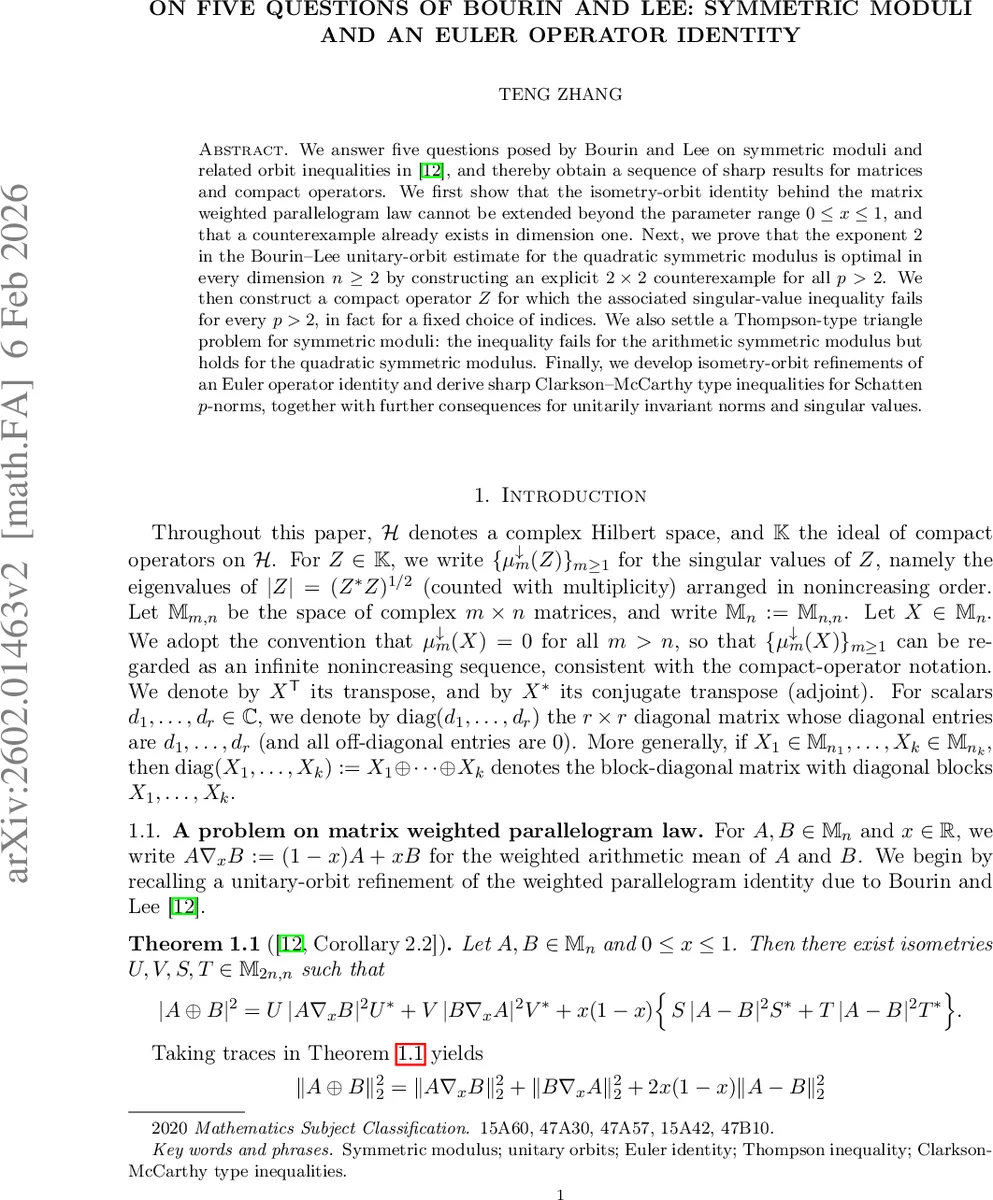
We answer five questions posed by Bourin and Lee on symmetric moduli and related orbit inequalities in \cite{BL26}, and thereby obtain a sequence of sharp results for matrices and compact operators. We first show that the isometry-orbit identity behind the matrix weighted parallelogram law cannot be extended beyond the parameter range $0\le x\le1$, and that a counterexample already exists in dimension one.Next, we prove that the exponent $2$ in the Bourin–Lee unitary-orbit estimate for the quadratic symmetric modulus is optimal in every dimension $n\ge2$ by constructing an explicit $2\times2$ counterexample for all $p>2$.We then construct a compact operator $Z$ for which the associated singular-value inequality fails for every $p>2$, in fact for a fixed choice of indices. We also settle a Thompson-type triangle problem for symmetric moduli: the inequality fails for the arithmetic symmetric modulus but holds for the quadratic symmetric modulus.Finally, we develop isometry-orbit refinements of an Euler operator identity and derive sharp Clarkson–McCarthy type inequalities for Schatten $p$-norms, together with further consequences for unitarily invariant norms and singular values.
💡 Research Summary
The paper addresses five open problems raised by Bourin and Lee concerning symmetric moduli, weighted parallelogram laws, and related orbit inequalities. The author provides definitive answers, often negative, and constructs explicit counterexamples that demonstrate the sharpness of previously known results.
- Weighted Parallelogram Law Extension (Question 2.3).
Theorem 1.1 of Bourin–Lee gives an isometry‑orbit identity for matrices A, B when the weight parameter x lies in
Comments & Academic Discussion
Loading comments...
Leave a Comment