A comprehensive study of the relations between the properties of planetary systems and the chemical compositions of their host stars
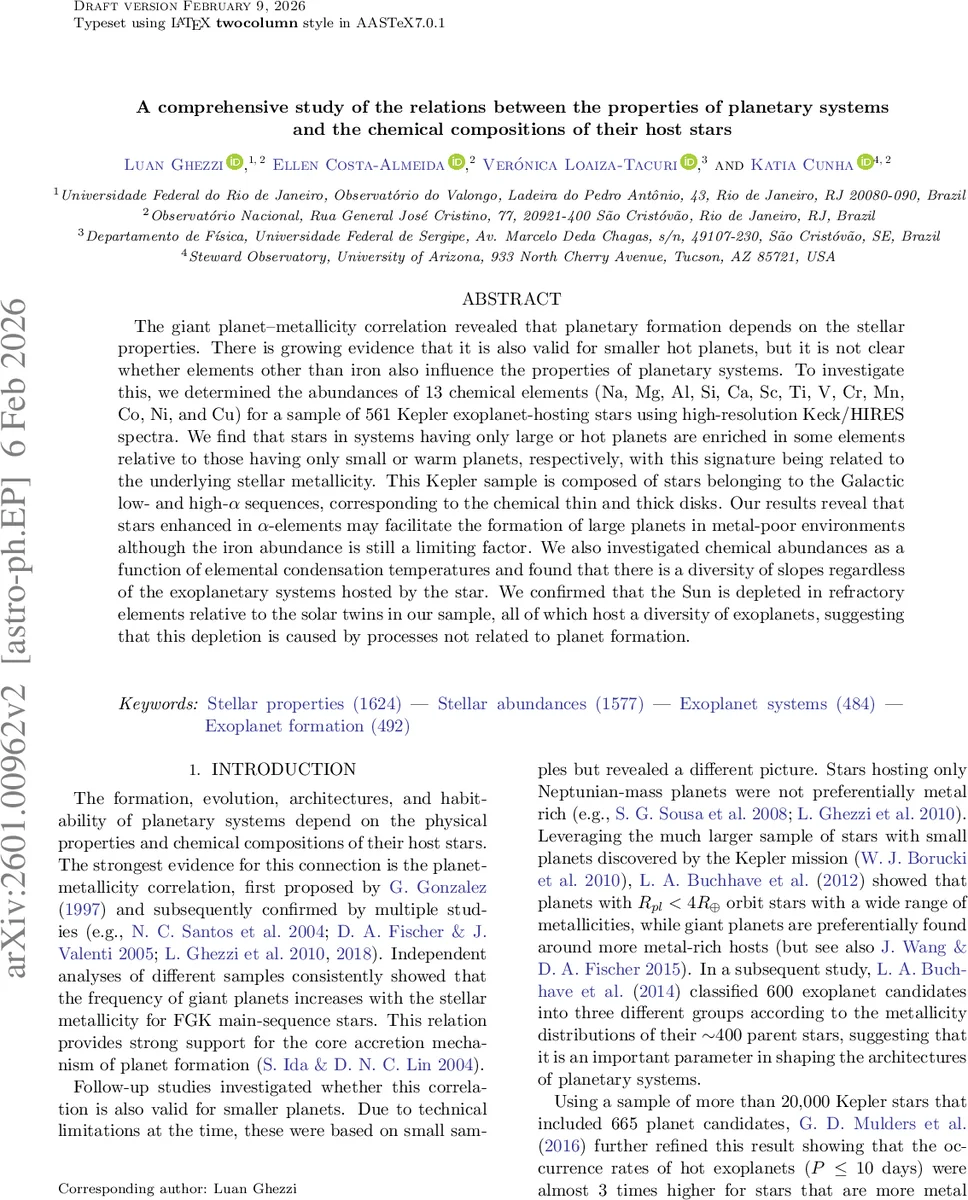
The giant planet-metallicity correlation revealed that planetary formation depends on the stellar properties. There is growing evidence that it is also valid for smaller hot planets, but it is not clear whether elements other than iron also influence the properties of planetary systems. To investigate this, we determined the abundances of 13 chemical elements (Na, Mg, Al, Si, Ca, Sc, Ti, V, Cr, Mn, Co, Ni and Cu) for a sample of 561 Kepler exoplanet-hosting stars using high-resolution Keck/HIRES spectra. We find that stars in systems having only large or hot planets are enriched in some elements relative to those having only small or warm planets, respectively, with this signature being related to the underlying stellar metallicity. This Kepler sample is composed of stars belonging to the Galactic low- and high-$α$ sequences, corresponding to the chemical thin and thick disks. Our results reveal that stars enhanced in $α$-elements may facilitate the formation of large planets in metal-poor environments although the iron abundance is still a limiting factor. We also investigated chemical abundances as a function of elemental condensation temperatures and found that there is a diversity of slopes regardless of the exoplanetary systems hosted by the star. We confirmed that the Sun is depleted in refractory elements relative to the solar twins in our sample, all of which host a diversity of exoplanets, suggesting that this depletion is caused by processes not related to planet formation.
💡 Research Summary
This paper presents a comprehensive spectroscopic analysis of 561 Kepler exoplanet‑hosting stars, aiming to explore how the detailed chemical composition of a host star influences the architecture of its planetary system beyond the well‑known planet‑metallicity correlation. High‑resolution (R ≈ 60,000) Keck/HIRES spectra, originally obtained for the California‑Kepler Survey (CKS), were re‑examined to derive precise abundances for thirteen elements: Na, Mg, Al, Si, Ca, Sc, Ti, V, Cr, Mn, Co, Ni, and Cu. The authors built an initial line list of 231 transitions from the literature, pruned it after visual inspection of the solar atlas, and measured equivalent widths (EWs) automatically with ARES v2, supplementing problematic lines with manual IRAF splot measurements. Hyperfine splitting and isotopic components were accounted for in Sc, V, Mn, Co, and Cu. Using the 2019 version of MOOG under LTE assumptions and adopting stellar parameters (Teff, log g, microturbulence,
Comments & Academic Discussion
Loading comments...
Leave a Comment