From Complex-Analytic Models to Dyadic Methods: A Real-Variable Approach to Hypersingular Operators
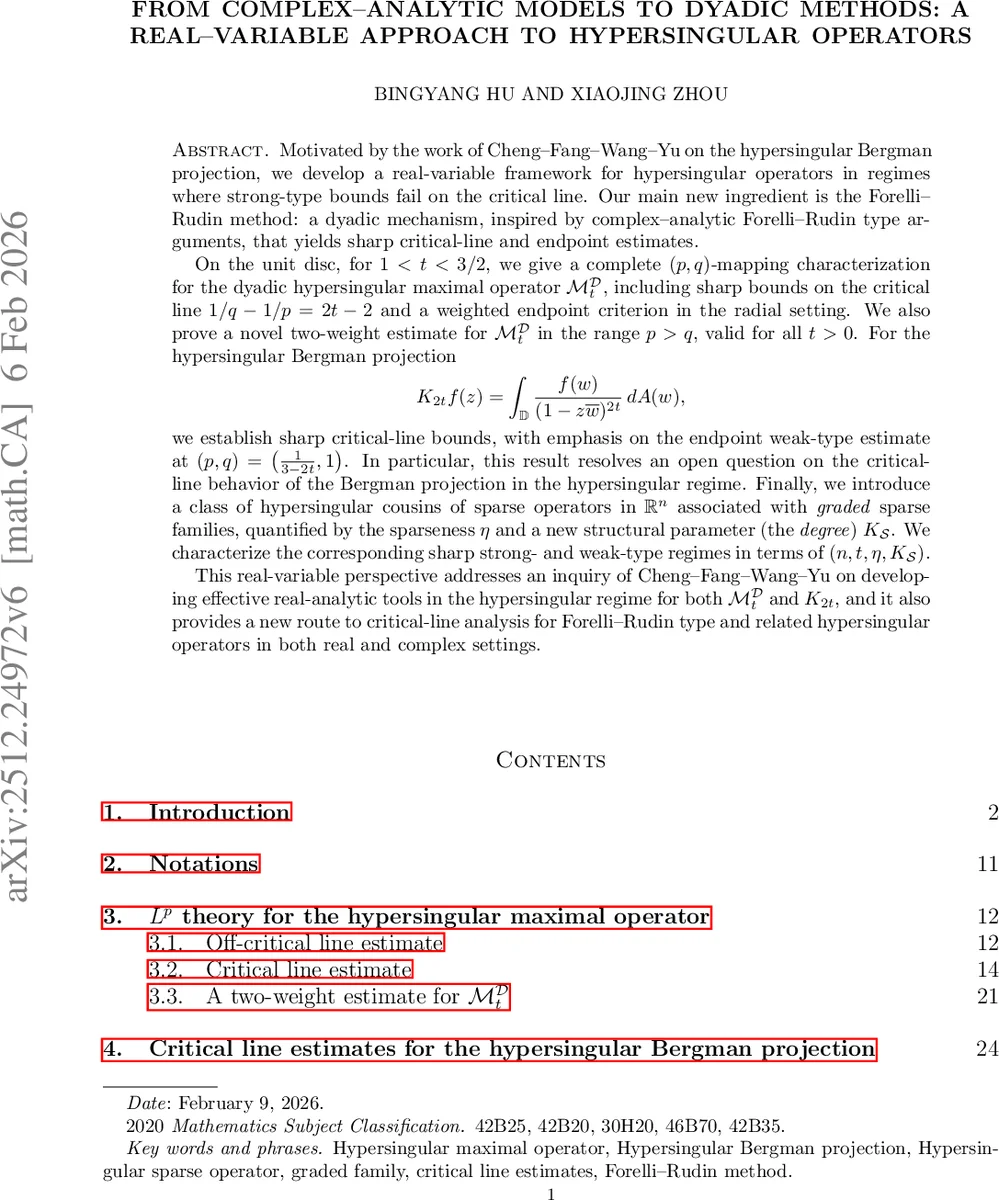
Motivated by the work of Cheng-Fang-Wang-Yu on the hypersingular Bergman projection, we develop a real-variable framework for hypersingular operators in regimes where strong-type bounds fail on the critical line. Our main new ingredient is the Forelli-Rudin method: a dyadic mechanism, inspired by complex-analytic Forelli-Rudin type arguments, that yields sharp critical-line and endpoint estimates. On the unit disc, for $1<t<3/2$, we give a complete $(p,q)$-mapping characterization for the dyadic hypersingular maximal operator $\mathcal M_t^{\mathcal D}$, including sharp bounds on the critical line $1/q-1/p=2t-2$ and a weighted endpoint criterion in the radial setting. We also prove a novel two-weight estimate for $\mathcal M_t^{\mathcal D}$ in the range $p>q$, valid for all $t>0$. For the hypersingular Bergman projection [ K_{2t}f(z)=\int_{\mathbb D}\frac{f(w)}{(1-z\overline w)^{2t}},dA(w), ] we establish sharp critical-line bounds, with emphasis on the endpoint weak-type estimate at $(p,q)=\bigl(\tfrac{1}{3-2t},1\bigr)$. In particular, this result resolves an open question on the critical-line behavior of the Bergman projection in the hypersingular regime. Finally, we introduce a class of hypersingular cousins of sparse operators in $\mathbb R^n$ associated with graded sparse families, quantified by the sparseness $η$ and a new structural parameter (the degree) $K_{\mathcal S}$. We characterize the corresponding sharp strong- and weak-type regimes in terms of $(n,t,η,K_{\mathcal S})$. This real-variable perspective addresses an inquiry of Cheng-Fang-Wang-Yu on developing effective real-analytic tools in the hypersingular regime for both $\mathcal M_t^{\mathcal D}$ and $K_{2t}$, and it also provides a new route to critical-line analysis for Forelli-Rudin type and related hypersingular operators in both real and complex settings.
💡 Research Summary
The paper tackles the long‑standing problem of understanding hypersingular Bergman projections and their maximal analogues in the regime where the singularity exponent t exceeds the classical threshold (t>1). By moving from complex‑analytic techniques to a real‑variable dyadic framework, the authors develop a suite of tools that yield sharp mapping properties on the critical line 1/q – 1/p = 2t – 2, where strong‑type estimates are known to fail.
The first major contribution is the dyadic hypersingular maximal operator 𝓜ₜᴰ defined on the unit disc via Carleson boxes associated with a dyadic system D. For 1<t<3/2 the authors give a complete (p,q)‑characterization: strong‑type boundedness holds when 1/q – 1/p > 2t – 2, while weak‑type boundedness holds exactly on the critical line 1/q – 1/p = 2t – 2. These results are proved in Proposition 3.3, Lemma 3.4, Theorem 3.5 and Corollary 3.7 and are illustrated in Figure 1. At the endpoint (p,q) = (1/(3‑2t),1) they obtain necessary and sufficient conditions in the radial weighted setting ω(r). The weak‑type condition is expressed by a supremum involving integrals of ω over dyadic annuli, while the strong‑type condition requires ω to belong to the Békollé‑Bonami class B_{1/(3‑2t)} (Theorem 3.8).
The paper then addresses two‑weight inequalities for 𝓜ₜᴰ in the range p>q. Assuming the weights μ and ω satisfy a B_∞‑type condition (Definition 3.10), the operator is bounded from L^p(ω) to L^q(μ) if and only if a testing function φ, defined by a dyadic sum (1.3), belongs to L^{p/(p‑q)}(𝔻). This condition reduces to the classical Békollé‑Bonami condition when p=q and t=1, thereby linking the new theory to the well‑studied Bergman‑Carleson embedding framework.
The second major part of the paper concerns the hypersingular Bergman projection
K_{2t}f(z)=∫𝔻 f(w)/(1‑z \overline w)^{2t} dA(w).
Previous work provided strong‑type bounds only away from the critical line; strong‑type estimates fail exactly on the line 1/q – 1/p = 2t – 2. The authors introduce a “Forelli‑Rudin method” in a dyadic guise: they factor K{2t}=W·B_{2t}, where W(z)=(1‑|z|²)^{2‑2t} is a simple weight and B_{2t} is a less singular operator of Forelli‑Rudin type. This factorization reduces the endpoint weak‑type estimate at (p,q) = (1/(3‑2t),1) to a strong‑type bound for B_{2t} together with a Lorentz‑type control of W. Consequently, they obtain sharp weak‑type estimates on the critical line (Lemma 4.1, Proposition 4.3, Corollary 4.5) and extend the results to the positive version K_{2t}⁺, which can be viewed as a hypersingular Berezin transform.
Finally, the authors study hypersingular sparse operators on ℝⁿ:
A_{t}^{𝒮}f(x)=∑{Q∈𝒮} |Q|^{t‑1} 1_Q(x)∫Q f(y) dy,
where 𝒮 is an η‑sparse family equipped with a new structural parameter, the degree K{𝒮}, measuring the maximal dyadic scale drop between consecutive cubes. They prove that for 1<t<1‑log₂(1‑η)·nK{𝒮}, the operator is strong‑type when 1/q – 1/p > nK_{𝒮}(t‑1)‑log₂(1‑η) and weak‑type exactly on the equality (Theorem 5.7, Figure 3). Example 1.9 shows that without a finite degree the operator can be unbounded, highlighting the necessity of K_{𝒮}.
Overall, the paper achieves a breakthrough by translating the complex‑analytic Forelli‑Rudin technique into a real‑variable dyadic setting, thereby providing the first complete description of hypersingular operators on the critical line, including weighted endpoint criteria, two‑weight testing conditions, and a novel class of hypersingular sparse operators. This work opens new avenues for further exploration of singular integral operators that lie beyond the reach of classical Calderón‑Zygmund theory.
Comments & Academic Discussion
Loading comments...
Leave a Comment