Corrosion-resistant and conductive Ti-Nb-O coatings tailored for ultra-low Pt-loaded BPPs and PTLs in PEM electrolyzers
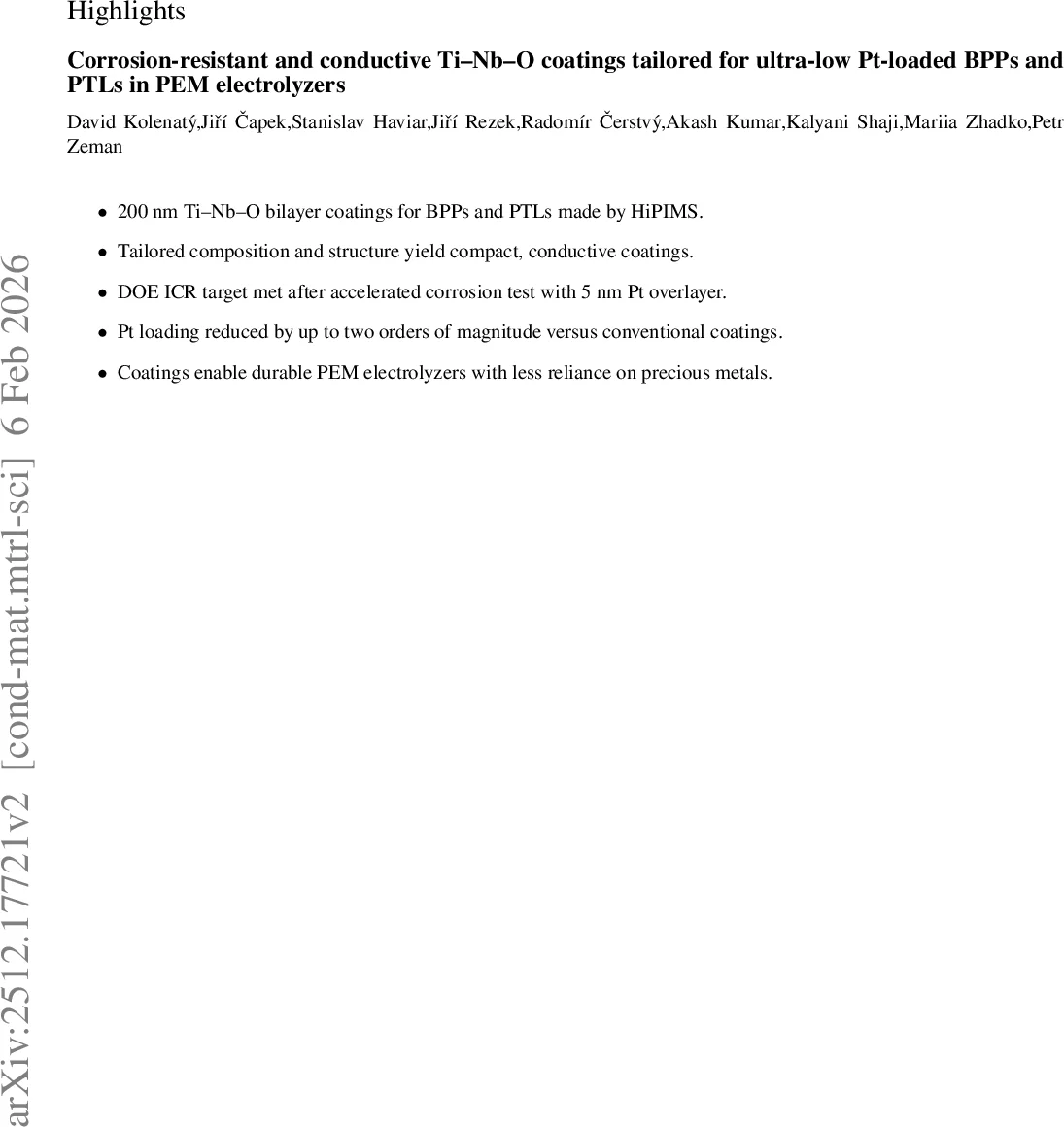
We develop highly corrosion-resistant and conductive Ti-Nb-O coatings for metallic components – bipolar plates (BPPs) and porous transport layers (PTLs) – in PEM water electrolyzers. Using reactive high-power impulse magnetron sputtering (HiPIMS), we deposit compact 200 nm bilayer coatings onto SS316L substrates, systematically tailoring their composition. By precisely controlling oxygen partial pressure and Nb/Ti ratio, we adjust stoichiometry and structure, directly affecting electrical resistivity and corrosion resistance. We examine interfacial contact resistance (ICR) and electrochemical parameters before and after accelerated corrosion testing. Optimized coatings exhibit resistivity on the order of 10^-4 Ohmcm and extremely low corrosion current densities (J_corr = 0.01-0.08 uA/cm^2), well below the U.S. DOE 2026 target. Most importantly, these coatings enable the ICR target after accelerated corrosion testing with a Pt overlayer as thin as 5 nm, reducing Pt loading by up to two orders of magnitude compared to conventional approaches.
💡 Research Summary
The authors address two critical cost drivers in proton‑exchange‑membrane (PEM) electrolyzers – the high loading of precious‑metal catalysts on metallic components such as bipolar plates (BPPs) and porous transport layers (PTLs). By employing high‑power impulse magnetron sputtering (HiPIMS), they deposit a compact 200 nm Ti‑Nb‑O bilayer coating onto AISI 316L stainless‑steel substrates. The lower 100 nm layer is sputtered in pure argon to ensure strong adhesion and electrical continuity, while the upper 100 nm layer is co‑deposited from Ti and Nb targets under controlled oxygen partial pressures (p_Ox = 0, 3, 5, 8 mPa). The Nb content is varied by positioning the substrate at four distances from a Nb strip on the target, yielding Nb/Ti ratios from near zero up to ~0.5.
Compositional analysis by wavelength‑dispersive spectroscopy (WDS) confirms systematic tuning of Ti, Nb, and O atomic fractions. X‑ray diffraction (XRD) shows that optimal coatings (Nb/Ti ≈ 0.3, p_Ox ≈ 5 mPa) are largely amorphous with a nanocrystalline Ti‑Nb‑O network, a structure that simultaneously provides a percolating electronic pathway and a dense, chemically stable oxide barrier. Four‑point probe measurements on glass‑supported films give an electrical resistivity of ~1 × 10⁻⁴ Ω·cm, an order of magnitude lower than typical TiN, TiO₂, or Au‑based protective layers.
Accelerated corrosion testing is performed in a three‑electrode cell containing 0.5 M H₂SO₄ with 5 ppm NaF at 60 °C, mimicking PEM electrolyzer conditions. Potentiodynamic polarization yields corrosion current densities (J_corr) of 0.01–0.08 µA cm⁻², comfortably below the U.S. DOE 2026 target of ≤0.1 µA cm⁻². Interfacial contact resistance (ICR) is measured using a gold‑coated copper electrode, a carbon gas‑diffusion layer (GDL), and the coated BPP under a 1 A current with compaction pressures ranging from 0.3 to 2 MPa. After the corrosion protocol, a 5 nm Pt overlayer deposited by RF sputtering reduces the ICR to 9.8 mΩ·cm² (pre‑test) and 10.2 mΩ·cm² (post‑test) at 1 MPa, satisfying the DOE requirement of ICR < 10 mΩ·cm². This Pt thickness is two orders of magnitude thinner than conventional Pt or Au coatings (typically ≥200 nm), representing a ~100‑fold reduction in precious‑metal usage.
Key insights include: (1) Nb incorporation dramatically enhances the electronic conductivity of Ti‑O based oxides while preserving their corrosion resistance; (2) precise oxygen partial‑pressure control yields a mixed amorphous‑nanocrystalline Ti‑Nb‑O phase that balances low resistivity with chemical stability; (3) an ultra‑thin (5 nm) Pt layer is sufficient to achieve DOE‑compliant ICR when backed by the conductive Ti‑Nb‑O underlayer, enabling drastic Pt savings. The authors also discuss practical considerations for PTL implementation: Ti‑based PTLs can directly adopt the presented protocol, whereas stainless‑steel PTLs may require additional internal surface treatments (e.g., Ti electro‑plating) to prevent metal‑ion leaching from uncoated pores.
The study demonstrates a scalable, cost‑effective route to replace expensive Ti or thick Pt/Au coatings on stainless‑steel BPPs and PTLs, thereby lowering the capital cost of PEM electrolyzers and advancing the economic viability of green hydrogen production. Future work should focus on applying the coating to real porous PTL architectures, long‑term durability testing (>80 000 h), and large‑area process scale‑up.
Comments & Academic Discussion
Loading comments...
Leave a Comment