Nash Equilibria in Games with Playerwise Concave Coupling Constraints: Existence and Computation
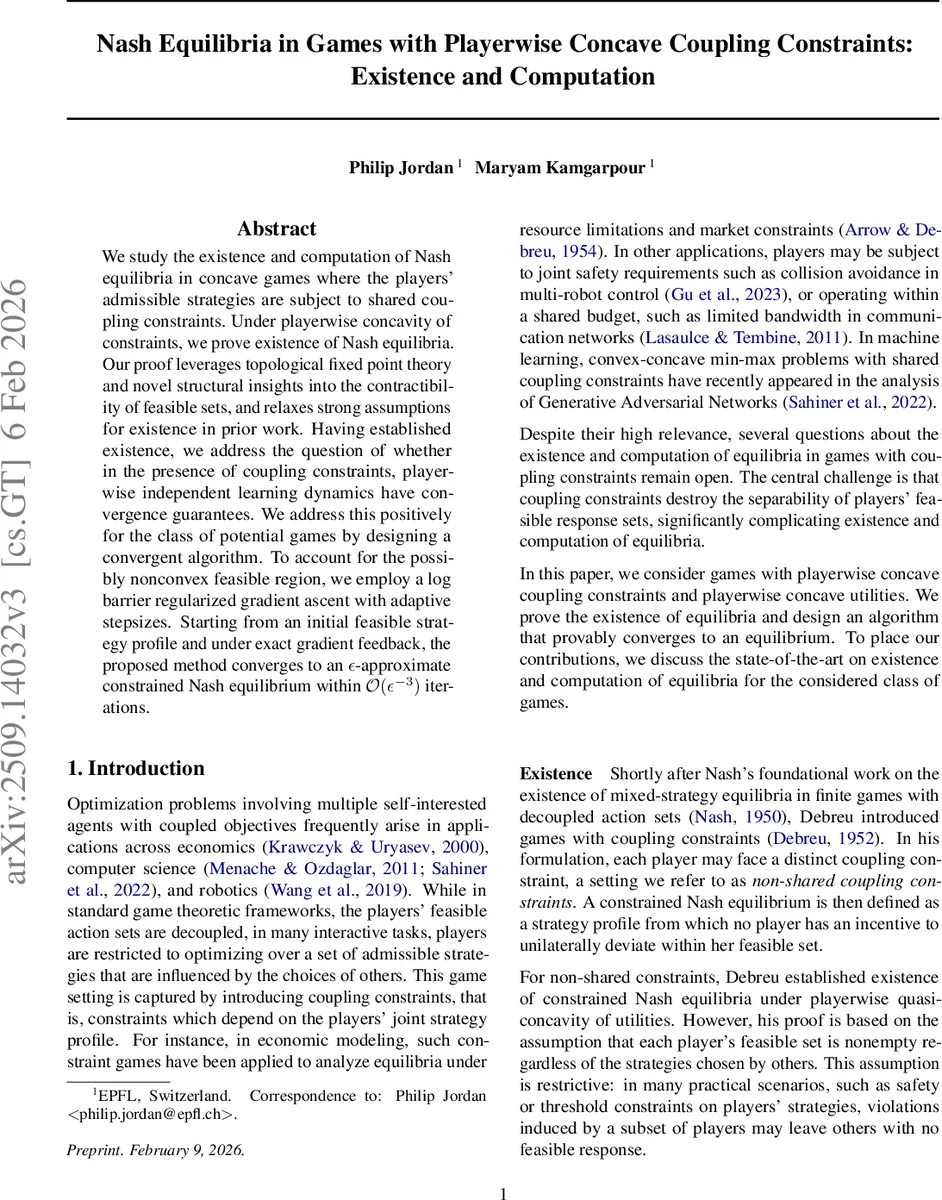
We study the existence and computation of Nash equilibria in concave games where the players’ admissible strategies are subject to shared coupling constraints. Under playerwise concavity of constraints, we prove existence of Nash equilibria. Our proof leverages topological fixed point theory and novel structural insights into the contractibility of feasible sets, and relaxes strong assumptions for existence in prior work. Having established existence, we address the question of whether in the presence of coupling constraints, playerwise independent learning dynamics have convergence guarantees. We address this positively for the class of potential games by designing a convergent algorithm. To account for the possibly nonconvex feasible region, we employ a log barrier regularized gradient ascent with adaptive stepsizes. Starting from an initial feasible strategy profile and under exact gradient feedback, the proposed method converges to an $ε$-approximate constrained Nash equilibrium within $\mathcal{O}(ε^{-3})$ iterations.
💡 Research Summary
The paper tackles two fundamental challenges in continuous‑strategy games that feature shared coupling constraints: (i) establishing the existence of constrained Nash equilibria under weaker assumptions than previously required, and (ii) providing a concrete algorithm that can compute such equilibria in a tractable manner.
Existence under player‑wise concave constraints
Traditional existence results for constrained games fall into two camps. Debreu (1952) handled non‑shared constraints but demanded that each player’s feasible response set be non‑empty regardless of others’ actions—a condition often violated in safety‑critical or resource‑limited settings. Rosen (1965) dealt with shared constraints but required the joint feasible set to be convex; many natural coupling constraints (e.g., bilinear capacity limits) break this convexity. The authors introduce a new structural assumption: each constraint function is concave in a given player’s own decision variable when the others’ decisions are held fixed (player‑wise concavity). This permits the individual feasible slices (C_i(x_{‑i})) to be convex while the overall feasible region (C) may be non‑convex or even disconnected.
Because standard fixed‑point theorems (Brouwer, Kakutani) rely on convexity, the authors turn to a topological generalisation dating back to Eilenberg‑Montgomery (1946) and Begle (1950). They show that under a player‑wise Mangasarian‑Fromovitz constraint qualification (Assumption 3.1) the feasible region’s connected components are contractible—i.e., each can be continuously shrunk to a point within the set. Contractibility is sufficient for the existence of a fixed point of any continuous self‑map on the component (Begle’s theorem). By constructing a best‑response correspondence that is continuous on each component, they prove Theorem 3.4: a constrained Nash equilibrium exists whenever the feasible set is non‑empty and the two assumptions hold. This result relaxes both the joint convexity requirement of Rosen and the universal non‑emptiness condition of Debreu.
Computation for potential games
Having guaranteed existence, the paper focuses on a tractable subclass: potential games with shared player‑wise concave constraints. Potential games admit a scalar potential function (\Phi) whose gradient aligns with each player’s utility gradient, enabling coordinated analysis despite decentralized decision‑making. The authors design a log‑barrier interior‑point algorithm that each player can run independently. At iteration (k), player (i) updates
\
Comments & Academic Discussion
Loading comments...
Leave a Comment