A priori error analysis of the proximal Galerkin method
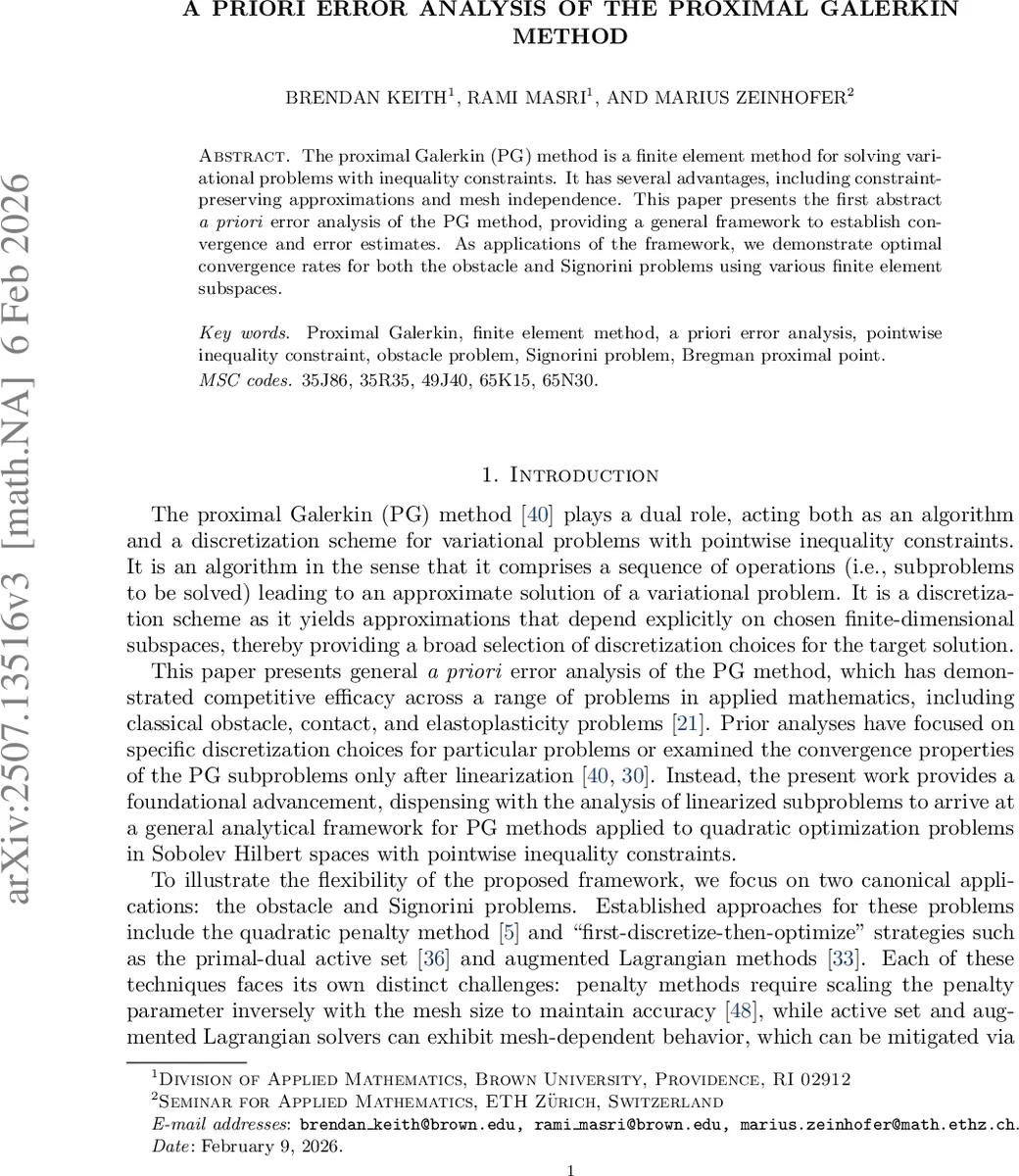
The proximal Galerkin (PG) method is a finite element method for solving variational problems with inequality constraints. It has several advantages, including constraint-preserving approximations and mesh independence. This paper presents the first abstract a priori error analysis of PG methods, providing a general framework to establish convergence and error estimates. As applications of the framework, we demonstrate optimal convergence rates for both the obstacle and Signorini problems using various finite element subspaces.
💡 Research Summary
The paper presents the first abstract a‑priori error analysis for the Proximal Galerkin (PG) method, a finite‑element discretization designed for variational problems with pointwise inequality constraints. The authors begin by formulating a general constrained optimization problem
\
Comments & Academic Discussion
Loading comments...
Leave a Comment