Set-Based Control Barrier Functions for Scalable Safety Filter Design
Industrial control applications require high performance under strict constraints. Control barrier functions (CBFs) provide principled safety mechanisms, but constructing CBF-based safety filters for large-scale systems is challenging. We introduce set-based CBFs for linear systems with convex constraints by defining the barrier via the Minkowski functional of a control invariant set. This invariant set can be obtained from scalable computations, including reachability analysis and model predictive control (MPC). The approach yields tunable safety filters with dampened intervention and asymptotic stability of the set of safe states. We derive reformulations embedding set-based CBF constraints into convex optimization for common set representations and present learning-based approximations reducing runtime while preserving safety. We demonstrate the approach through simulations on a high-dimensional system and a motion control task, and validate the method experimentally on an electric drive with short sampling times.
💡 Research Summary
The paper addresses the pressing need for high‑performance yet safety‑critical control in industrial applications, where strict state and input constraints must be respected at all times. Traditional safety filters based on pre‑computed invariant sets are scalable but suffer from aggressive intervention near the safety boundary and lack guarantees for recovery when the system state leaves the safe region. Conversely, control barrier function (CBF)‑based filters allow tunable boundary behavior but are difficult to construct for large‑scale linear systems with many constraints.
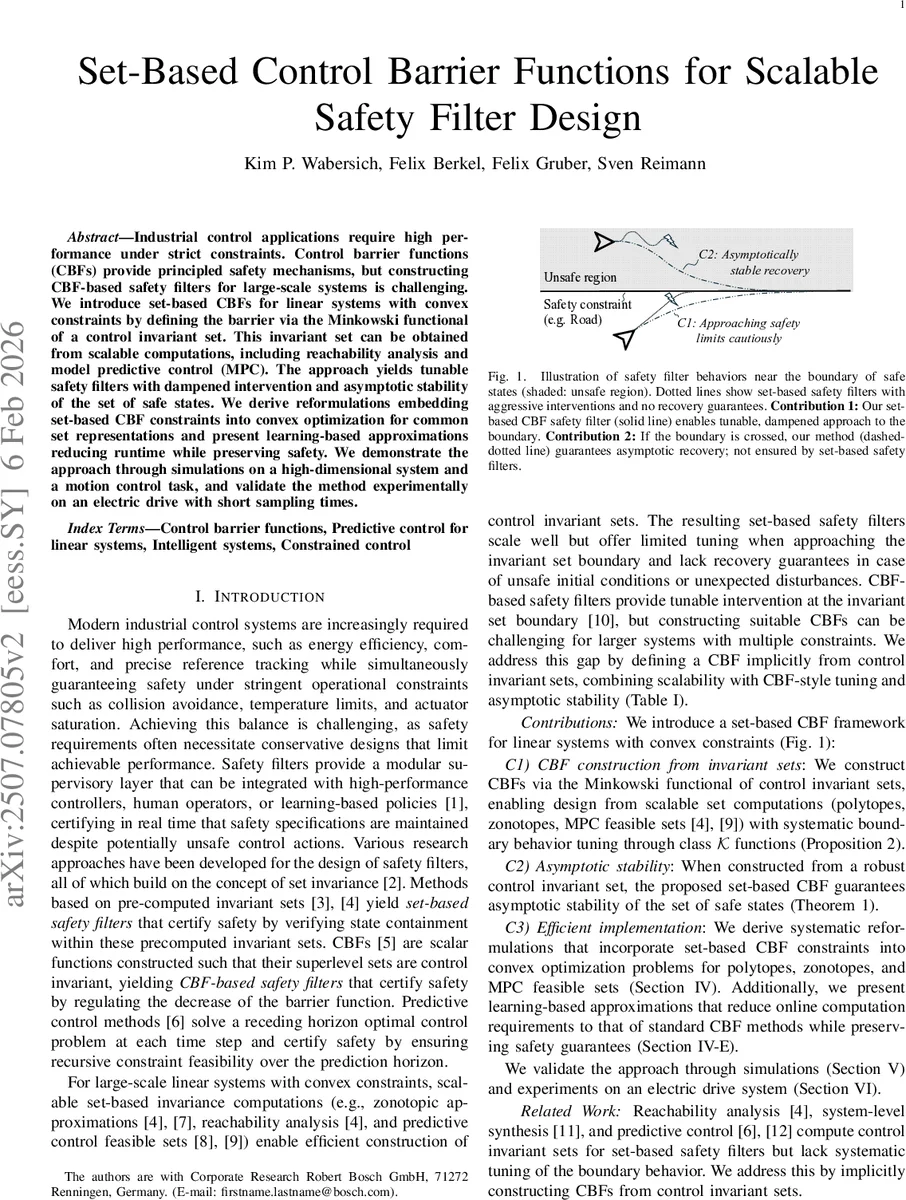
To bridge this gap, the authors propose a set‑based CBF framework for linear systems with convex constraints. The key idea is to define a barrier function implicitly from a control‑invariant set Ω using its Minkowski functional γΩ(x)=inf{γ≥0 | x∈γΩ}. The barrier is then h(x)=1−γΩ(x). If Ω is convex, contains the origin in its interior, and is a control‑invariant set, h satisfies the discrete‑time CBF definition with safe set S=Ω and domain D=S. This construction automatically guarantees forward invariance and enables systematic tuning of the decrease bound Δh(x) through any class‑K function α, providing the desired “soft” approach to the boundary.
For asymptotic recovery, the authors introduce a robust control‑invariant set \tildeΩ that remains invariant under additive disturbances w∈W. By selecting a contraction factor ν∈(0,1) such that \tildeΩ⊖W⊆ν\tildeΩ, the safe set is defined as S=ν\tildeΩ, while the domain of attraction is the larger set D=\tildeΩ. Theorem 1 proves that the same set‑based CBF guarantees asymptotic stability of S on D, i.e., any state inside \tildeΩ (even outside S) can be driven back into S despite bounded disturbances. This provides a non‑local recovery guarantee absent in conventional set‑based filters.
Implementation details cover several common set representations: polytopes (H‑representation), zonotopes (center‑generator form), and MPC feasible sets. For each, the authors derive convex reformulations of the CBF constraint h(Ax+Bu)−h(x)≥−Δh(x) that can be embedded in a single‑level quadratic program (or linear program) together with the original performance objective (e.g., minimizing ‖u−u_des‖). This yields a tractable online optimization that scales with the dimension of the system rather than with the complexity of the invariant set.
To further reduce online computation, a learning‑based approximation is proposed. An offline dataset of (x, h(x), ∇h(x)) pairs is used to train a neural network that predicts the barrier value and its gradient. A conservative safety margin is added to the learned output to preserve the formal safety guarantees. Consequently, the online filter retains the same structure as a standard CBF filter but with evaluation cost comparable to a simple norm calculation.
The authors validate the approach through two simulation studies and an experimental test on an electric drive. In a 20‑dimensional linear system, the set‑based CBF filter exhibits smoother intervention and faster recovery compared to a pure set‑based filter, while achieving performance close to the unconstrained controller. In a 2‑D motion‑control task, the method respects obstacle avoidance and actuator limits without sacrificing trajectory fidelity. The hardware experiment uses a drive with a 1 ms sampling period; when the desired torque would violate voltage or current limits, the safety filter intervenes minimally, keeping the system within safe operating bounds and demonstrating real‑time feasibility.
Overall, the contributions are: (1) a systematic method to construct CBFs from scalable invariant‑set computations; (2) a robust‑invariance based design that guarantees asymptotic stability of the safe set; (3) convex reformulations for various set representations; and (4) a learning‑based surrogate that preserves safety while dramatically cutting runtime. The work is limited to linear dynamics with convex constraints; extending the framework to nonlinear or non‑convex settings remains an open research direction.
Comments & Academic Discussion
Loading comments...
Leave a Comment