Position: Epistemic uncertainty estimation methods are fundamentally incomplete
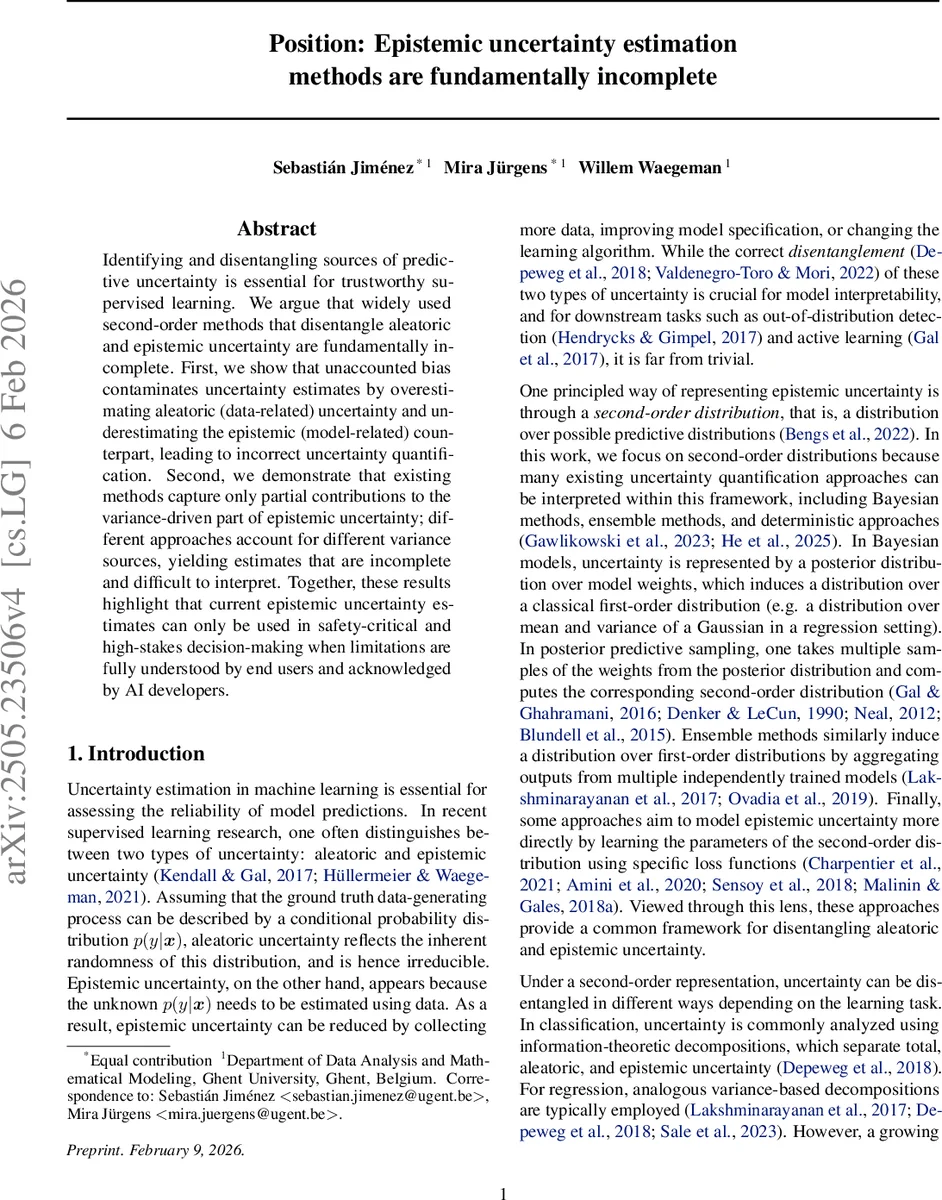
Identifying and disentangling sources of predictive uncertainty is essential for trustworthy supervised learning. We argue that widely used second-order methods that disentangle aleatoric and epistemic uncertainty are fundamentally incomplete. First, we show that unaccounted bias contaminates uncertainty estimates by overestimating aleatoric (data-related) uncertainty and underestimating the epistemic (model-related) counterpart, leading to incorrect uncertainty quantification. Second, we demonstrate that existing methods capture only partial contributions to the variance-driven part of epistemic uncertainty; different approaches account for different variance sources, yielding estimates that are incomplete and difficult to interpret. Together, these results highlight that current epistemic uncertainty estimates can only be used in safety-critical and high-stakes decision-making when limitations are fully understood by end users and acknowledged by AI developers.
💡 Research Summary
The paper puts forward a strong position that contemporary epistemic uncertainty estimation methods—particularly those based on second‑order distributions—are fundamentally incomplete. The authors first review the landscape of uncertainty quantification in supervised learning, distinguishing aleatoric (data‑intrinsic) from epistemic (model‑related) uncertainty. They adopt a unifying framework in which a second‑order distribution q(θ|x) over model parameters induces a predictive distribution via model averaging. This framework encompasses Bayesian posteriors, deep ensembles, and evidential (deterministic) approaches.
The core argument is built on two observations. (1) Bias contaminates uncertainty estimates. By extending the classic bias‑variance decomposition to any proper scoring rule through Bregman divergences, the authors decompose the expected loss into three terms: (i) the intrinsic aleatoric term (the entropy of the true conditional distribution), (ii) a generalized bias term measuring the divergence between the averaged predictive distribution and the true data‑generating distribution, and (iii) a generalized variance term capturing variability due to data sampling and procedural randomness. The bias term itself splits into approximation error (model class misspecification) and estimation bias (systematic deviation caused by regularisation, initialization, optimisation, etc.). Because modern neural networks are heavily regularised, this bias can be large, leading to systematic over‑estimation of aleatoric uncertainty and under‑estimation of epistemic uncertainty.
(2) Only partial variance contributions are captured. The variance component can be further decomposed into data uncertainty (variability arising from the stochasticity of the observations) and procedural uncertainty (variability due to random training factors such as weight initialisation, data ordering, or stochastic optimisation). Existing second‑order methods each capture only a subset of these sources. Deep ensembles, for instance, reflect procedural uncertainty but ignore the extra variance introduced by different training data draws. Monte‑Carlo dropout or evidential networks may model data‑driven variance but fail to account for procedural effects. Consequently, the epistemic uncertainty reported by any single method is an incomplete picture of the total predictive variance.
To illustrate these points, the authors construct a synthetic one‑dimensional regression problem with heteroscedastic noise (σ²(x)=x⁴) and a nonlinear target function. The domain is split into a left region where the function is complex and noise low (high epistemic, low aleatoric) and a right region where the function is simple and noise high (low epistemic, high aleatoric). Using a multilayer perceptron that predicts both mean and variance, they aggregate predictions from multiple independently trained networks (deep ensembles). Visualisations (Figures 1‑4) show that in the high‑bias region the aleatoric estimate is inflated while the epistemic estimate collapses, exactly as predicted by the bias‑variance analysis. Additional experiments in the appendix confirm the phenomenon on real‑world regression datasets and with other second‑order estimators.
The paper also surveys related critical work: identifiability and convergence pathologies in evidential risk minimisation, epistemic collapse in over‑parameterised Bayesian networks, and theoretical inconsistencies between aleatoric/epistemic decompositions. It situates its contribution among these critiques, emphasizing that the incompleteness identified here is more structural: any method that relies solely on a second‑order distribution cannot simultaneously correct for model bias and capture the full variance decomposition.
In the discussion, alternative perspectives on epistemic uncertainty are examined, such as distributional shift‑focused uncertainty (distributional uncertainty) and approaches that explicitly model model‑class uncertainty. The authors argue that while these alternatives may alleviate some issues, they still require careful handling of bias and variance components.
The conclusion urges practitioners, especially in safety‑critical or high‑stakes domains, to treat epistemic uncertainty estimates from current second‑order methods with caution. Developers must disclose the inherent limitations—bias‑induced aleatoric inflation, epistemic under‑estimation, and partial variance coverage—so that end‑users can make informed decisions about model reliability. The paper calls for future research to develop uncertainty estimators that either incorporate bias correction mechanisms or move beyond the restrictive second‑order paradigm.
Comments & Academic Discussion
Loading comments...
Leave a Comment