Canonical torus action on symplectic singularities
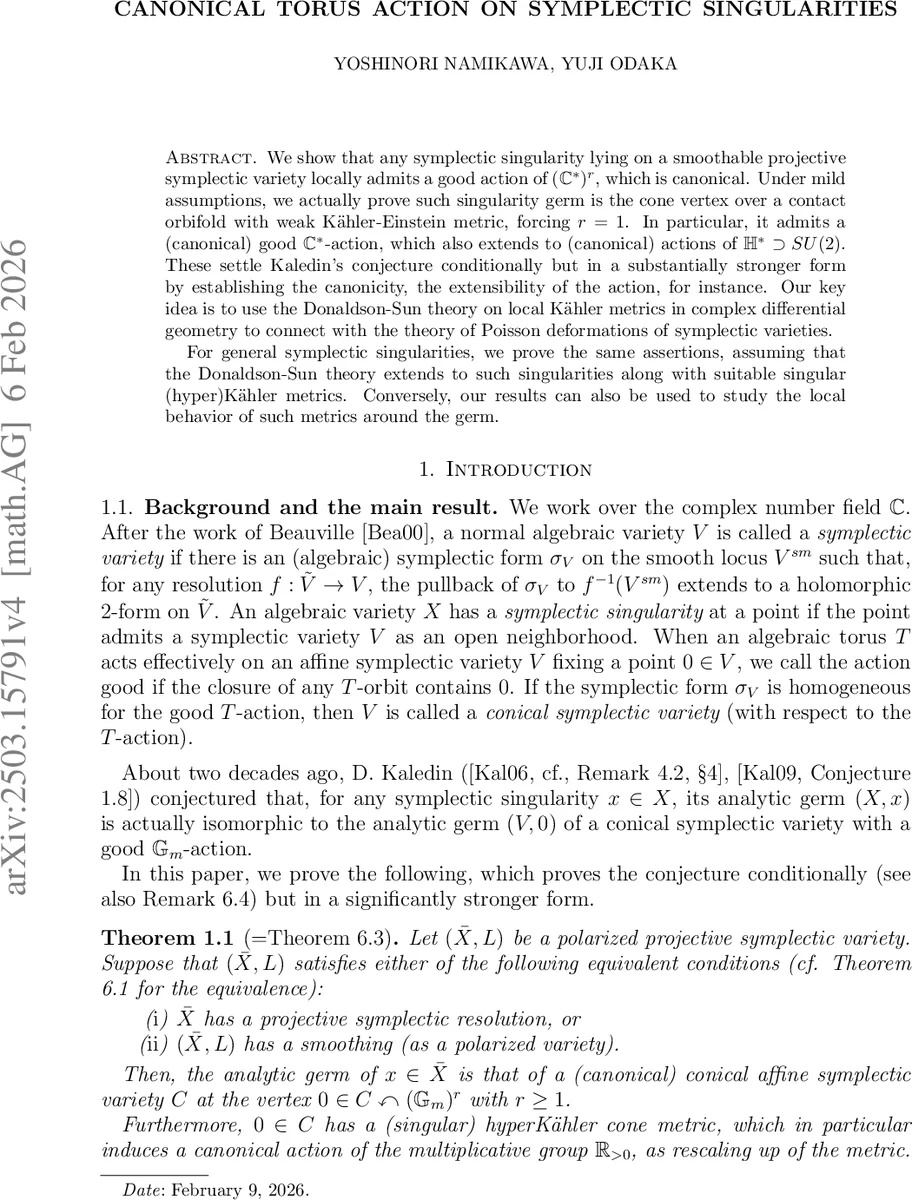
We show that any symplectic singularity lying on a smoothable projective symplectic variety locally admits a good action of $(\mathbb{C}^)^r$, which is canonical. Under mild assumptions, we actually prove such singularity germ is the cone vertex over a contact orbifold with weak Kähler-Einstein metric, forcing $r=1$. In particular, it admits a (canonical) good $\mathbb{C}^$-action, which also extends to (canonical) actions of $\mathbb{H}^*\supset SU(2)$. These settle Kaledin’s conjecture conditionally but in a substantially stronger form by establishing the canonicity, the extensibility of the action, for instance. Our key idea is to use the Donaldson-Sun theory on local Kähler metrics in complex differential geometry to connect with the theory of Poisson deformations of symplectic varieties. For general symplectic singularities, we prove the same assertions, assuming that the Donaldson-Sun theory extends to such singularities along with suitable singular (hyper)Kähler metrics. Conversely, our results can also be used to study the local behavior of such metrics around the germ.
💡 Research Summary
The paper addresses a long‑standing conjecture of D. Kaledin concerning the local structure of symplectic singularities. A symplectic singularity is a normal algebraic variety whose smooth locus carries a holomorphic symplectic form that extends (as a closed 2‑form) to any resolution. Kaledin conjectured that every such singularity germ is analytically isomorphic to the germ of a conical symplectic variety equipped with a good (\mathbb{G}_m)‑action (i.e. a (\mathbb{C}^*)‑action whose closure of every orbit contains the cone vertex).
The authors prove a far stronger, conditional version of this conjecture. Their main result (Theorem 1.1) states that if a symplectic singularity (x\in \bar X) lies on a projective symplectic variety ((\bar X,L)) that either admits a projective symplectic resolution or is smoothable as a polarized variety, then the analytic germ ((\bar X,x)) is isomorphic to the germ of an affine conical symplectic variety (C) at its vertex, and (C) carries a canonical action of an algebraic torus ((\mathbb{C}^)^{r}) with (r\ge 1). Moreover, (C) admits a singular hyper‑Kähler cone metric; the associated real scaling group (\mathbb{R}{>0}) coincides with the restriction of the algebraic torus action via a Lie‑group embedding (\mathbb{R}{>0}\hookrightarrow (\mathbb{C}^)^{r}).
A key novelty is the canonicity of the torus action: the rank (r) and the action are uniquely determined by the analytic germ of the singularity, not merely existential. Under mild additional hypotheses (e.g. (b_2(X)\ge 6) or the existence of a non‑trivial isotropic class in (c_1(L)^\perp) with respect to the Beauville–Bogomolov form) the authors prove that (r=1). Consequently the singularity is a cone over a contact orbifold that carries a weak Kähler–Einstein metric, and the torus reduces to a single (\mathbb{C}^)‑action. This yields a canonical (\mathbb{C}^)‑action extending further to an action of the quaternionic group (\mathbb{H}^*\supset SU(2)).
The proof intertwines complex differential geometry with Poisson deformation theory. The authors use the Donaldson–Sun theory of metric tangent cones for singular Kähler–Ricci‑flat metrics. For a smoothable projective symplectic variety, the metric tangent cone at (x) is a metric cone (C) whose smooth part is a Riemannian Sasakian manifold with Reeb vector field (\xi). The closure of the one‑parameter group generated by (\xi) complexifies to an algebraic torus (T\cong (\mathbb{C}^*)^{r}).
To relate the metric cone to an algebraic cone, they construct two flat families:
-
Scale‑up Poisson deformation (X\to \mathbb{A}^1): choosing a one‑parameter subgroup (G_m\subset T) whose infinitesimal generator approximates (\xi), they produce a (G_m)‑equivariant flat degeneration whose central fiber is a variety (W). They show that the symplectic form on the smooth locus of (X) extends to a (G_m)‑homogeneous symplectic form on (W). This step relies on a delicate Diophantine approximation argument (Kronecker–Weyl type) to control the metric behavior and ensure the Poisson structure persists.
-
T‑equivariant Poisson deformation (W_D\to D): a second flat family with full torus (T) action degenerates (W) to the metric cone (C). Again the symplectic form extends homogeneously.
Both families are shown to be formally rigid: the induced Poisson deformations of the formal completions ((X,x)^\wedge) and ((W,0)^\wedge) are trivial, yielding formal Poisson isomorphisms ((X,x)^\wedge\cong (C,0)^\wedge). By Artin approximation, this lifts to an analytic isomorphism of germs, establishing the main theorem.
The authors also prove a generalized theorem (Theorem 1.4) that removes the global projectivity assumption, assuming instead that the singularity admits a singular hyper‑Kähler metric and that the Donaldson–Sun theory extends to such singularities (Conjecture 1.3). Under these hypotheses the same conclusions hold.
Further consequences are explored:
- For isolated symplectic singularities, the cone metric on (C) approximates the original metric on (\bar X) to order (O(r^\delta)) in the radial coordinate.
- In many natural examples (e.g., hyper‑Kähler quotients such as Nakajima quiver varieties, toric hyper‑Kähler manifolds, O’Grady’s ten‑folds), the conditions are satisfied and (r=1) is confirmed.
- The quotient ((C\setminus{0})/\mathbb{G}_m) yields a log‑Fano pair ((F,\Delta)) with a contact orbifold structure; when (r=1) this pair admits a Kähler–Einstein metric and is log K‑polystable, providing a systematic construction of non‑homogeneous log K‑stable Fano varieties without explicit K‑stability calculations.
The paper also discusses technical obstructions: extending the Donaldson–Sun theory to arbitrary log terminal singularities and establishing a Darboux‑type theorem for singular symplectic forms parallel to the metric. Overcoming these would fully resolve Kaledin’s conjecture.
In summary, the work establishes that symplectic singularities arising from smoothable projective symplectic varieties are canonically conical, equipped with a uniquely determined torus action that often reduces to a single (\mathbb{C}^*). The argument blends metric tangent cone analysis, Diophantine approximation, and Poisson deformation rigidity, and opens pathways to further applications in contact geometry, log Fano theory, and the study of singular hyper‑Kähler metrics.
Comments & Academic Discussion
Loading comments...
Leave a Comment