Train on classical, deploy on quantum: scaling generative quantum machine learning to a thousand qubits
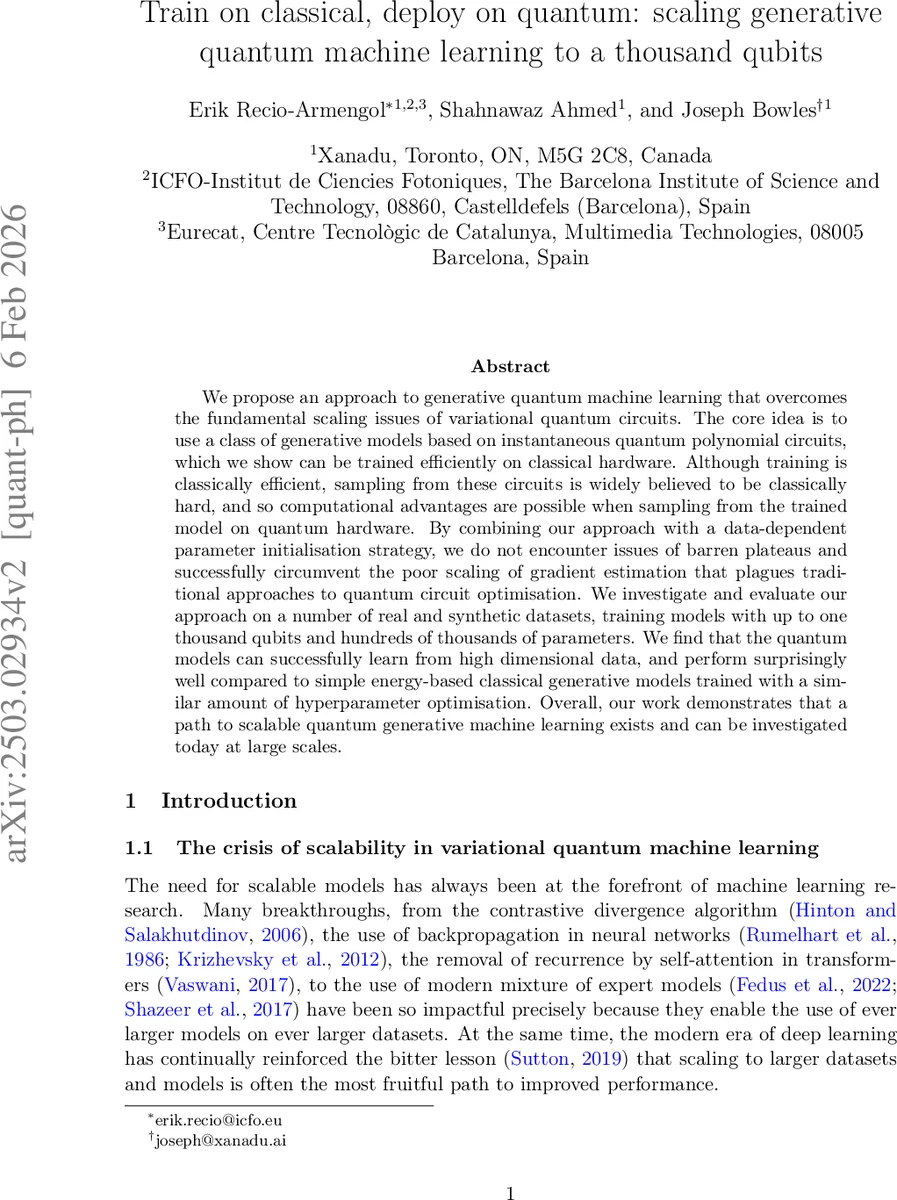
We propose an approach to generative quantum machine learning that overcomes the fundamental scaling issues of variational quantum circuits. The core idea is to use a class of generative models based on instantaneous quantum polynomial circuits, which we show can be trained efficiently on classical hardware. Although training is classically efficient, sampling from these circuits is widely believed to be classically hard, and so computational advantages are possible when sampling from the trained model on quantum hardware. By combining our approach with a data-dependent parameter initialisation strategy, we do not encounter issues of barren plateaus and successfully circumvent the poor scaling of gradient estimation that plagues traditional approaches to quantum circuit optimisation. We investigate and evaluate our approach on a number of real and synthetic datasets, training models with up to one thousand qubits and hundreds of thousands of parameters. We find that the quantum models can successfully learn from high dimensional data, and perform surprisingly well compared to simple energy-based classical generative models trained with a similar amount of hyperparameter optimisation. Overall, our work demonstrates that a path to scalable quantum generative machine learning exists and can be investigated today at large scales.
💡 Research Summary
The paper tackles the long‑standing scalability bottlenecks of variational quantum machine learning (VQML), namely barren plateaus and the prohibitive cost of gradient estimation, by proposing a completely different training paradigm: “train on classical, deploy on quantum.” The authors focus on generative modeling with parameterised instantaneous quantum polynomial (IQP) circuits, a class of shallow, commuting‑gate circuits whose output probabilities are believed to be hard to sample classically (i.e., #P‑hard).
The key technical insight is that the maximum‑mean‑discrepancy (MMD) loss, widely used for training implicit generative models, can be expressed as a linear combination of expectation values of Pauli‑Z observables. Rudolph et al. (2024) showed this decomposition, and den Nest (2010) proved that for IQP circuits those Pauli‑Z expectation values can be computed exactly in polynomial time on a classical computer. By plugging the classical simulation algorithm into the MMD loss, the authors obtain a fully classical objective that can be differentiated with automatic differentiation. Consequently, the gradient of the loss with respect to the circuit parameters can be obtained without ever running the quantum circuit during training. This eliminates the need for millions of quantum circuit evaluations that would otherwise be required for stochastic gradient estimation.
To avoid barren plateaus, the authors introduce a data‑dependent parameter initialisation scheme. They initialise the rotation angles of two‑qubit gates proportionally to the variance (or covariance) of the training data, ensuring that the initial point already lies on a region of the loss landscape with non‑vanishing gradients. Empirically, this strategy prevents the exponential concentration of gradients that plagues random initialisation.
The training pipeline is implemented in JAX, leveraging the newly released IQPopt library. Because the loss reduces to linear‑algebra operations, the algorithm scales linearly with both the number of qubits and the number of gates. The authors demonstrate training of IQP models with up to 1 000 qubits and hundreds of thousands of parameters on a single compute node, showing that the method can exploit GPUs/TPUs just like large neural networks.
After training, the learned parameters θ* are uploaded to a quantum processor, and the circuit is sampled to generate new data. Since IQP sampling is believed to be classically intractable, this step could provide a quantum advantage. The authors evaluate the generative performance using two metrics: (i) test‑set MMD and (ii) kernel‑generalised empirical likelihood (Kernel‑GEL). They compare against two energy‑based classical baselines—a restricted Boltzmann machine and a feed‑forward neural‑network energy model—trained with comparable hyper‑parameter search budgets. Across synthetic, image (MNIST‑like), and genomics datasets, the IQP models match or surpass the classical baselines. Notably, on larger datasets the classical models suffer from mode collapse or training instability, whereas the quantum models remain stable, suggesting that the quantum architecture mitigates some of the optimization pathologies of classical energy‑based models.
Additional experiments probe the role of quantum coherence: when the authors deliberately decohere the IQP circuit (turning it into a purely classical stochastic process), training performance degrades dramatically, indicating that genuine quantum interference contributes to the model’s expressive power. They also demonstrate encoding a global bit‑flip (Z₂) symmetry into the circuit, which aligns with the bias of a particular dataset and improves performance, hinting at a systematic way to incorporate known symmetries.
The paper situates its contribution among related works: prior attempts to use classical simulability for training (e.g., tensor‑network pre‑training, matchgate circuits) either remain classically simulable and thus cannot yield quantum advantage, or still require quantum training for large‑scale models. By contrast, the present approach fully offloads the costly optimisation to classical hardware while retaining a quantum‑hard sampling step at inference time.
In summary, the authors provide (1) a theoretically sound reduction of a generative loss to classically computable quantities for IQP circuits, (2) a practical initialization method that sidesteps barren plateaus, and (3) empirical evidence that large‑scale IQP generative models can be trained efficiently and can compete with state‑of‑the‑art classical energy‑based models. This work therefore opens a realistic pathway toward scalable quantum generative machine learning, leveraging current classical compute resources and anticipating future quantum hardware for the sampling phase where potential quantum speed‑ups may emerge.
Comments & Academic Discussion
Loading comments...
Leave a Comment