Braidings for Non-Split Tambara-Yamagami Categories over the Reals
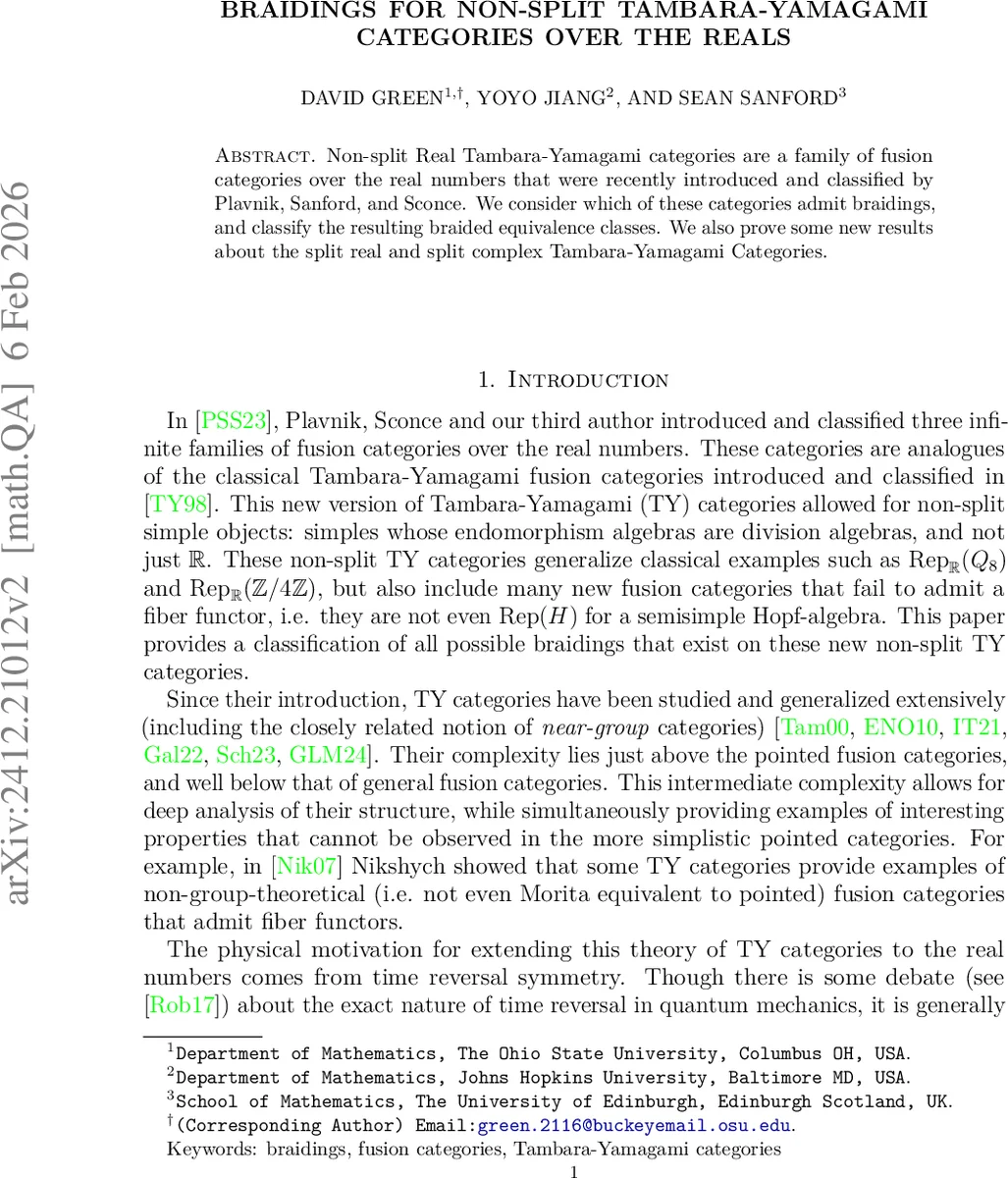
Non-split Real Tambara-Yamagami categories are a family of fusion categories over the real numbers that were recently introduced and classified by Plavnik, Sanford, and Sconce. We consider which of these categories admit braidings, and classify the resulting braided equivalence classes. We also prove some new results about the split real and split complex Tambara-Yamagami Categories. V2: Final Section removed, to appear in Transformation Groups.
💡 Research Summary
This paper provides a complete classification of braidings on the recently introduced family of non‑split Tambara‑Yamagami (TY) fusion categories over the real numbers, together with a parallel analysis of the split real and split complex cases. A TY category is determined by a finite abelian 2‑group A, a non‑degenerate bicharacter χ:A×A→K×, and a square root τ of |A|. In the non‑split setting the endomorphism algebras of the unit object 1 and the distinguished non‑invertible object m can be ℝ, ℂ or the quaternions ℍ, and when End(m)=ℂ a Galois automorphism of ℂ/ℝ must be specified.
The authors begin by translating the hexagon and inverse‑hexagon equations for a braiding into a finite system of polynomial equations for “braiding coefficients’’ on simple objects, using the Yoneda lemma and Schur’s lemma. They show that these coefficients are completely determined by a quadratic form σ on A satisfying δσ=χ; such σ are called χ‑admissible. Consequently, the existence of a braiding is equivalent to the existence of a χ‑admissible quadratic form, and distinct braidings correspond to Aut(A,χ)‑orbits of such forms.
A striking structural result is that for every real‑linear (split or non‑split) TY category there is essentially a unique family of bicharacters that can support a braiding. The classification therefore reduces to counting Aut(A,χ)‑orbits of χ‑admissible quadratic forms and determining how many distinct braidings each orbit yields. The authors tabulate these numbers in Table 1 for the four possible pairs (End(1), End(m))—namely ℝ/ℝ, ℝ/ℂ, ℝ/ℍ and the Galois‑nontrivial ℝ/ℂ case. For example, in the ℝ/ℂ (real unit, complex non‑invertible) case there are two χ‑admissible orbits, each giving two braidings, for a total of four inequivalent braided structures. Similar counts are given for the other three cases.
The split complex TY categories (ℂ/ℂ) behave differently: three families of bicharacters arise, distinguished by the multiplicity |ℓ| (mod 3) of the basic quadratic form ℓ on ℤ/2ℤ with ℓ(g,g)=−1. Table 2 shows that when |ℓ|=0 there are two χ‑admissible orbits, each yielding two braidings (total 4); when |ℓ|=1 or 2 there are four orbits, giving eight braidings in each case. In all split complex cases τ and the distinguished element σ₃(1) are invariants of the braided structure, and the classification is up to complex‑linear equivalences.
Symmetry (whether the braiding is symmetric) and non‑degeneracy (whether the resulting braided category is modular) are governed by the signs of τ and σ, where the sign of σ is defined via the Gauss sum Σ(σ). Table 3 summarizes the outcomes: for real/complex with the identity Galois action, symmetry requires sgn(σ)=sgn(τ); with the complex‑conjugation Galois action symmetry never occurs. Non‑degeneracy only appears when the group of invertible objects is trivial or extremely small; in the split complex case the non‑degenerate examples are precisely the semion and reverse‑semion categories.
Finally, the authors prove that in the “complex‑over‑complex’’ situation where the non‑invertible object is Galois‑nontrivial, no braiding can exist. The obstruction comes from the presence of objects whose endomorphism algebra is a non‑trivial Galois extension, which prevents the construction of a compatible quadratic form.
Methodologically, the paper combines categorical descent (Etingof–Gelaki), explicit computation of hexagon equations, and classical number‑theoretic tools such as Gauss sums and the classification of quadratic forms on finite 2‑groups (Wall, 1963). The results have a clear physical motivation: time‑reversal symmetry in (2+1)‑dimensional topological quantum field theories is modeled by real‑linear braided fusion categories, and the classifications here enumerate all possible such symmetry‑enriched phases arising from TY data.
In summary, the work delivers a thorough, case‑by‑case enumeration of all braided structures on real‑linear (both split and non‑split) Tambara‑Yamagami categories, clarifies when these braidings are symmetric or modular, and identifies the precise obstruction in the complex‑over‑complex non‑split case. This advances the understanding of real fusion categories and provides a concrete catalogue for applications in mathematical physics.
Comments & Academic Discussion
Loading comments...
Leave a Comment