Investigating cosmic strings using large-volume hydrodynamical simulations in the context of JWST's massive UV-bright galaxies
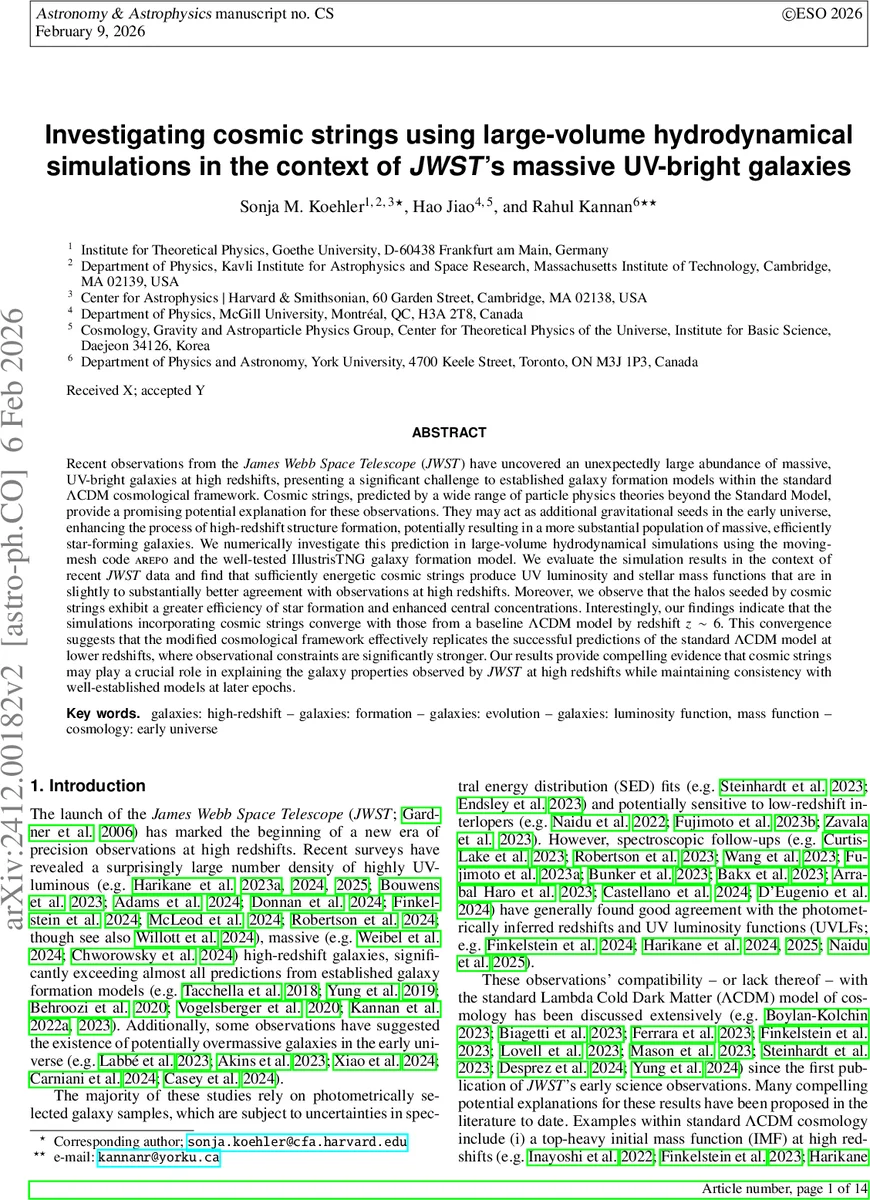
Recent observations from the James Webb Space Telescope (JWST) have uncovered an unexpectedly large abundance of massive, UV-bright galaxies at high redshifts, presenting a significant challenge to established galaxy formation models within the standard $Λ$CDM cosmological framework. Cosmic strings, predicted by a wide range of particle physics theories beyond the Standard Model, provide a promising potential explanation for these observations. They may act as additional gravitational seeds in the early universe, enhancing the process of high-redshift structure formation, potentially resulting in a more substantial population of massive, efficiently star-forming galaxies. We numerically investigate this prediction in large-volume hydrodynamical simulations using the moving-mesh code AREPO and the well-tested IllustrisTNG galaxy formation model. We evaluate the simulation results in the context of recent JWST data and find that sufficiently energetic cosmic strings produce UV luminosity and stellar mass functions that are in slightly to substantially better agreement with observations at high redshifts. Moreover, we observe that the halos seeded by cosmic strings exhibit a greater efficiency of star formation and enhanced central concentrations. Interestingly, our findings indicate that the simulations incorporating cosmic strings converge with those from a baseline $Λ$CDM model by redshift $z \sim 6$. This convergence suggests that the modified cosmological framework effectively replicates the successful predictions of the standard $Λ$CDM model at lower redshifts, where observational constraints are significantly stronger. Our results provide compelling evidence that cosmic strings may play a crucial role in explaining the galaxy properties observed by JWST at high redshifts while maintaining consistency with well-established models at later epochs.
💡 Research Summary
The paper tackles the “high‑z UV‑bright galaxy excess” revealed by JWST, where the observed number density of massive, UV‑luminous galaxies at redshifts z ≳ 10 far exceeds predictions from standard ΛCDM‑based galaxy formation models. The authors propose cosmic strings—linear topological defects predicted by many beyond‑Standard‑Model theories—as an additional source of early gravitational perturbations that could seed the formation of massive dark‑matter halos and, consequently, massive star‑forming galaxies at very early times.
To test this hypothesis, they run a suite of large‑volume (148 cMpc on a side) hydrodynamical simulations with the moving‑mesh code AREPO, coupled to the well‑validated IllustrisTNG galaxy‑formation model. The baseline simulation follows a concordance ΛCDM cosmology. For the string‑enhanced runs they embed cosmic‑string loops directly into the initial conditions at z = 127 using a Zel’dovich‑approximation correction to particle positions and velocities. Two string‑tension values are explored: G µ = 10⁻⁸ (labelled CS‑8) and G µ = 10⁻¹⁰ (CS‑10). For each tension three realizations with different random loop placements are generated, providing statistical robustness. Loop masses are set by M_loop = β µ R, with a lower cutoff of 10⁷ M⊙ for CS‑8 and 10⁵ M⊙ for CS‑10, both safely below the dark‑matter and gas particle masses (1.74 × 10⁸ M⊙ and 3.24 × 10⁷ M⊙ respectively).
The simulations are evolved to z = 6, outputting halo and galaxy catalogs via the Subfind‑HBT algorithm. The authors compare UV luminosity functions (UVLFs) and stellar‑mass functions (SMFs) from the runs with recent JWST measurements and with a composite ΛCDM benchmark derived from previous large‑volume TNG runs (K23).
Key findings:
-
Enhanced high‑z galaxy abundance – The CS‑8 runs produce significantly higher number densities of UV‑bright galaxies at z ≳ 10, bringing the simulated UVLF and SMF into much better agreement with JWST data (typically 30–70 % higher than the ΛCDM baseline). The CS‑10 runs also show an uplift, though more modest.
-
Increased star‑formation efficiency – Halos that host string‑induced overdensities exhibit star‑formation efficiencies 1.5–2 times larger than typical ΛCDM halos of comparable mass, and they develop higher central concentrations, reflecting the deeper potential wells seeded by the loops.
-
Redshift‑dependent convergence – By z ≈ 6 the differences between the string‑enhanced and ΛCDM simulations have largely vanished; all models converge on similar halo mass functions, UVLFs, and SMFs. This demonstrates that the string effect is confined to the earliest epochs and does not spoil the successful low‑z predictions of ΛCDM.
-
Robustness checks – The authors validate their results against the K23 suite, applying resolution corrections and confirming that the trends persist across different simulation volumes and resolutions.
The paper acknowledges uncertainties in the loop scaling distribution, especially the poorly constrained small‑loop population that dominates the stochastic gravitational‑wave background but contributes less to halo seeding. They argue that the most reliable constraint on G µ comes from CMB anisotropies (G µ < 10⁻⁷), which comfortably encompasses the values explored.
In conclusion, the study provides the first full‑physics hydrodynamical demonstration that cosmic strings with G µ ≈ 10⁻⁸ can naturally boost early structure formation enough to alleviate the JWST‑observed excess of massive, UV‑bright galaxies, while preserving the well‑tested ΛCDM predictions at later times. This positions cosmic strings as a compelling, testable extension to the standard cosmological model, motivating further observational probes (e.g., CMB, pulsar timing arrays, and future gravitational‑wave detectors) to tighten the allowed string‑tension parameter space.
Comments & Academic Discussion
Loading comments...
Leave a Comment