Universal Negative Energetic Elasticity in Polymer Chains: Crossovers among Random, Self-Avoiding, and Neighbor-Avoiding Walks
Negative energetic elasticity in gels challenges the conventional understanding of gel elasticity; despite extensive research, a concise explanation remains elusive. In this study, we use the weakly self-avoiding walk (the Domb-Joyce model; DJ model) and interacting self-avoiding walk (ISAW) to investigate the emergence of negative energetic elasticity in polymer chains. Using exact enumeration, we show that both the DJ model and ISAW exhibit negative energetic elasticity, which is caused by effective soft-repulsive interactions between polymer segments. Moreover, we find that a universal scaling law for the internal energy of both models, with a common exponent of $7/4$, holds consistently across both random-walk-self-avoiding-walk and self-avoiding-walk-neighbor-avoiding-walk crossovers. These findings suggest that negative energetic elasticity is a fundamental and universal property of polymer networks and chains.
💡 Research Summary
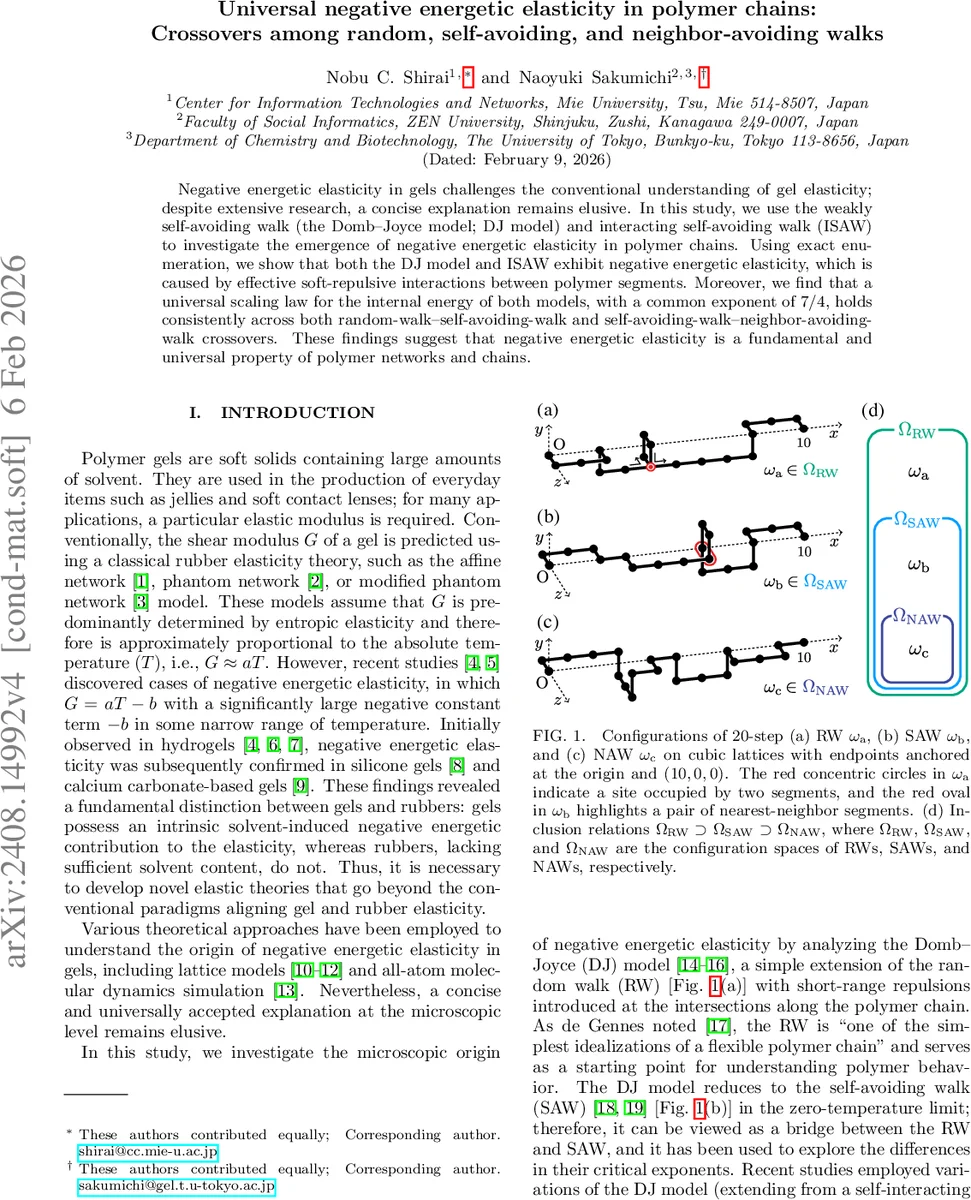
This paper tackles the puzzling observation of negative energetic elasticity in polymer gels—a phenomenon where the shear modulus G can be expressed as G = a T − b with a sizable negative constant b, contrary to the purely entropic predictions of classical rubber elasticity. To uncover the microscopic origin, the authors study two lattice polymer models that incorporate soft repulsive interactions: the Domb‑Joyce (DJ) model, which extends a simple random walk (RW) by assigning an energy penalty ε>0 each time two monomers occupy the same lattice site, and the interacting self‑avoiding walk (ISAW), which adds a soft nearest‑neighbor repulsion to a self‑avoiding walk (SAW). By varying ε from zero to infinity, the DJ model interpolates continuously between RW (ε=0) and SAW (ε→∞), while ISAW bridges SAW and the neighbor‑avoiding walk (NAW).
The authors perform exhaustive exact enumeration of all possible chain configurations for lengths up to n = 20 (and selected longer lengths) under an on‑axis constraint (end‑to‑end vector (r,0,0)). For each configuration they count the number of interacting pairs m, thereby constructing the multiplicity tables W_{n,m}(r) – the number of configurations with given length n, end‑to‑end distance r, and interaction count m. These tables are validated against known results for pure RW and SAW, and against combinatorial formulas for total RW counts, confirming the correctness of the enumeration.
With the multiplicities in hand, the partition function is written as
Z(r,β ε) = ∑{m=0}^{m_max} W{n,m}(r) e^{−β ε m},
where β = 1/(k_B T). From Z they derive the free energy A = −k_B T ln Z, the internal energy U = ε ⟨m⟩, and the entropy S = (U − A)/T. The mechanical stiffness (second derivative of A with respect to r) is evaluated using finite‑difference expressions involving ΔW and Δ²W. Importantly, the stiffness is decomposed into an entropic part k_S and an energetic part k_U, with the Maxwell relation k_S = −β ε ∂k/∂(β ε) allowing k_U = k − k_S.
The numerical results reveal that for both models the energetic contribution k_U becomes negative once ε is finite, reaching a maximum magnitude around β ε ≈ 1. This indicates that stretching the chain (increasing r) reduces the number of overlaps or nearest‑neighbor contacts, thereby lowering the internal energy. The entropic contribution, by contrast, always opposes stretching. The net stiffness k remains positive, but the negative k_U reduces the overall modulus, producing the observed “negative energetic elasticity”. The effect is more pronounced in the DJ model because the RW configuration space is larger than that of SAW, leading to a larger absolute value of k_U.
Beyond the qualitative picture, the authors discover a universal scaling law for the internal energy:
U(r,β ε) ∝ r^{7/4} f(β ε),
which holds across both crossover regimes (RW↔SAW and SAW↔NAW) and for all examined chain lengths where 0 ≤ n − r ≤ 10. They derive exact polynomial expressions for W_{n,m}(r) in terms of n, enabling analytic evaluation of U for arbitrary n within this range. The exponent 7/4 is the same for both models, suggesting a deep, model‑independent fractal‑like scaling of energetic contributions in three‑dimensional lattice walks.
The paper concludes that (i) soft short‑range repulsions are sufficient to generate negative energetic elasticity in polymer chains, (ii) this effect is universal across different types of self‑avoidance constraints, and (iii) the internal energy follows a robust r^{7/4} scaling. These insights provide a microscopic foundation for the anomalous temperature dependence observed in gels, where solvent‑mediated repulsions effectively act like the ε parameter. Practically, the results imply that by tuning solvent quality, ionic strength, or other factors that modify effective monomer‑monomer repulsion, one can design gels with tailored elastic responses, including regimes where the energetic term dominates and even becomes negative. The work thus bridges lattice polymer theory, exact combinatorial enumeration, and experimental observations of gel mechanics, offering a unified framework for understanding and engineering negative energetic elasticity in soft matter.
Comments & Academic Discussion
Loading comments...
Leave a Comment