RuleSmith: Multi-Agent LLMs for Automated Game Balancing
Game balancing is a longstanding challenge requiring repeated playtesting, expert intuition, and extensive manual tuning. We introduce RuleSmith, the first framework that achieves automated game balancing by leveraging the reasoning capabilities of multi-agent LLMs. It couples a game engine, multi-agent LLMs self-play, and Bayesian optimization operating over a multi-dimensional rule space. As a proof of concept, we instantiate RuleSmith on CivMini, a simplified civilization-style game containing heterogeneous factions, economy systems, production rules, and combat mechanics, all governed by tunable parameters. LLM agents interpret textual rulebooks and game states to generate actions, to conduct fast evaluation of balance metrics such as win-rate disparities. To search the parameter landscape efficiently, we integrate Bayesian optimization with acquisition-based adaptive sampling and discrete projection: promising candidates receive more evaluation games for accurate assessment, while exploratory candidates receive fewer games for efficient exploration. Experiments show that RuleSmith converges to highly balanced configurations and provides interpretable rule adjustments that can be directly applied to downstream game systems. Our results illustrate that LLM simulation can serve as a powerful surrogate for automating design and balancing in complex multi-agent environments.
💡 Research Summary
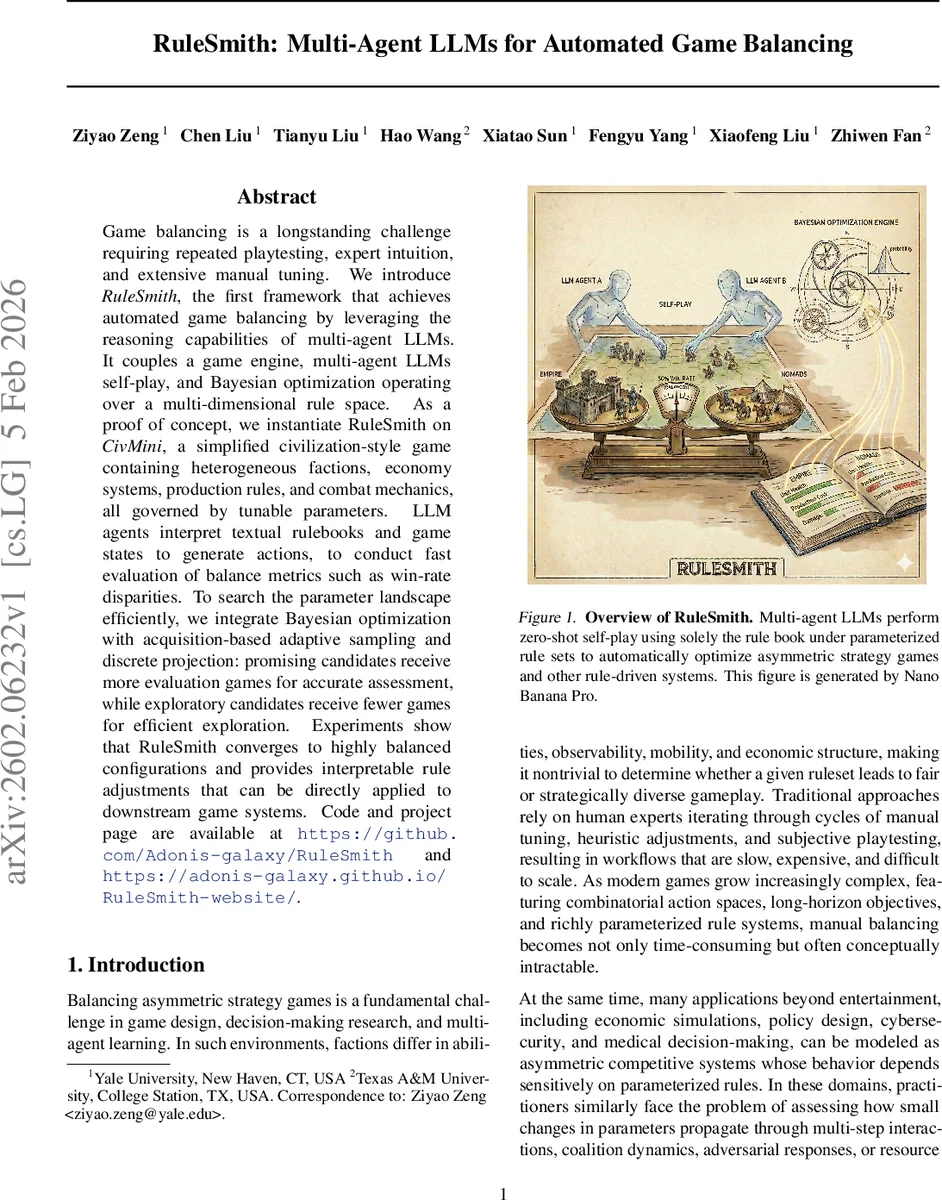
RuleSmith introduces a novel framework for automatically balancing asymmetric games by harnessing the reasoning capabilities of multi‑agent large language models (LLMs). The system integrates three components: (1) LLM agents that read natural‑language rulebooks, interpret structured game states, and generate legal actions without any prior policy training; (2) a deterministic game engine (CivMini) that executes the actions of the two agents (Empire and Nomads) and returns outcomes such as win rates, draw rates, and resource statistics; and (3) a Bayesian optimization loop with adaptive sampling that searches a high‑dimensional, mostly discrete rule‑parameter space.
The balancing objective is formalized as a loss function L(θ)=|w_E‑0.5|+|w_N‑0.5|+0.5·w_D, where w_E, w_N, and w_D denote the win rates of Empire, Nomads, and the draw rate respectively, under a given rule configuration θ. Because each evaluation of L(θ) requires many self‑play games and is noisy, the authors relax the discrete space to a continuous surrogate, fit a Gaussian‑process‑like model (or tree‑based surrogate) to predict L, and use an acquisition function (Expected Improvement) to propose new candidates. Each continuous proposal is projected back to a valid discrete rule set via a deterministic discretization operator D(·). Crucially, the number of self‑play games allocated to a candidate, N_t, is determined adaptively: promising candidates (high EI) receive more simulations for accurate estimation, while exploratory points receive fewer games, dramatically reducing overall computational cost.
CivMini, the testbed, is a minimal 7×7 grid turn‑based strategy game inspired by Civilization. It features two asymmetric factions: Empire (with dedicated farmer and soldier units) and Nomads (with a single versatile cavalry unit). Parameters include unit hit points, damage values, movement ranges, maximum turn limit, and three scoring weights (resources, battles won, surviving units). The game ends when one city is destroyed or the turn limit is reached, after which a weighted score decides the winner.
Experiments start from deliberately imbalanced parameter settings. Using 2‑billion and 8‑billion parameter LLMs, RuleSmith runs roughly 200–300 Bayesian iterations, each evaluating candidates with an average of 20–50 games. The optimizer quickly drives the win‑rate disparity to near zero (≈0 % difference) and produces rule adjustments that are both effective and interpretable—for example, equalizing soldier and cavalry hit points and increasing resource‑score weight to offset Nomads’ aggressive playstyle. The larger 8B model shows lower evaluation variance and faster convergence.
The paper discusses limitations: LLMs introduce stochastic decision noise, requiring multiple simulations per candidate; the current implementation assumes full observability and a simple grid engine, so extending to partially observable, real‑time, or physics‑heavy games would need richer prompting and tool integration. Nonetheless, RuleSmith is the first system to combine zero‑shot multi‑agent LLM self‑play with Bayesian optimization for rule‑space tuning, offering a scalable, data‑efficient approach to game balancing and broader asymmetric system design such as economic simulations, policy modeling, or security scenario calibration.
Comments & Academic Discussion
Loading comments...
Leave a Comment