Explicit conditional bounds for $ζ(s)$ at the edge of the critical strip
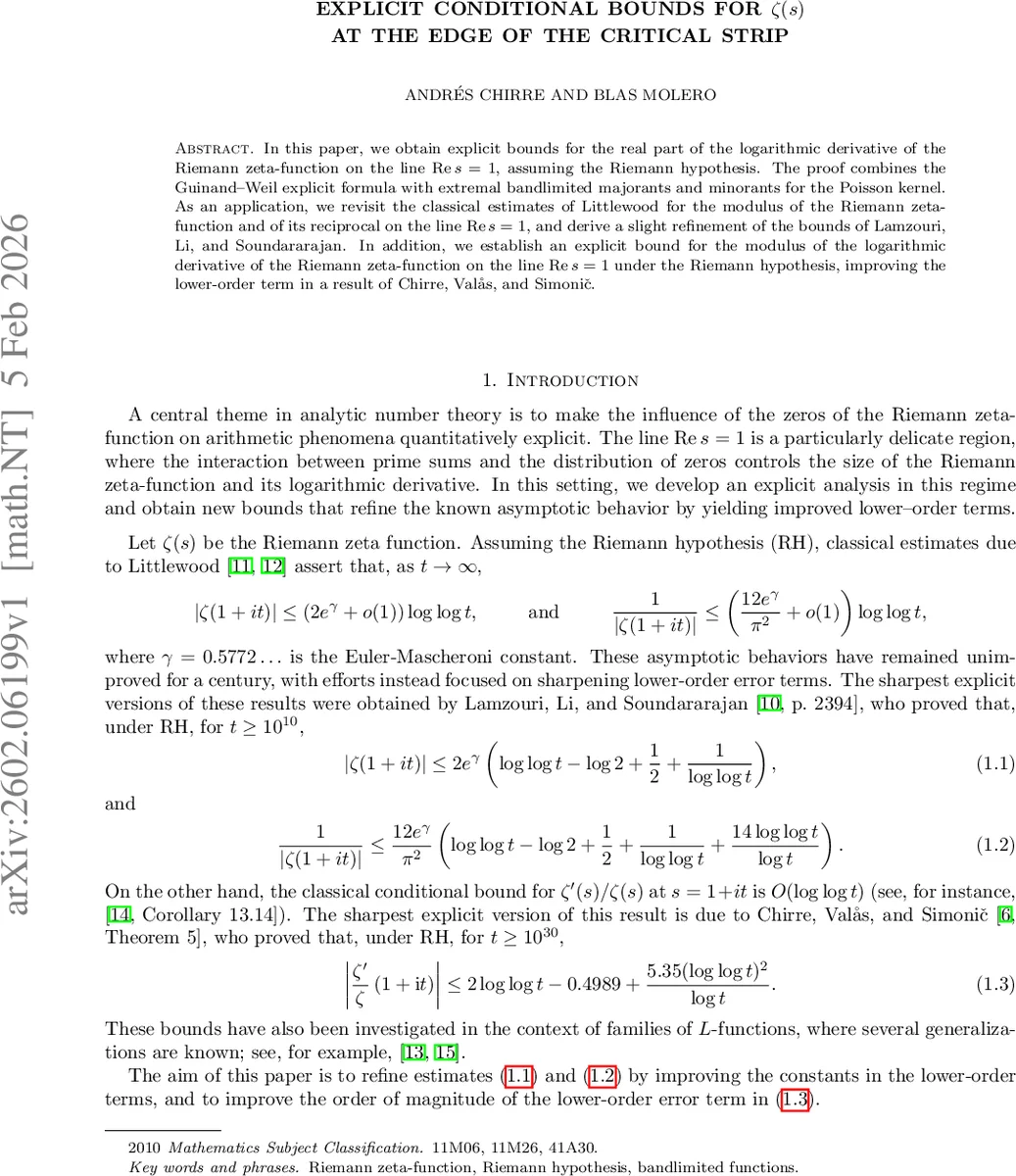
In this paper, we obtain explicit bounds for the real part of the logarithmic derivative of the Riemann zeta-function on the line $\re s=1$, assuming the Riemann hypothesis. The proof combines the Guinand–Weil explicit formula with extremal bandlimited majorants and minorants for the Poisson kernel. As an application, we revisit the classical estimates of Littlewood for the modulus of the Riemann zeta-function and of its reciprocal on the line $\re{s}=1$, and derive a slight refinement of the bounds of Lamzouri, Li, and Soundararajan. In addition, we establish an explicit bound for the modulus of the logarithmic derivative of the Riemann zeta-function on the line $\re{s}=1$ under the Riemann hypothesis, improving the lower-order term in a result of Chirre, Valås, and Simonič.
💡 Research Summary
This paper establishes new explicit conditional bounds for the Riemann zeta‑function ζ(s) and its logarithmic derivative ζ′/ζ(s) on the line Re s = 1, assuming the Riemann hypothesis (RH). The authors combine the Guinand–Weil explicit formula with extremal band‑limited majorants and minorants for the Poisson kernel to obtain refined estimates that improve the lower‑order terms of classical results.
The starting point is a representation (Lemma 4) of Re ζ′/ζ(1+it) as a sum over the ordinates γ of non‑trivial zeros of ζ(s) involving the Poisson kernel h(x)=1/(2(¼+x²)) plus a Γ‑function term. Since h does not satisfy the analytic and decay conditions required by the Guinand–Weil formula, the authors replace it with the band‑limited extremal functions h_Δ^±(z) introduced by Carneiro, Chirre and Milinović. These functions have exponential type ½πΔ, their Fourier transforms are supported in
Comments & Academic Discussion
Loading comments...
Leave a Comment