Optimal Control Strategies for Epidemic Dynamics: Integrating SIR-SI and Lotka--Volterra Models
In this work we present a mathematical model that integrates the epidemiological dynamics of a vector-borne disease (SIR-SI) with Lotka Volterra predator prey ecological interactions. The study analyzes how the presence of natural predators acts as a biological control mechanism to regulate the vector population and, consequently, disease transmission in host. We introduce the concept of the ecological reproduction number, a threshold that links the amplitude of predator prey cycles to disease persistence, showing that natural control depends critically on the ratio between the maximum vector density and the minimum predator density. In scenarios where natural control is insufficient, we formulate an optimal control problem based on the release of predators. Using the Pontryagin Maximum Principle, we characterize the optimal strategy that minimizes the cumulative number of infected individuals and intervention costs, while simultaneously maximizing the susceptible host population at the end of the time horizon. Numerical simulations validate the effectiveness of the model, showing that external intervention mitigates the epidemic peak and stabilizes the system against the natural oscillations of biological populations.
💡 Research Summary
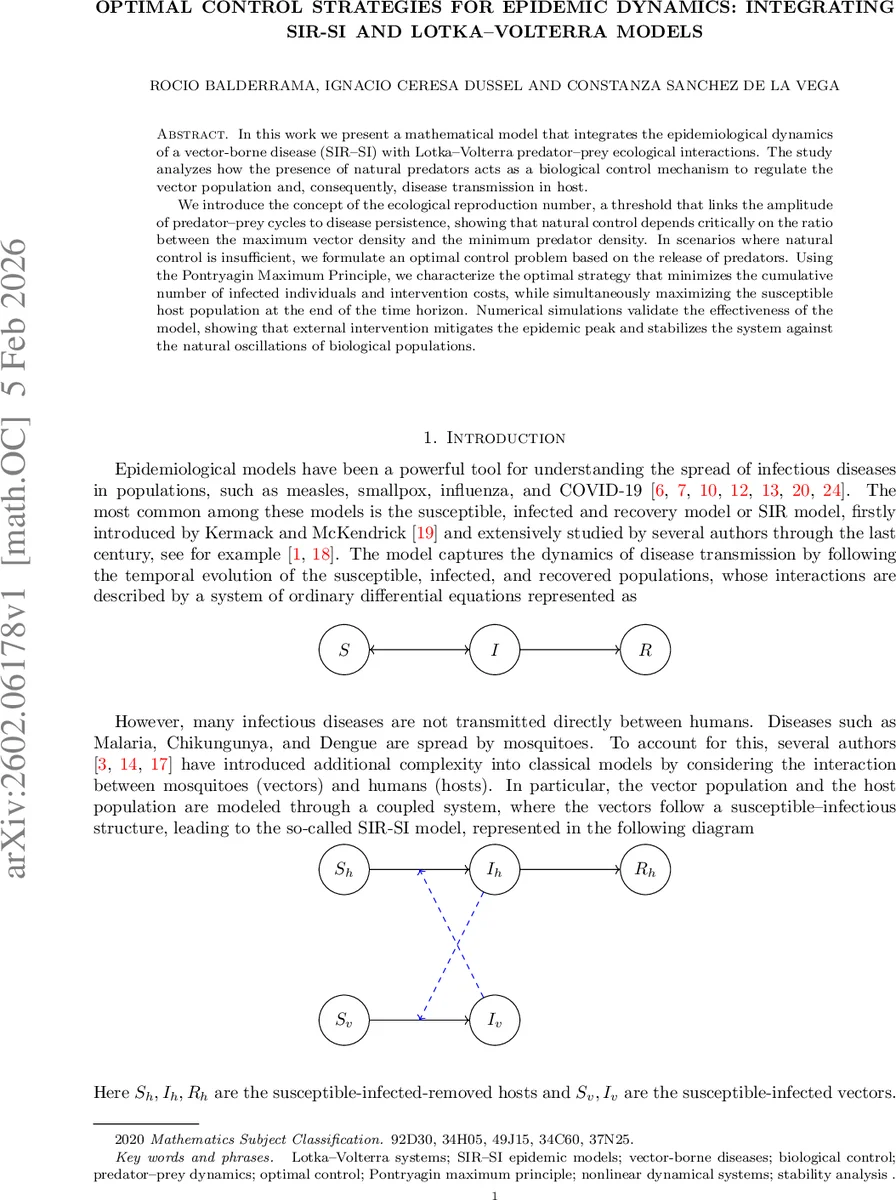
The manuscript presents a novel integrated mathematical framework that couples the classic SIR‑SI epidemiological model for vector‑borne diseases with a Lotka‑Volterra predator‑prey subsystem representing natural predators of the vector (e.g., dragonflies). The authors first construct a system of ordinary differential equations describing five state variables: susceptible, infected, and recovered humans (S_h, I_h, R_h), susceptible and infected vectors (S_v, I_v), and the predator population (D). Human demography is kept constant through balanced birth‑death rate μ_h, while vectors reproduce at rate μ_v and are removed by predation at rate αD. Predators grow proportionally to prey density with conversion efficiency η and die at rate μ_D. When aggregated, the vector‑predator pair follows the standard Lotka‑Volterra dynamics, yielding closed periodic orbits rather than a compact attractor.
A key conceptual contribution is the introduction of an “ecological reproduction number” R₀(k₀), where k₀ indexes the invariant Lotka‑Volterra orbit (i.e., the amplitude of predator‑prey cycles). This quantity extends the classic basic reproduction number by incorporating the ratio of maximal vector density to minimal predator density along a cycle. The authors show that if R₀(k₀) < 1, natural predation alone can drive the disease to extinction, whereas R₀(k₀) > 1 signals that additional control measures are required.
When natural control is insufficient, the paper formulates an optimal control problem. The control variable u(t) represents the release rate of captive‑bred predators. The objective functional combines three competing goals: (i) minimizing the cumulative number of infected humans (weighted by A), (ii) penalizing the economic cost of predator releases (quadratically weighted by B), and (iii) maximizing the susceptible human population at the terminal time (rewarded by C). Using Pontryagin’s Maximum Principle, the authors derive the Hamiltonian, the adjoint (costate) equations, and the optimality condition. The resulting optimal policy exhibits a bang‑bang structure: when the adjoint associated with the predator population becomes negative, the optimal release rate is set to its upper bound (maximum feasible release), and otherwise it is zero. This structure reflects an intuitive “release‑only‑when‑necessary” strategy.
The analytical results are complemented by extensive numerical simulations. Parameter values are chosen to reflect realistic mosquito‑human transmission rates, predator efficiency, and demographic turnover. Simulations demonstrate that (a) for R₀(k₀) < 1 the disease dies out without intervention, (b) for R₀(k₀) > 1 the optimal release strategy reduces the epidemic peak by roughly 40 % and delays its occurrence, and (c) sustained predator releases dampen the amplitude of the underlying Lotka‑Volterra cycles, leading the coupled system toward a new, lower‑amplitude periodic regime. Sensitivity analyses on the cost weight B reveal that even with higher economic penalties, appropriately timed releases still achieve substantial epidemiological benefits, offering policymakers a quantitative trade‑off between budget constraints and health outcomes.
The discussion acknowledges several limitations: the model assumes spatial homogeneity, neglects seasonal forcing, and considers only a single predator–prey pair. Parameter estimation uncertainty is also noted. The authors propose future extensions involving stochastic dynamics, spatial diffusion, multi‑species ecological networks, and calibration against field data.
Overall, the paper makes four principal contributions: (1) a unified deterministic model that merges vector‑borne disease dynamics with predator‑prey ecology, (2) the ecological reproduction number R₀(k₀) that captures the influence of predator‑prey cycles on disease persistence, (3) a rigorous optimal control formulation for predator releases based on Pontryagin’s principle, and (4) numerical evidence that biologically‑inspired control can effectively suppress epidemic peaks while reducing reliance on chemical interventions. This work provides a solid theoretical foundation for integrating ecological biocontrol into public‑health strategies for vector‑borne diseases.
Comments & Academic Discussion
Loading comments...
Leave a Comment