Computing Diffusion Geometry
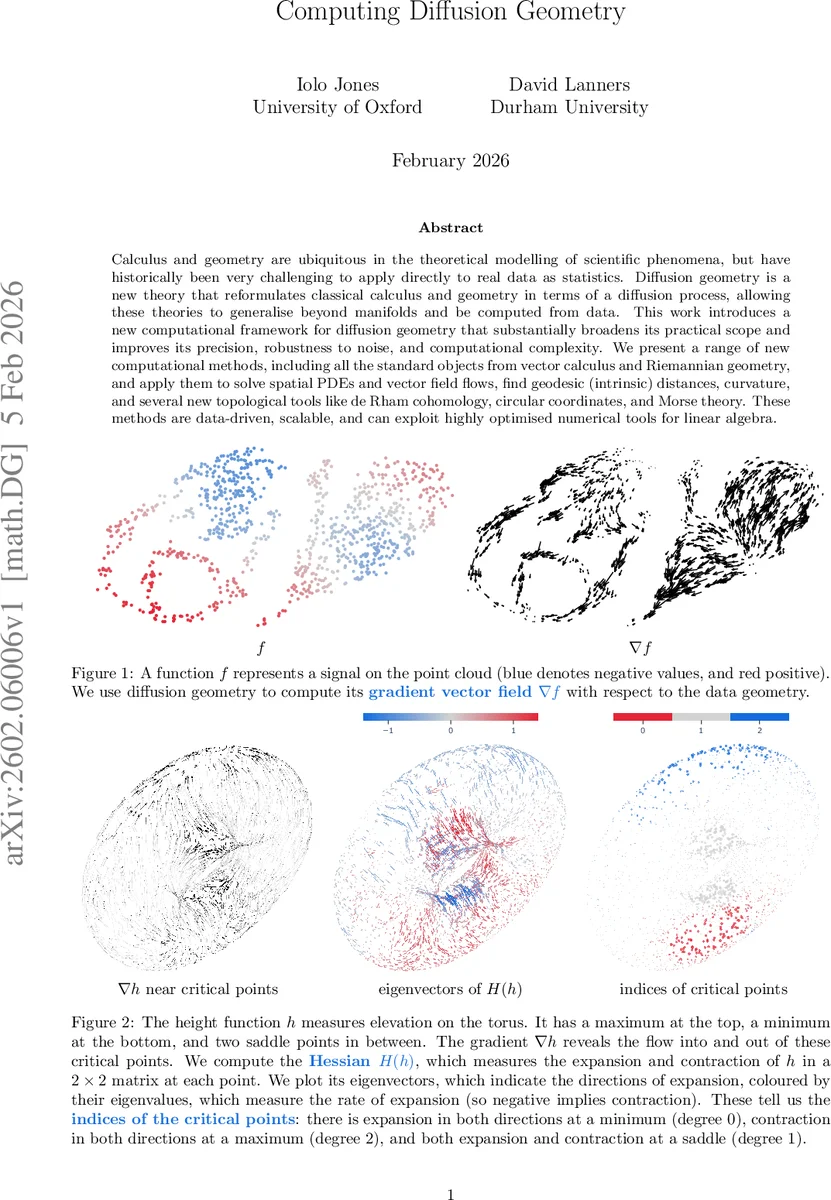
Calculus and geometry are ubiquitous in the theoretical modelling of scientific phenomena, but have historically been very challenging to apply directly to real data as statistics. Diffusion geometry is a new theory that reformulates classical calculus and geometry in terms of a diffusion process, allowing these theories to generalise beyond manifolds and be computed from data. This work introduces a new computational framework for diffusion geometry that substantially broadens its practical scope and improves its precision, robustness to noise, and computational complexity. We present a range of new computational methods, including all the standard objects from vector calculus and Riemannian geometry, and apply them to solve spatial PDEs and vector field flows, find geodesic (intrinsic) distances, curvature, and several new topological tools like de Rham cohomology, circular coordinates, and Morse theory. These methods are data-driven, scalable, and can exploit highly optimised numerical tools for linear algebra.
💡 Research Summary
The paper introduces a comprehensive computational framework for diffusion geometry, a theory that re‑expresses calculus and Riemannian geometry in terms of a diffusion (heat) process. By leveraging the heat kernel of a Markov diffusion, the authors show how to estimate inner products, gradients, divergences, Laplacians, exterior derivatives, and other differential operators directly from point‑cloud data without assuming a manifold structure. The key technical device is the carré du champ operator Γ, which encodes the infinitesimal covariance of functions under the diffusion and can be computed from the discrete Markov transition matrix. Using Γ, functions are represented via eigenfunctions of the graph Laplacian, vector fields are built from gradients of coordinate functions, and differential forms and tensors are assembled from these generators.
A rigorous functional‑analytic treatment based on frame theory guarantees that the discrete constructions converge to their continuous counterparts and that the resulting linear systems are well‑conditioned. Weak formulations of all operators are derived, enabling mesh‑free numerical solutions of PDEs such as the heat, wave, and transport equations on arbitrary data geometries. The framework also provides novel algorithms for geometric analysis: intrinsic (geodesic) distances are obtained by solving a Poisson‑type equation; sectional curvature is estimated via the Levi‑Civita connection derived from the discrete Γ; and the Hessian is computed as a second‑order Γ‑based operator.
On the topological side, the authors compute de Rham cohomology by extracting harmonic forms from the Hodge Laplacian, construct circular coordinates for 1‑cohomology classes, and implement Morse theory by locating critical points of scalar functions using the discrete Hessian and index calculations. These methods are shown to be orders of magnitude faster and more memory‑efficient than Vietoris‑Rips persistent homology, while exhibiting superior robustness to noise and outliers.
Experimental evaluation on synthetic and real‑world datasets (including high‑dimensional image manifolds and brain surface point clouds) demonstrates linear or near‑linear scaling with the number of points, strong resistance to sampling irregularities, and accurate recovery of geometric and topological invariants even on non‑manifold structures such as branching graphs. The authors release a Python package (github.com/Iolo-Jones/DiffusionGeometry) that integrates with high‑performance linear algebra back‑ends (PETSc, cuBLAS) for large‑scale applications.
In summary, the work provides a unified, data‑driven pipeline that translates the full machinery of differential calculus, Riemannian geometry, and differential topology into computable linear‑algebraic operations on point clouds. It opens the door to mesh‑free geometric analysis, scalable PDE solvers, and efficient topological data analysis for complex, noisy, and high‑dimensional datasets. Future directions include extensions to nonlinear diffusion models, multiscale hierarchies, and integration with deep learning architectures.
Comments & Academic Discussion
Loading comments...
Leave a Comment