Large bulk viscosity limit for compressible MHD equations in critical Besov spaces
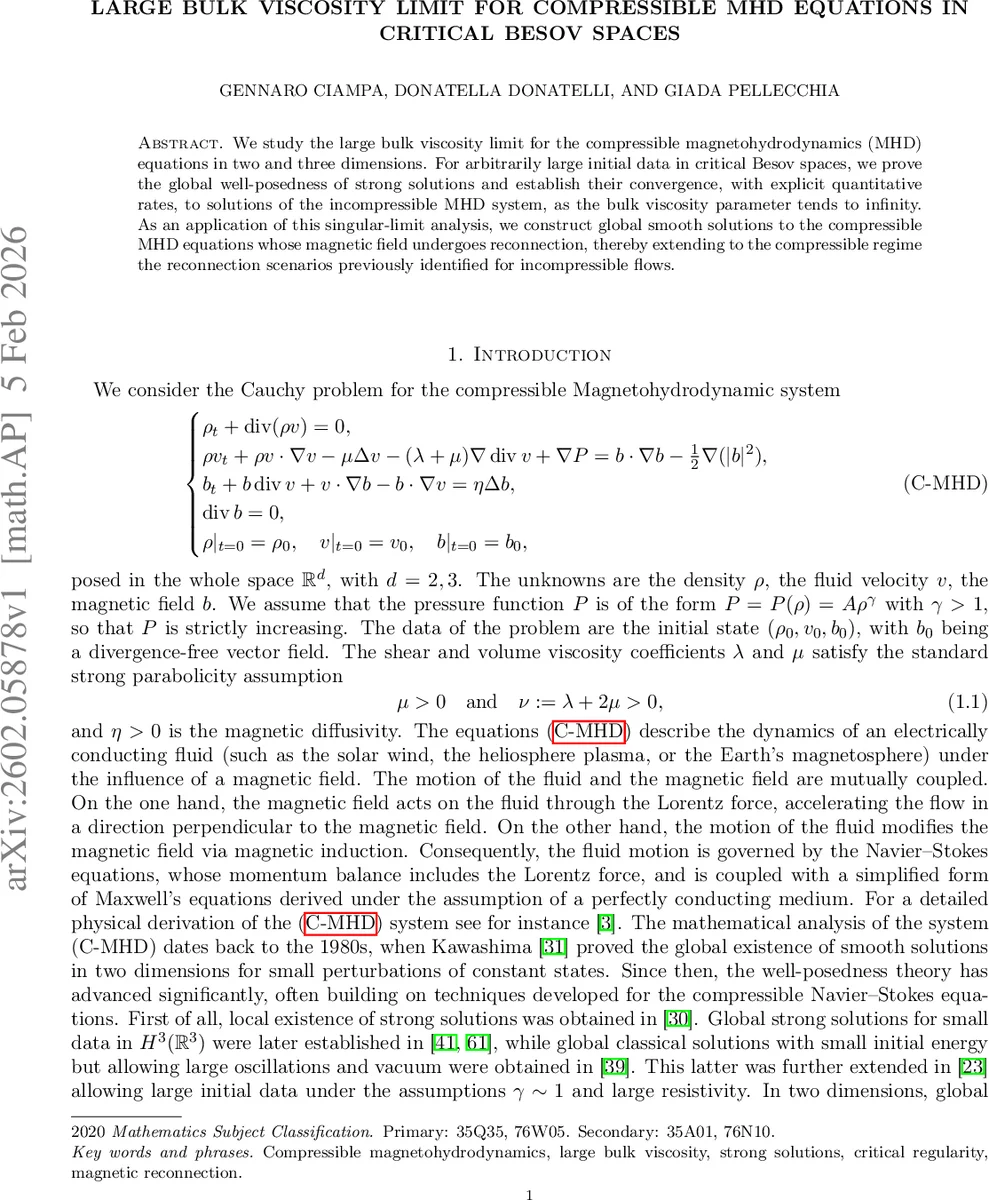
We study the large bulk viscosity limit for the compressible magnetohydrodynamics (MHD) equations in two and three dimensions. For arbitrarily large initial data in critical Besov spaces, we prove the global well-posedness of strong solutions and establish their convergence, with explicit quantitative rates, to solutions of the incompressible MHD system, as the bulk viscosity parameter tends to infinity. As an application of this singular-limit analysis, we construct global smooth solutions to the compressible MHD equations whose magnetic field undergoes reconnection, thereby extending to the compressible regime the reconnection scenarios previously identified for incompressible flows.
💡 Research Summary
The paper investigates the singular limit of the compressible magnetohydrodynamics (C‑MHD) system when the bulk viscosity coefficient becomes arbitrarily large. Working in the critical Besov framework, the authors allow arbitrarily large initial data measured in the scaling‑invariant spaces (\dot B^{d/2-1}{2,1}) (or more generally (\dot B^{d/p-1}{p,1}) with (2\le p\le4)). The main results are threefold.
First, Theorem A establishes global‑in‑time strong solutions for C‑MHD in any space dimension (d\ge2) provided the bulk viscosity (\nu=\lambda+2\mu) is sufficiently large relative to the shear viscosity (\mu) and to a combination of the initial Besov norms and the size of a given global incompressible MHD (I‑MHD) solution ((V,B)). The proof follows the “large bulk‑viscosity” strategy introduced for compressible Navier–Stokes equations: one fixes a global incompressible flow as a reference, decomposes the compressible velocity into its divergence‑free part (Pv) and compressible part (Qv) via Leray projectors, and derives separate energy estimates for each component together with the density fluctuation (a=\rho-1). The bulk viscosity term supplies a strong damping for the compressible component, allowing the nonlinear terms to be closed under a smallness condition that involves (\sqrt{\mu\nu}). Consequently, the solution satisfies uniform bounds in the critical Besov norms and the compressible part decays like (\nu^{-1}).
Second, Theorem B extends the result to the (L^{p})‑based critical Besov spaces. By splitting the initial density into low‑frequency and high‑frequency parts and using hybrid Besov norms, the authors obtain analogous global existence and uniform estimates for (2\le p\le4) (with the usual restriction (p\le 2d/(d-2)) in higher dimensions). The quantitative convergence estimate remains of order (\mu/\nu).
Third, Theorem C applies the stability framework to construct explicit global smooth solutions of the compressible MHD system that exhibit magnetic reconnection. Starting from a known incompressible MHD flow in which magnetic field lines change topology (as constructed in recent works on reconnection for the incompressible case), the authors invoke the quantitative convergence from Theorem A to show that, for sufficiently large bulk viscosity, the corresponding compressible solution remains arbitrarily close to the incompressible one for all times. Hence the magnetic field lines of the compressible solution inherit the same topological change, providing the first rigorous example of reconnection in a compressible MHD setting.
The paper is organized as follows. Section 2 collects the functional analytic tools: Littlewood–Paley decomposition, Besov space embeddings, and properties of Leray projectors. Section 3 contains the detailed proof of Theorem A, including the derivation of the energy functional, the handling of the coupling terms between velocity and magnetic field, and the closure of the Grönwall inequality under the large‑(\nu) condition. Section 4 adapts the argument to the (L^{p}) framework, introducing low‑high frequency decompositions for the density and velocity. Section 5 presents the reconnection construction, describing how the incompressible reconnection flow is lifted to the compressible regime using the stability estimates.
Overall, the work provides a rigorous bridge between compressible and incompressible MHD dynamics in the regime of dominant bulk viscosity, delivers explicit convergence rates, and demonstrates that complex topological phenomena such as magnetic reconnection persist in the compressible model. This advances both the mathematical theory of fluid–magnetics and the analytical understanding of plasma phenomena where compressibility cannot be neglected.
Comments & Academic Discussion
Loading comments...
Leave a Comment