A Dieudonné theory for analytic p-divisible groups and applications to Shimura varieties
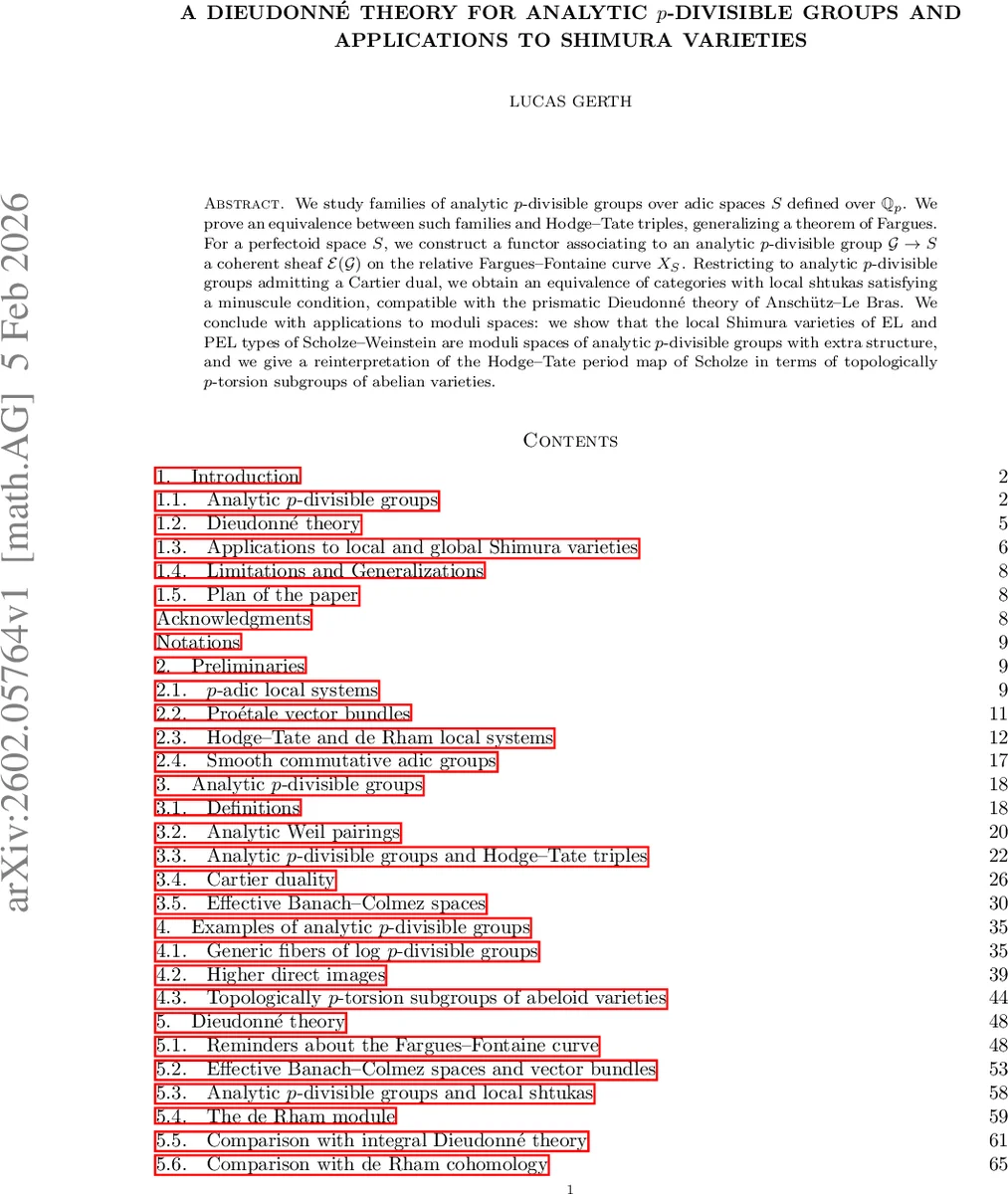
We study families of analytic $p$-divisible groups over adic spaces $S$ defined over $\mathbb{Q}_p$. We prove an equivalence between such families and Hodge-Tate triples, generalizing a theorem of Fargues. For a perfectoid space $S$, we construct a functor associating to an analytic $p$-divisible group $\mathcal{G} \rightarrow S$ a coherent sheaf $\mathcal{E}(\mathcal{G})$ on the relative Fargues–Fontaine curve $X_S$. Restricting to analytic $p$-divisible groups admitting a Cartier dual, we obtain an equivalence of categories with local shtukas satisfying a minuscule condition, compatible with the prismatic Dieudonné theory of Anschütz–Le Bras. We conclude with applications to moduli spaces: we show that the local Shimura varieties of EL and PEL types of Scholze–Weinstein are moduli spaces of analytic $p$-divisible groups with extra structure, and we give a reinterpretation of the Hodge–Tate period map of Scholze in terms of topologically $p$-torsion subgroups of abelian varieties.
💡 Research Summary
The paper develops a comprehensive Dieudonné theory for analytic p‑divisible groups over adic spaces defined over ℚₚ and applies this theory to the study of Shimura varieties. The authors begin by defining analytic p‑divisible groups on “good” adic spaces (including seminormal rigid spaces and perfectoid spaces). Such a group 𝔊→S is a smooth commutative adic group whose multiplication‑by‑p map is finite étale and surjective, and it satisfies the topological p‑torsion condition 𝔊 = 𝔊⟨p^∞⟩, i.e. it coincides with the image of Hom(ℤₚ,𝔊) under the evaluation map.
The first major result (Theorem 1.1, cf. 3.13) establishes an equivalence of categories between analytic p‑divisible groups over a good adic space S and triples (L,E,f) where L is a ℤₚ‑local system on the v‑site of S, E is a vector bundle on the underlying analytic space, and f : E⊗𝒪_{S^v} → L(−1)⊗{ℤₚ}𝒪{S^v} is a morphism of v‑vector bundles. In the case S = Spa(K) for a complete algebraically closed field K, this recovers the classical description of a Hodge–Tate representation as a pair consisting of a Galois representation and a filtered K‑vector space.
A crucial technical ingredient is the construction of a natural Weil p‑pairing between the p‑torsion subgroup 𝔊
Comments & Academic Discussion
Loading comments...
Leave a Comment