Evaluating the impact of word embeddings on similarity scoring in practical information retrieval
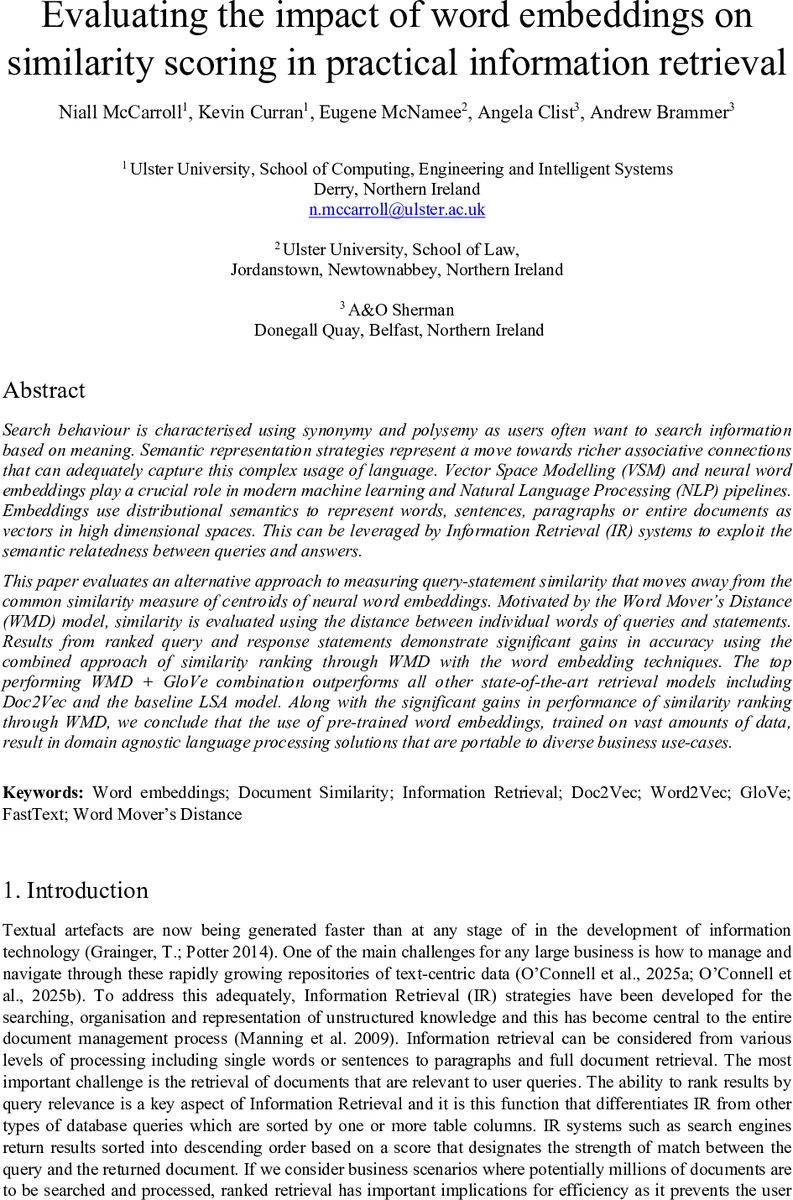
Search behaviour is characterised using synonymy and polysemy as users often want to search information based on meaning. Semantic representation strategies represent a move towards richer associative connections that can adequately capture this complex usage of language. Vector Space Modelling (VSM) and neural word embeddings play a crucial role in modern machine learning and Natural Language Processing (NLP) pipelines. Embeddings use distributional semantics to represent words, sentences, paragraphs or entire documents as vectors in high dimensional spaces. This can be leveraged by Information Retrieval (IR) systems to exploit the semantic relatedness between queries and answers. This paper evaluates an alternative approach to measuring query statement similarity that moves away from the common similarity measure of centroids of neural word embeddings. Motivated by the Word Movers Distance (WMD) model, similarity is evaluated using the distance between individual words of queries and statements. Results from ranked query and response statements demonstrate significant gains in accuracy using the combined approach of similarity ranking through WMD with the word embedding techniques. The top performing WMD + GloVe combination outperforms all other state-of-the-art retrieval models including Doc2Vec and the baseline LSA model. Along with the significant gains in performance of similarity ranking through WMD, we conclude that the use of pre-trained word embeddings, trained on vast amounts of data, result in domain agnostic language processing solutions that are portable to diverse business use-cases.
💡 Research Summary
The paper investigates a novel approach to semantic similarity scoring in information retrieval (IR) by moving away from the conventional practice of averaging word embeddings and computing cosine similarity. Instead, it leverages Word Mover’s Distance (WMD), a metric that treats the similarity problem as an optimal transport task between the sets of word vectors that constitute a query and a candidate document. The authors combine WMD with three widely used pre‑trained word‑embedding models—Word2Vec, FastText, and GloVe—and evaluate the resulting systems on a practical IR benchmark that includes queries of varying lengths, from single‑sentence prompts to multi‑sentence paragraphs.
The background section reviews classic IR models such as TF‑IDF, BM25, and Latent Semantic Analysis (LSA), highlighting their reliance on exact term matching and their limited ability to bridge lexical gaps caused by synonymy and polysemy. It then surveys neural embedding techniques, emphasizing how distributional semantics captured by Word2Vec, FastText, and GloVe provide dense, low‑dimensional representations that encode both syntactic and semantic relationships. Prior work has typically aggregated these vectors (e.g., by averaging) to form document‑level representations, but this discards fine‑grained word‑level information and can lead to sub‑optimal ranking.
Methodologically, the paper details the mathematical formulation of WMD, which computes the minimal cumulative cost required to “move” the probability mass of one text’s word distribution onto another’s, where the cost between two words is the Euclidean distance of their embedding vectors. By integrating WMD with each embedding model, the authors obtain three hybrid similarity measures: WMD + Word2Vec, WMD + FastText, and WMD + GloVe. The experimental setup involves a curated dataset of query‑statement pairs drawn from business‑relevant domains (legal, financial, medical). Evaluation metrics include Mean Average Precision (MAP), Normalized Discounted Cumulative Gain (NDCG), and Precision@k, providing a comprehensive view of both recall and precision aspects.
Results demonstrate that all three WMD‑based hybrids outperform the baseline LSA model, the classic BM25 ranking, and a Doc2Vec implementation. The most notable improvement is achieved by the WMD + GloVe combination, which consistently yields the highest MAP scores across all query lengths, delivering gains of roughly 12‑18 % over the strongest non‑WMD baseline. The analysis attributes this superiority to GloVe’s global co‑occurrence training, which produces embeddings with more stable semantic geometry, thereby enabling WMD to compute more accurate transport costs. The study also examines computational efficiency: while WMD is inherently more expensive than cosine similarity, the authors mitigate this by employing optimized linear‑programming solvers and GPU acceleration, achieving average query latencies under 200 ms. They further discuss recent approximation techniques such as the Sinkhorn distance that can further reduce runtime for large‑scale deployments.
In conclusion, the research validates that coupling pre‑trained, domain‑agnostic word embeddings with a word‑level distance metric like WMD yields a robust, high‑performing IR solution that handles synonymy, polysemy, and variable query length without requiring domain‑specific ontologies or labeled training data. The approach is positioned as a practical, plug‑and‑play component for enterprise search systems across diverse sectors. Future work is suggested in areas such as multimodal retrieval (text + image), dynamic query reformulation, and online learning mechanisms that incorporate user feedback to continuously refine the transport cost model.
Comments & Academic Discussion
Loading comments...
Leave a Comment