Neutrino mass ordering in JUNO at risk from scalar NSI induced resonance
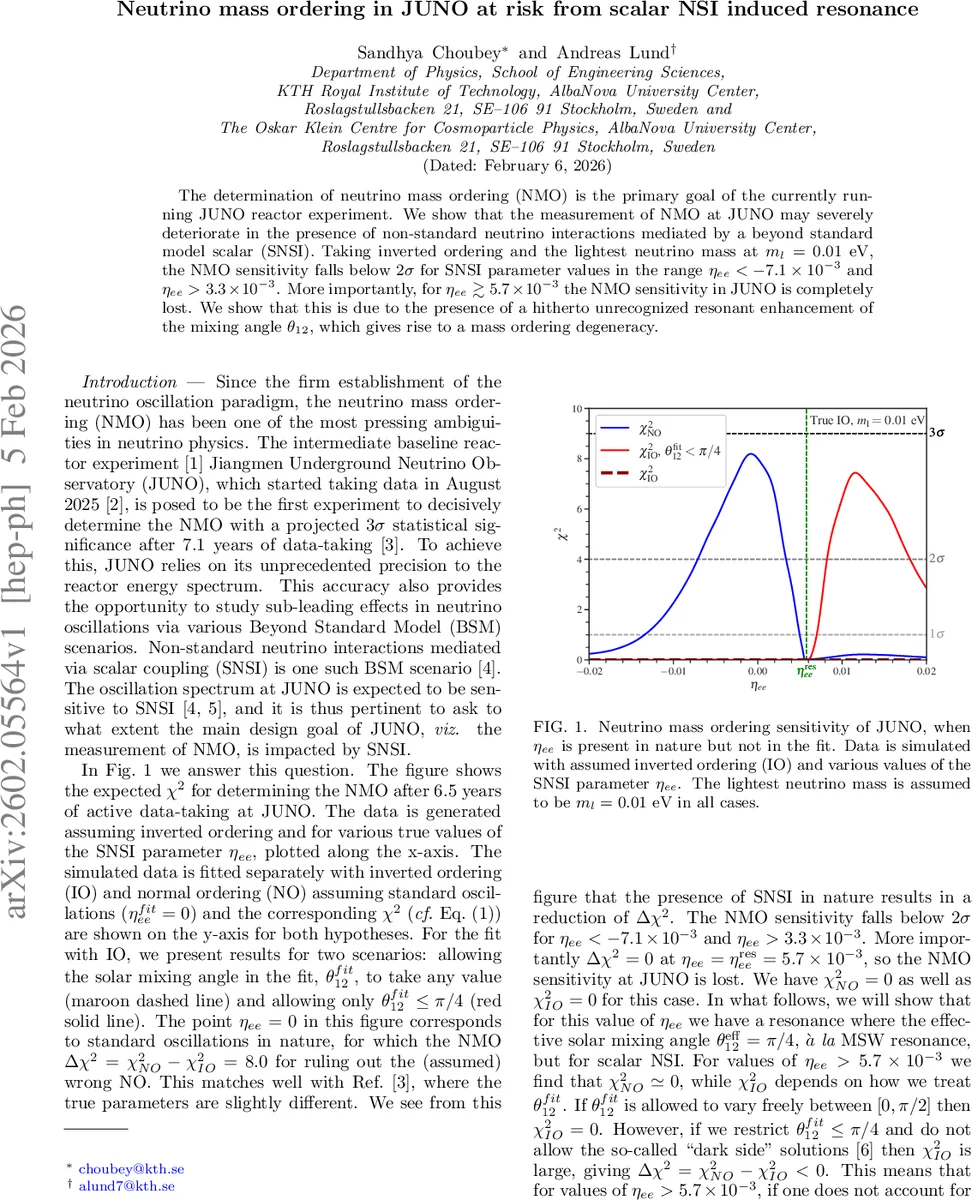
The determination of neutrino mass ordering (NMO) is the primary goal of the currently running JUNO reactor experiment. We show that the measurement of NMO at JUNO may severely deteriorate in the presence of non-standard neutrino interactions mediated by a beyond standard model scalar (SNSI). Taking inverted ordering and the lightest neutrino mass at $m_l=0.01$ eV, the NMO sensitivity falls below $2σ$ for SNSI parameter values in the range $η_{ee}< -7.1\times 10^{-3}$ and $η_{ee} > 3.3\times 10^{-3}$. More importantly, for $η_{ee} \gtrsim 5.7\times 10^{-3}$ the NMO sensitivity in JUNO is completely lost. We show that this is due to the presence of a hitherto unrecognized resonant enhancement of the mixing angle $θ_{12}$, which gives rise to a mass ordering degeneracy.
💡 Research Summary
The paper investigates how scalar‑mediated non‑standard neutrino interactions (SNSI) can jeopardize the primary goal of the Jiangmen Underground Neutrino Observatory (JUNO): the determination of the neutrino mass ordering (NMO). The authors introduce a new scalar field ϕ′ that couples to neutrinos (Yukawa coupling yαβ) and to ordinary fermions (coupling yf). Integrating out ϕ′ generates an effective four‑fermion operator that modifies the neutrino propagation Hamiltonian in matter. The modification is parametrised by a dimensionless parameter ηee, which quantifies the strength of the electron‑flavour scalar NSI.
Using a GLoBES‑based simulation that reproduces JUNO’s design (20 reactor cores, 340 energy bins, 6.5 yr exposure), the authors generate pseudo‑data assuming inverted ordering (IO) and various true values of ηee. They then fit the data with the standard oscillation hypothesis (ηfit=0) under both normal ordering (NO) and IO, allowing all standard oscillation parameters to vary and including realistic systematic pulls. The NMO sensitivity is quantified by Δχ² = χ²_NO – χ²_IO.
The results (Fig. 1) show that for ηee≈0 the expected Δχ²≈8 (≈3σ) is reproduced. However, when ηee lies outside the interval (−7.1×10⁻³, +3.3×10⁻³) the Δχ² drops below 2σ, and at ηee≈5.7×10⁻³ the Δχ² becomes zero: the experiment loses any ability to distinguish NO from IO. The loss of sensitivity is traced to a novel resonance in the effective solar mixing angle θ12. Analytically, the authors derive
tan 2θ_eff12 = Δm²21 sin 2θ12 / (Δm²21 cos 2θ12 – ηee B),
where B is a combination of mass‑squared differences, mixing angles and the lightest neutrino mass. The denominator vanishes when ηee = η_res ≡ Δm²21 cos 2θ12 / B, yielding θ_eff12 = π/4. This “SNSI‑resonance” mirrors the MSW resonance but is driven by the scalar NSI term ηee B rather than the standard matter potential. At the resonance the effective Δm²21 becomes minimal, and for ηee > η_res the effective θ12 moves into the “dark side” (θ12 > π/4).
Because the ν̄e survival probability depends on sin²2θ12 c⁴13 sin²Δ21 (the dominant term) and on a sub‑leading term proportional to sin²2θ13 Δ31, the resonance forces the two terms to cancel for the NO hypothesis, making the predicted spectrum indistinguishable from the IO data. Consequently χ²_NO ≈ 0 and Δχ² ≈ 0. For the IO fit, if θ_fit12 is unrestricted the fit can also achieve χ²_IO ≈ 0; if the fit is constrained to the “light side” (θ12 ≤ π/4) χ²_IO becomes large, leading to a false preference for the wrong ordering.
The authors also explore the dependence on the lightest neutrino mass m_l, showing that η_res is essentially independent of m_l for m_l ≲ 10⁻² eV but varies modestly for larger masses. They compare their required ηee values with existing limits from Borexino, noting that current 90 % C.L. bounds are still compatible with the problematic region.
In conclusion, scalar‑mediated NSI can induce a resonant enhancement of θ12 that creates an almost perfect degeneracy between NO and IO in JUNO’s reactor spectrum. For ηee ≳ 5.7×10⁻³ the NMO sensitivity is lost entirely, and even smaller values already degrade the significance below 2σ. This finding implies that JUNO analyses must either incorporate the possibility of SNSI or rely on independent experiments to tighten constraints on ηee, otherwise the flagship goal of determining the neutrino mass ordering could be compromised.
Comments & Academic Discussion
Loading comments...
Leave a Comment