Regularity results for linear parabolic equations on Carnot tori via mollifier kernel construction
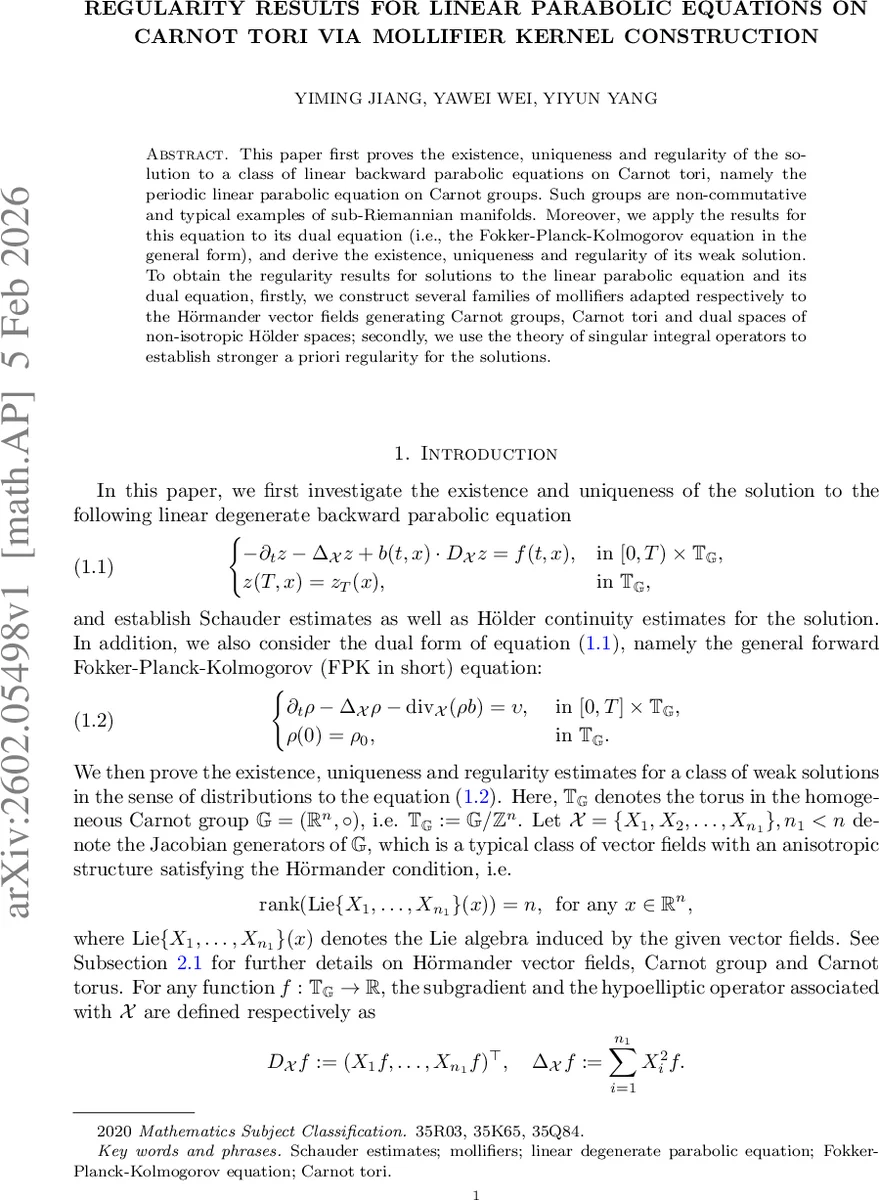
This paper first proves the existence, uniqueness and regularity of the solution to a class of linear backward parabolic equations on Carnot tori, namely the periodic linear parabolic equation on Carnot groups. Such groups are non-commutative and typical examples of sub-Riemannian manifolds. Moreover, we apply the results for this equation to its dual equation (i.e., the Fokker-Planck-Kolmogorov equation in the general form), and derive the existence, uniqueness and regularity of its weak solution. To obtain the regularity results for solutions to the linear parabolic equation and its dual equation, firstly, we construct several families of mollifiers adapted respectively to the Hörmander vector fields generating Carnot groups, Carnot tori and dual spaces of non-isotropic Hölder spaces; secondly, we use the theory of singular integral operators to establish stronger a priori regularity for the solutions.
💡 Research Summary
The paper addresses the well‑posedness and regularity of a class of linear backward parabolic equations posed on the torus associated with a Carnot group, together with the dual Fokker‑Planck‑Kolmogorov (FPK) equation. A Carnot group (G=(\mathbb{R}^{n},\circ)) is a non‑commutative Lie group equipped with a family of Hörmander vector fields ({X_{i}}{i=1}^{n{1}}) that satisfy the bracket‑generating condition. The associated sub‑Laplacian (\Delta_{X}=\sum_{i=1}^{n_{1}}X_{i}^{2}) and sub‑gradient (D_{X}) define a hypo‑elliptic operator. The authors consider the backward parabolic problem
\
Comments & Academic Discussion
Loading comments...
Leave a Comment