TSBOW: Traffic Surveillance Benchmark for Occluded Vehicles Under Various Weather Conditions
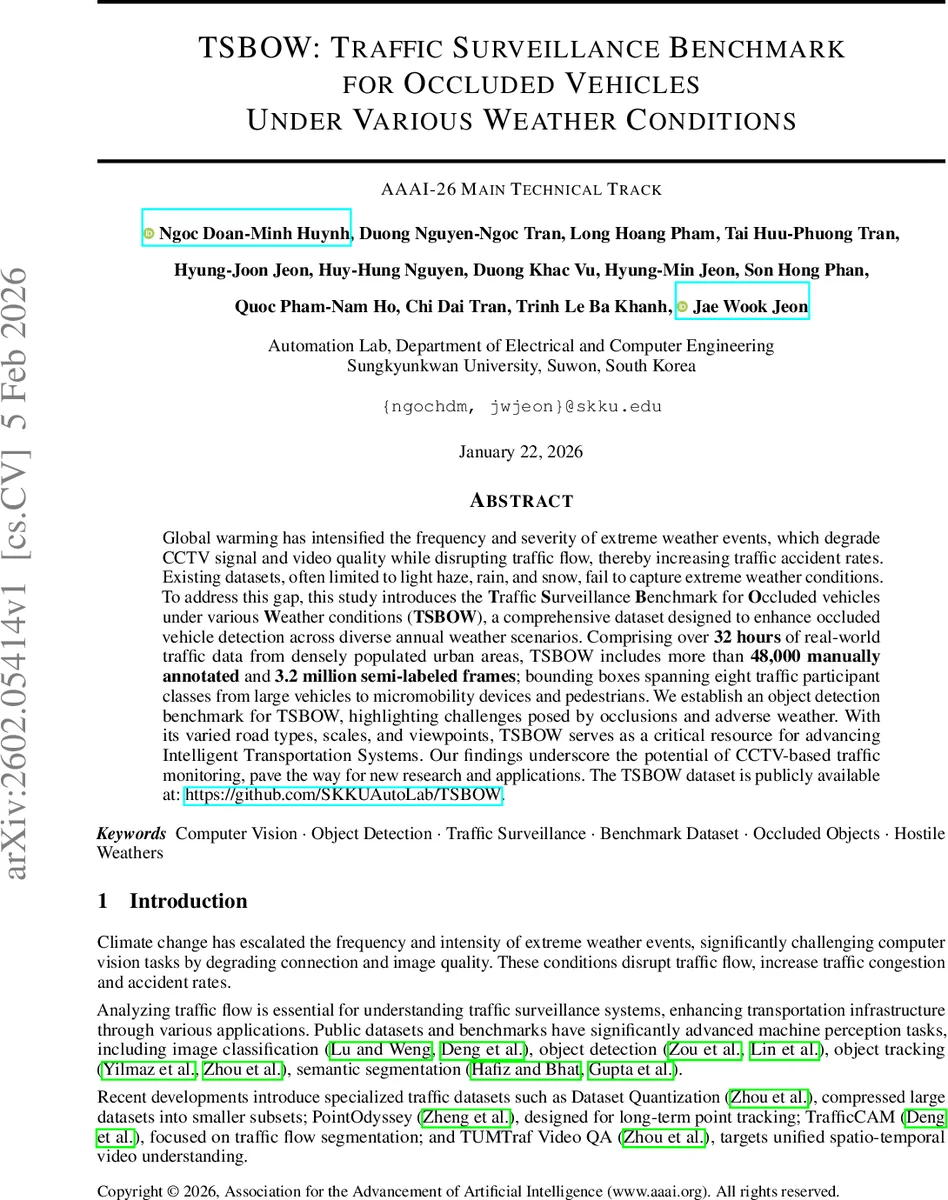
Global warming has intensified the frequency and severity of extreme weather events, which degrade CCTV signal and video quality while disrupting traffic flow, thereby increasing traffic accident rates. Existing datasets, often limited to light haze, rain, and snow, fail to capture extreme weather conditions. To address this gap, this study introduces the Traffic Surveillance Benchmark for Occluded vehicles under various Weather conditions (TSBOW), a comprehensive dataset designed to enhance occluded vehicle detection across diverse annual weather scenarios. Comprising over 32 hours of real-world traffic data from densely populated urban areas, TSBOW includes more than 48,000 manually annotated and 3.2 million semi-labeled frames; bounding boxes spanning eight traffic participant classes from large vehicles to micromobility devices and pedestrians. We establish an object detection benchmark for TSBOW, highlighting challenges posed by occlusions and adverse weather. With its varied road types, scales, and viewpoints, TSBOW serves as a critical resource for advancing Intelligent Transportation Systems. Our findings underscore the potential of CCTV-based traffic monitoring, pave the way for new research and applications. The TSBOW dataset is publicly available at: https://github.com/SKKUAutoLab/TSBOW.
💡 Research Summary
The paper introduces TSBOW (Traffic Surveillance Benchmark for Occluded Vehicles Under Various Weather Conditions), a large‑scale dataset designed to address the scarcity of traffic surveillance data captured under extreme weather conditions. Motivated by the increasing frequency of severe climate events that degrade CCTV video quality and raise traffic accident rates, the authors collected 32.36 hours of real‑world CCTV footage from densely populated urban areas in Suwon, South Korea, spanning an entire year. The dataset comprises 198 video clips (52 unique scenes) categorized into four scenario types (road, intersection, special case, disaster) and five weather conditions (sunny/cloudy, haze/fog, rain, snow, disaster). Eight object classes are annotated: small car, large car, truck, bus, pedestrian, micromobility devices, other, and unidentified, resulting in over 48 k manually labeled frames and 3.2 M semi‑automatically labeled frames.
A semi‑automatic annotation pipeline is described: expert annotators first label a core set, a state‑of‑the‑art detection model (fine‑tuned on the core set) then generates labels for the remaining frames, followed by cross‑checking and post‑processing to ensure consistency. This approach balances labeling quality with scalability. The dataset also records camera height and angle, allowing objects to be grouped into fine, medium, and coarse scales, and covers three road types (urban two‑lane, standard four‑lane, boulevard six‑plus lane), thereby reflecting a wide range of occlusion and density patterns.
For benchmarking, the authors fine‑tuned four recent detectors—YOLOv8‑x, YOLOv11‑x, YOLOv12‑x, and RT‑DETR‑x (all x‑large variants)—and evaluated mean Average Precision (mAP) and frames‑per‑second (FPS). YOLOv11‑x achieved the highest overall mAP (≈0.42) with real‑time speed (~38 FPS), while RT‑DETR‑x, though more robust to dense scenes, lagged at ~12 FPS. All models suffered dramatic performance drops in the “disaster” subset (heavy snow, dense haze, strong wind), with mAP falling below 0.18, highlighting the difficulty of detecting objects when background‑foreground contrast is severely reduced and occlusions are extreme.
The authors compare TSBOW with existing benchmarks such as UA‑VDT, UA‑DETRAC, and AAU‑RainSnow, showing that TSBOW offers longer recordings, higher resolution (1280 × 720), more diverse FPS, and, crucially, weather conditions that include heavy snowfall and severe haze—scenarios absent from prior datasets. The paper argues that TSBOW’s rich metadata (scenario, weather, road type, scale) and balanced class distribution make it a valuable testbed for research on weather‑adaptive detection, domain adaptation, multimodal fusion (e.g., thermal or LiDAR), crowd counting, speed estimation, and accident risk prediction.
In conclusion, TSBOW fills a critical gap in traffic surveillance research by providing a comprehensive, real‑world benchmark that stresses modern detectors under the most challenging environmental conditions. The dataset is publicly released on GitHub, accompanied by evaluation protocols, to foster reproducible research and accelerate the development of robust, real‑time traffic monitoring systems capable of operating reliably in the face of climate‑induced extremes. Future work will extend the collection to nighttime conditions, incorporate additional sensor modalities, and further improve the automation of the annotation pipeline.
Comments & Academic Discussion
Loading comments...
Leave a Comment