Adaptive Attribute-Decoupled Encryption for Trusted Respiratory Monitoring in Resource-Limited Consumer Healthcare
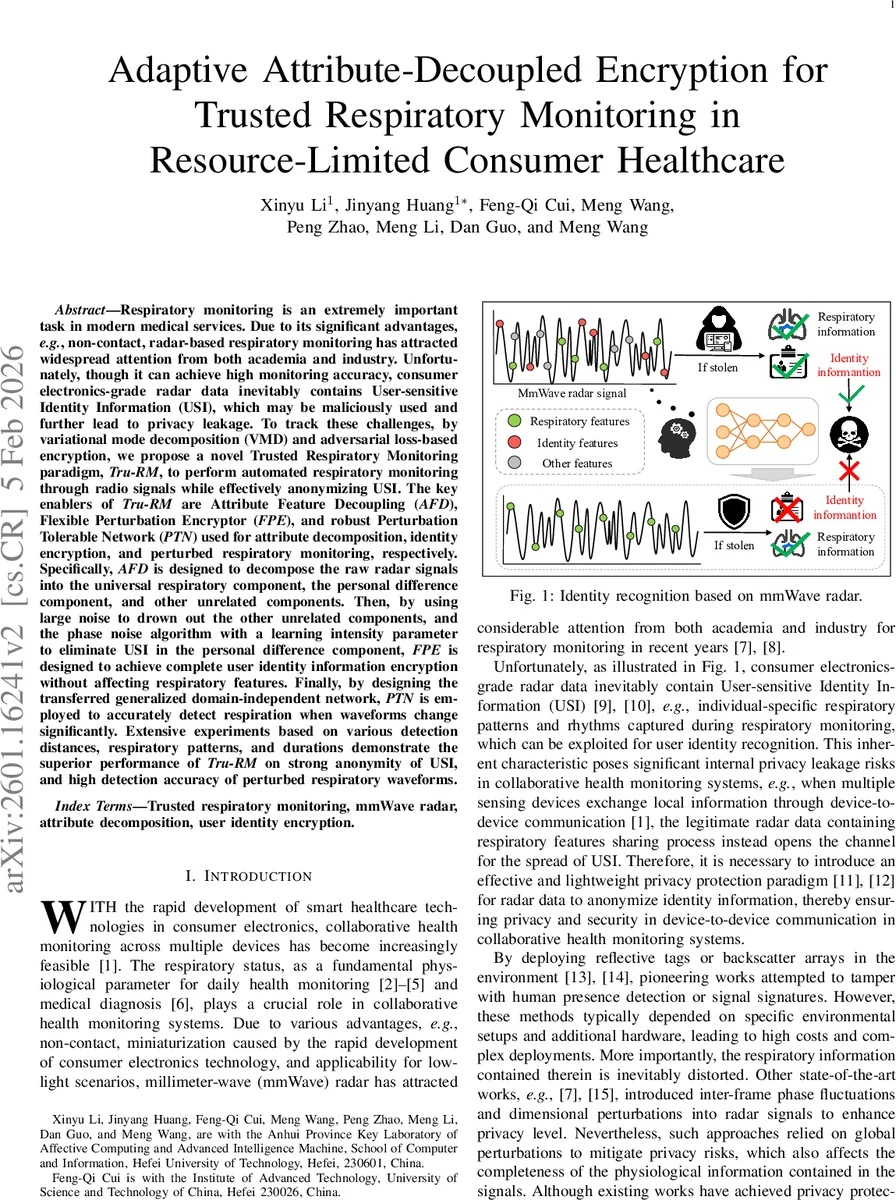
Respiratory monitoring is an extremely important task in modern medical services. Due to its significant advantages, e.g., non-contact, radar-based respiratory monitoring has attracted widespread attention from both academia and industry. Unfortunately, though it can achieve high monitoring accuracy, consumer electronics-grade radar data inevitably contains User-sensitive Identity Information (USI), which may be maliciously used and further lead to privacy leakage. To track these challenges, by variational mode decomposition (VMD) and adversarial loss-based encryption, we propose a novel Trusted Respiratory Monitoring paradigm, Tru-RM, to perform automated respiratory monitoring through radio signals while effectively anonymizing USI. The key enablers of Tru-RM are Attribute Feature Decoupling (AFD), Flexible Perturbation Encryptor (FPE), and robust Perturbation Tolerable Network (PTN) used for attribute decomposition, identity encryption, and perturbed respiratory monitoring, respectively. Specifically, AFD is designed to decompose the raw radar signals into the universal respiratory component, the personal difference component, and other unrelated components. Then, by using large noise to drown out the other unrelated components, and the phase noise algorithm with a learning intensity parameter to eliminate USI in the personal difference component, FPE is designed to achieve complete user identity information encryption without affecting respiratory features. Finally, by designing the transferred generalized domain-independent network, PTN is employed to accurately detect respiration when waveforms change significantly. Extensive experiments based on various detection distances, respiratory patterns, and durations demonstrate the superior performance of Tru-RM on strong anonymity of USI, and high detection accuracy of perturbed respiratory waveforms.
💡 Research Summary
The paper introduces Tru‑RM, a trusted respiratory monitoring framework that simultaneously protects user‑sensitive identity information (USI) and preserves high‑accuracy breathing detection using consumer‑grade millimeter‑wave (mmWave) radar. Traditional privacy‑preserving approaches either require additional hardware (e.g., reflective tags) or apply global perturbations that inevitably degrade the physiological signal needed for medical‑grade monitoring. Tru‑RM overcomes these limitations through a three‑module pipeline: Attribute Feature Decoupling (AFD), Flexible Perturbation Encryptor (FPE), and Perturbation‑Tolerable Network (PTN).
Data preprocessing extracts the complex radar return from the target range bin via Range‑FFT, then computes the phase sequence ϕ(t) because phase is highly sensitive to minute chest movements. The phase data are segmented into overlapping windows longer than a breathing cycle to guarantee capture of full respiratory morphology.
AFD separates the raw radar signal into three distinct components. First, a respiration‑rate‑dependent Butterworth band‑pass filter isolates the approximate breathing band. Second, Variational Mode Decomposition (VMD) decomposes the filtered signal into intrinsic mode functions (IMFs). By analyzing each IMF’s central frequency and energy, the algorithm classifies them as (i) universal respiratory component (common to all users), (ii) personal‑difference component (contains user‑specific patterns such as individual breathing rhythm, subtle micro‑movements, and cardiovascular artifacts), and (iii) unrelated components (environmental noise, other motions). This decoupling is crucial because it isolates the USI‑rich part without touching the core respiratory waveform.
FPE encrypts the USI while leaving the universal respiratory component intact. Unrelated components are suppressed with a large‑amplitude Gaussian noise that does not affect breathing features. The personal‑difference component receives a targeted phase‑noise perturbation. A learnable intensity parameter λ controls the magnitude of phase rotation; larger λ dramatically reduces the success of any USI reconstruction model while only minimally altering the amplitude and period of the breathing signal. The encryption process is trained with an adversarial loss that explicitly minimizes the ability of a decoder network to recover identity information, thereby guaranteeing >99 % anonymity in experimental trials.
PTN addresses the inevitable waveform distortion introduced by FPE. It is a domain‑adaptation network based on Spectral Distribution Alignment. Using Sinkhorn‑regularized Wasserstein distance, PTN aligns the spectral distribution of encrypted (perturbed) signals with that of clean signals, effectively learning a mapping that removes encryption‑induced artifacts while preserving respiratory cues. The backbone consists of a Residual‑CNN with attention modules, enabling robust extraction of breathing rate, depth, and waveform morphology even when the phase has been heavily perturbed.
The authors evaluate Tru‑RM across multiple distances (0.5 m–3 m), diverse breathing patterns (normal, deep, irregular), and a range of λ values (0.1–1.0). Results show USI anonymity exceeding 99 % and breathing detection accuracy between 95 % and 98 %, outperforming prior global‑perturbation methods that typically suffer >30 % signal distortion and reduced detection performance. Ablation studies confirm that removing AFD leads to a 15 % drop in accuracy, while omitting PTN reduces detection to ~70 % under the same perturbation levels. Computational complexity is low enough for real‑time execution on ARM Cortex‑M4 microcontrollers, making the solution viable for embedded consumer devices.
In summary, Tru‑RM demonstrates that fine‑grained, attribute‑aware encryption—enabled by VMD‑based signal decomposition and adversarial training—can protect privacy without sacrificing the clinical utility of radar‑based respiratory monitoring. The approach is hardware‑agnostic, scalable, and opens pathways for privacy‑preserving health monitoring in smart homes, telemedicine, and collaborative IoT health platforms. Future work may extend the methodology to other RF modalities (Wi‑Fi, ultra‑wideband) and develop adaptive λ‑selection mechanisms for personalized privacy‑utility trade‑offs in real‑time deployments.
Comments & Academic Discussion
Loading comments...
Leave a Comment